Evolution and organisation of nervous system in different animals
Learning objective:
1. Knowledge of the organisation of nervous systems in representatives of the major animal phyla.
2. Knowledge of an on-going debate about the evolutionary origin of central nervous systems (CNS) in the Bacteria. Did
the common ancestor of the Bilateria have a CNS?
3. Knowledge of an on-going debate about the evolutionary origins of nervous systems in the animal kingdom. Did
nervous systems evolve only once or have they evolved independently more than once?
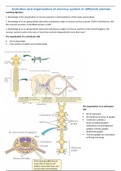
The organisation of a vertebrate CNS
NS of salamander
cross section of spinal cord of salamander
The organisation of an arthropod
CNS
NS of cockroach
NS comprise of series of ganglia
Cockroach contains a
brain/vertebral ganglian
followed by circumesphaheal
ganglia, thorasic ganglia,
abdominal ganglia
Thoracic ganglia are associated
with legs and wings
,Neuronal elements in a NS: a neural circuit mediating the cockroach startle response
Reflex circuit
Same NS plan form vertebrate animals
, Comparison of typical vertebrate and arthropod NS
Vertebrate NS Arthropod NS
Anterior brain with dorsal NC (spinal Anterior brain with ventral NC
cord) when lying down
Columnar NS comprising a continuous Ganglionic NS comprising chains of
column of neural tissue with cell segmental ganglia
bodies and synaptic are intermingled
CNS is hollow with neural tissue CNS not hollow
arranged around fluid filled cavities
(ventricles in brain; central canal in
spinal cord)
Spinal cord comprises inner grey Segmental ganglia comprise outer rind
matter (cell bodies and synapses) and of cell bodies (including sensory, inter-
outer white matter (axon tracts) and motor neurons) surrounding
central neuropil (synapses) and axon
tracts. Axon tracts linking ganglia in an
anterior-posterior orientation are
known as connectives. Axon tracts
linking left and right halves of a
ganglion are known commissures
Vertebrate and arthropods are studied in detail
Position of NC is the main difference in animal NS
Comparison of NS organisation in selected metazoans
Chordate contains anterior brain or cerebral ganglia depending on the vertebrate and a dorsal nerve cord
Fundermental distinction between protostomes and chordate is the position of the nerve cord ventral VS dorsal
From an evoluntionary prospective, what was the anscestors condition
Learning objective:
1. Knowledge of the organisation of nervous systems in representatives of the major animal phyla.
2. Knowledge of an on-going debate about the evolutionary origin of central nervous systems (CNS) in the Bacteria. Did
the common ancestor of the Bilateria have a CNS?
3. Knowledge of an on-going debate about the evolutionary origins of nervous systems in the animal kingdom. Did
nervous systems evolve only once or have they evolved independently more than once?
The organisation of a vertebrate CNS
NS of salamander
cross section of spinal cord of salamander
The organisation of an arthropod
CNS
NS of cockroach
NS comprise of series of ganglia
Cockroach contains a
brain/vertebral ganglian
followed by circumesphaheal
ganglia, thorasic ganglia,
abdominal ganglia
Thoracic ganglia are associated
with legs and wings
,Neuronal elements in a NS: a neural circuit mediating the cockroach startle response
Reflex circuit
Same NS plan form vertebrate animals
, Comparison of typical vertebrate and arthropod NS
Vertebrate NS Arthropod NS
Anterior brain with dorsal NC (spinal Anterior brain with ventral NC
cord) when lying down
Columnar NS comprising a continuous Ganglionic NS comprising chains of
column of neural tissue with cell segmental ganglia
bodies and synaptic are intermingled
CNS is hollow with neural tissue CNS not hollow
arranged around fluid filled cavities
(ventricles in brain; central canal in
spinal cord)
Spinal cord comprises inner grey Segmental ganglia comprise outer rind
matter (cell bodies and synapses) and of cell bodies (including sensory, inter-
outer white matter (axon tracts) and motor neurons) surrounding
central neuropil (synapses) and axon
tracts. Axon tracts linking ganglia in an
anterior-posterior orientation are
known as connectives. Axon tracts
linking left and right halves of a
ganglion are known commissures
Vertebrate and arthropods are studied in detail
Position of NC is the main difference in animal NS
Comparison of NS organisation in selected metazoans
Chordate contains anterior brain or cerebral ganglia depending on the vertebrate and a dorsal nerve cord
Fundermental distinction between protostomes and chordate is the position of the nerve cord ventral VS dorsal
From an evoluntionary prospective, what was the anscestors condition