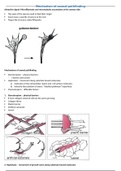
Mechanism of axonal pathfinding
Attractive signal: Microfilaments and microtubules accumulate at the contact side
The axon of the neuron need to find their target.
Axons have a specific structure at the end
Finger-like structure called fillopodia
Mechanisms of axonal pathfinding
Stereotropism – physical barriers:
- Chanels and tunnels
Haptotaxis – movement along substrate bound molecules:
a) molecules of the extracellular matrix and cell surface molecules
b) Selective fasciculation of axons: ‘‘labelled pathways“ hypothese
Chemotropism – diffusible factors
1. Stereotropism – physical barriers
If have collagen network will see the axons growing
Collagen fibres
Plastic barrier
Artificial substrate
tunnel
2. Haptotaxis – movement of growth cones along substrate bound molecules
, ECM: glycoproteins and proteoglycans
Cells have surface molecules
Depending on which molecule is expressed they can bind to other cells
If the cell has a compatible molecule on the surface then can bind
Cell adhesion proteins control motility and guide forward movement
• Cell-Cell adhesion
• Classical Cadherins (E,N, P, VE), homophilic binding, associated with cytoskeleton (actin filaments) via catenins
• Ig family members (N-CAM, ICAM), homo- and heterophilic binding
• Cell-matrix adhesion
• Integrins (many types), heterophilic binding, associated with cytoskeleton (actin filaments) via talin, paxillin, filamin etc.
• Transmembrane proteoglycans (syndecans), heterophilic binding
Haptotaxis I: ECM-molecules facilitate or inhibit axonal
growth
Attractive signal: Microfilaments and microtubules accumulate at the contact side
The axon of the neuron need to find their target.
Axons have a specific structure at the end
Finger-like structure called fillopodia
Mechanisms of axonal pathfinding
Stereotropism – physical barriers:
- Chanels and tunnels
Haptotaxis – movement along substrate bound molecules:
a) molecules of the extracellular matrix and cell surface molecules
b) Selective fasciculation of axons: ‘‘labelled pathways“ hypothese
Chemotropism – diffusible factors
1. Stereotropism – physical barriers
If have collagen network will see the axons growing
Collagen fibres
Plastic barrier
Artificial substrate
tunnel
2. Haptotaxis – movement of growth cones along substrate bound molecules
, ECM: glycoproteins and proteoglycans
Cells have surface molecules
Depending on which molecule is expressed they can bind to other cells
If the cell has a compatible molecule on the surface then can bind
Cell adhesion proteins control motility and guide forward movement
• Cell-Cell adhesion
• Classical Cadherins (E,N, P, VE), homophilic binding, associated with cytoskeleton (actin filaments) via catenins
• Ig family members (N-CAM, ICAM), homo- and heterophilic binding
• Cell-matrix adhesion
• Integrins (many types), heterophilic binding, associated with cytoskeleton (actin filaments) via talin, paxillin, filamin etc.
• Transmembrane proteoglycans (syndecans), heterophilic binding
Haptotaxis I: ECM-molecules facilitate or inhibit axonal
growth