Extracellular matrix and integrins
Learning objectives:
1. Extra cellular matrix (ECM)
2. Integrins and ECM
3. Integrins and cancer
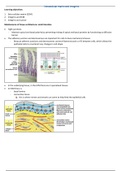
Maintenance of tissue architecture: small intestine
• Tight junctions
- Maintain apical and basal polarity by preventing mixing of apical and basal proteins by functioning as diffusion
barrier
• The adheren junction and desmosomes are important for cells to bare mechanical stresses
- Because adheren junctions and desmosomes connect filaments (actin or IF) between cells, which allows the
epithelial cells to counteract any changes in cell shape
• In the underlying tissue, in the ECM there are 2 specialised tissues
• In ECM there is
- basal lamina
- connective tissue
this is where nerves and vessels can come to help feed the epithelial cells
, Order of structure of epithelium
• lumen or external surface
• epithelial cells that are highly polarised
• basal lamina
• connective tissue
I-The extracellular matrix
• Cells are surrounded and regulated by extracellular matrix (ECM)
• Constituents of ECM:
- Collagen fibre
- Proteoglycan complex
Sugar that play an important role in the structure of ECM
Functions of ECM
• From first lecture
- GF mainly secreted by stromal cells or fibroblast cells (can re-differentiate meschymal cells) and these cells are
located within the ECM
- These cells will secrete the GF into the ECM
- On one hand the ECM helps GF/ligands navigate to receptor
- On the other hand, ECM acts as a storage compartment for GF
- There many molecules found in The ECM including GF
- ECM senses and transduces mechanical signals.
If there is a mechanical signal i.e. contraction of organ ECM will help counteract the mechanical signal
through binding to the integrin
- For many years ECM has been seen as not important but in reality has many functions and is important.
Learning objectives:
1. Extra cellular matrix (ECM)
2. Integrins and ECM
3. Integrins and cancer
Maintenance of tissue architecture: small intestine
• Tight junctions
- Maintain apical and basal polarity by preventing mixing of apical and basal proteins by functioning as diffusion
barrier
• The adheren junction and desmosomes are important for cells to bare mechanical stresses
- Because adheren junctions and desmosomes connect filaments (actin or IF) between cells, which allows the
epithelial cells to counteract any changes in cell shape
• In the underlying tissue, in the ECM there are 2 specialised tissues
• In ECM there is
- basal lamina
- connective tissue
this is where nerves and vessels can come to help feed the epithelial cells
, Order of structure of epithelium
• lumen or external surface
• epithelial cells that are highly polarised
• basal lamina
• connective tissue
I-The extracellular matrix
• Cells are surrounded and regulated by extracellular matrix (ECM)
• Constituents of ECM:
- Collagen fibre
- Proteoglycan complex
Sugar that play an important role in the structure of ECM
Functions of ECM
• From first lecture
- GF mainly secreted by stromal cells or fibroblast cells (can re-differentiate meschymal cells) and these cells are
located within the ECM
- These cells will secrete the GF into the ECM
- On one hand the ECM helps GF/ligands navigate to receptor
- On the other hand, ECM acts as a storage compartment for GF
- There many molecules found in The ECM including GF
- ECM senses and transduces mechanical signals.
If there is a mechanical signal i.e. contraction of organ ECM will help counteract the mechanical signal
through binding to the integrin
- For many years ECM has been seen as not important but in reality has many functions and is important.