TSI samenvatting
Ecomodernism:
- Modernism:
o Rationalism and functionalism
o Anthropocentric
o Efficient and expertly led- by the national government
o Techno-driven
- Modern rational plan: analysis situation – end reduction – design –
evaluation
- Critique
o Consensus about the goal is impossible
o Capacity and conditions to intervene are context dependent
and not given
- Rittel & Webber: 10 points of complexity
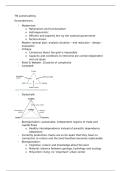
- Campbell:
- Godschalk:
- Bioregionalism: sustainable, independent regions of trade and
capital flows
o Healthy interdependence instead of parasitic dependence
(depletion)
- Currently production chains are so far apart that they have no
connection to culture and the land therefore becomes replaceable
- Bioregionalism:
o Cognitive: culture and knowledge about the land
o Material: balance between geology, hydrology and ecology
o Polycentric living: no ‘important’ urban center
, o Place based production system: closed system specific to
region
Reduces dependency
o Local energy, multifunctional forestry, self-governance and
specialization
Strategy:
- Roots vs. branch method
o Roots: analysis, new plan, research, new plan
Modernist
o Branch: comparison, incremental changes in the long term
Strategic
- Government does not have money or knowledge to implement plans
o Market and civil society start to play a role in planning
- Strategic planning:
o Vision making -> stakeholder mobilization -> means ->
building legitimacy
o Output: consensus
- Critiques:
o Split up into sections to reach consensus
This way the resource conflict is ignored by separating
sections
o Does not change power structures
o Vulnerable to lobbying and other powerful actors without real
knowledge
o Modern view on positive sum game: muffles critical voices
- Challenge: make it more comprehensive and territorial
- Two types of interventions: infrastructural and regulating
Institutions:
- Planning can be making plans, but also creating rules and
regulations
- Legitimacy: acknowledgement of authority by consent of the people
- Instrumentalism: using regulations as plans (too much prescription)
Post politics:
- Different stakeholders and participation: all activist (trying to change
a system)
- Power to create consensus is powerful in planning
Ecomodernism:
- Modernism:
o Rationalism and functionalism
o Anthropocentric
o Efficient and expertly led- by the national government
o Techno-driven
- Modern rational plan: analysis situation – end reduction – design –
evaluation
- Critique
o Consensus about the goal is impossible
o Capacity and conditions to intervene are context dependent
and not given
- Rittel & Webber: 10 points of complexity
- Campbell:
- Godschalk:
- Bioregionalism: sustainable, independent regions of trade and
capital flows
o Healthy interdependence instead of parasitic dependence
(depletion)
- Currently production chains are so far apart that they have no
connection to culture and the land therefore becomes replaceable
- Bioregionalism:
o Cognitive: culture and knowledge about the land
o Material: balance between geology, hydrology and ecology
o Polycentric living: no ‘important’ urban center
, o Place based production system: closed system specific to
region
Reduces dependency
o Local energy, multifunctional forestry, self-governance and
specialization
Strategy:
- Roots vs. branch method
o Roots: analysis, new plan, research, new plan
Modernist
o Branch: comparison, incremental changes in the long term
Strategic
- Government does not have money or knowledge to implement plans
o Market and civil society start to play a role in planning
- Strategic planning:
o Vision making -> stakeholder mobilization -> means ->
building legitimacy
o Output: consensus
- Critiques:
o Split up into sections to reach consensus
This way the resource conflict is ignored by separating
sections
o Does not change power structures
o Vulnerable to lobbying and other powerful actors without real
knowledge
o Modern view on positive sum game: muffles critical voices
- Challenge: make it more comprehensive and territorial
- Two types of interventions: infrastructural and regulating
Institutions:
- Planning can be making plans, but also creating rules and
regulations
- Legitimacy: acknowledgement of authority by consent of the people
- Instrumentalism: using regulations as plans (too much prescription)
Post politics:
- Different stakeholders and participation: all activist (trying to change
a system)
- Power to create consensus is powerful in planning