Mitochondria and chloroplast; analysis of compartments
Learning objectives:
1. Outline the endosymbiont theory
2. Explain the metabolic roles of mitochondria and chloroplast in eukaryotes
3. Describe the main structural features of mitochondria and their structural variability
4. Discuss the evidence from mitochondrial structure for the endosymbiont theory
The origin of the eukaryotic cell and the endosymbiont theory:
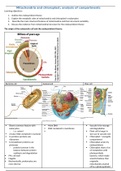
Bacteria cell Animal cell Plan cell
Shares common feature with More DNA Vacuole is for storage
eukaryotes DNA contained in membrane and degradation
- i.e. cytosol Plant cell is larger in
circular DNA contained in nucleoid size sue to vacuole size
to produce proteins use Chloroplast = energetic
ribosomes compartment
to breakdown proteins use Chloroplast arisen by
proteases endosymbiosis
- protein turnover is the Chloroplast share a lot
balance between protein of metabolism with
synthesis and degradation photosynthetic
PM, cell wall bacteria, which made
Flagella scientist believe that
Biochemically, prokaryotes are originally,
more diverse mitochondria started
off as a photosynthetic
, bacteria.
The origin of eukaryotic cells
Prokaryotic cells arose first
Margulis popularised the idea of endosymbiosis
Initially, people believed that all the complicated organelles inside he cell have been formed by invagination
(infolding) followed by more invagination from the plasma membrane
Endosymbiont theory:
- Organelles from eukaryotic cells (mitochondria an chloroplast )evolved from smaller prokaryotic cells
In the mitochondria, there are genes for 13 proteins but there are hundreds of proteins in the
mitochondria, which are encoded for from the nucleus
Evidence for this:
- Mitochondria and chloroplast having own DNA
- Nucleotide sequence of rRNA from eukaryotic from eukaryotic organelles resemble that of prokaryotes
- Organelles, mitochondria and chloroplast are capable of divide independently within the cell on their own
Possible steps in the evolution of eukaryotic cells
1. Anaerobic, heterotopic, large prokaryote contains
DNA that is not in the nucleus.
- Prokaryote living in an anaerobic environment
- Heterotrophic = organism that cannot
manufacture own food and instead obtains its
food and energy by taking in organic substances,
usually plant or animal matter.
2. A small aerobic prokaryote invades the prokaryote,
which may occur for 2 reasons
a. The large prokaryote could be engulfing and
digesting the small prokaryote.
b. The small prokaryote invading the large
prokaryote in a pathogenic attack.
3. Pre-eukaryote
- Nucleus started to develop
- Invagination of the plasma membrane formed a
membrane around the nucleus
- The mitochondria can gain gene but also lose
them back to the nucleus
- If the mitochondria is out of control can produce
large amount of free radicals, which is not good
around DNA as can cause mutation and
destruction of proteins.
- Part of the endosymbiotic event was the
movement of DNA from mitochondrial precursor
into the nucleus and this allows eukaryotic cells
to maintain control over it prokaryotic inhabitant
- Gradually see the mitochondria loosing ability to
live freely and independently and becoming
entirely independent on eukaryotic cell
4. Development of cytoskeleton, actin filament, which
allows mitosis to occur.
- Obtain fully formed nucleus and ER
5. In terms of plants, we have another endosymbiotic
event, which we know came second because all
photosynthetic prokaryotes have mitochondria, which came first.
- Photosynthetic bacteria resulted in the production of chloroplast.
Learning objectives:
1. Outline the endosymbiont theory
2. Explain the metabolic roles of mitochondria and chloroplast in eukaryotes
3. Describe the main structural features of mitochondria and their structural variability
4. Discuss the evidence from mitochondrial structure for the endosymbiont theory
The origin of the eukaryotic cell and the endosymbiont theory:
Bacteria cell Animal cell Plan cell
Shares common feature with More DNA Vacuole is for storage
eukaryotes DNA contained in membrane and degradation
- i.e. cytosol Plant cell is larger in
circular DNA contained in nucleoid size sue to vacuole size
to produce proteins use Chloroplast = energetic
ribosomes compartment
to breakdown proteins use Chloroplast arisen by
proteases endosymbiosis
- protein turnover is the Chloroplast share a lot
balance between protein of metabolism with
synthesis and degradation photosynthetic
PM, cell wall bacteria, which made
Flagella scientist believe that
Biochemically, prokaryotes are originally,
more diverse mitochondria started
off as a photosynthetic
, bacteria.
The origin of eukaryotic cells
Prokaryotic cells arose first
Margulis popularised the idea of endosymbiosis
Initially, people believed that all the complicated organelles inside he cell have been formed by invagination
(infolding) followed by more invagination from the plasma membrane
Endosymbiont theory:
- Organelles from eukaryotic cells (mitochondria an chloroplast )evolved from smaller prokaryotic cells
In the mitochondria, there are genes for 13 proteins but there are hundreds of proteins in the
mitochondria, which are encoded for from the nucleus
Evidence for this:
- Mitochondria and chloroplast having own DNA
- Nucleotide sequence of rRNA from eukaryotic from eukaryotic organelles resemble that of prokaryotes
- Organelles, mitochondria and chloroplast are capable of divide independently within the cell on their own
Possible steps in the evolution of eukaryotic cells
1. Anaerobic, heterotopic, large prokaryote contains
DNA that is not in the nucleus.
- Prokaryote living in an anaerobic environment
- Heterotrophic = organism that cannot
manufacture own food and instead obtains its
food and energy by taking in organic substances,
usually plant or animal matter.
2. A small aerobic prokaryote invades the prokaryote,
which may occur for 2 reasons
a. The large prokaryote could be engulfing and
digesting the small prokaryote.
b. The small prokaryote invading the large
prokaryote in a pathogenic attack.
3. Pre-eukaryote
- Nucleus started to develop
- Invagination of the plasma membrane formed a
membrane around the nucleus
- The mitochondria can gain gene but also lose
them back to the nucleus
- If the mitochondria is out of control can produce
large amount of free radicals, which is not good
around DNA as can cause mutation and
destruction of proteins.
- Part of the endosymbiotic event was the
movement of DNA from mitochondrial precursor
into the nucleus and this allows eukaryotic cells
to maintain control over it prokaryotic inhabitant
- Gradually see the mitochondria loosing ability to
live freely and independently and becoming
entirely independent on eukaryotic cell
4. Development of cytoskeleton, actin filament, which
allows mitosis to occur.
- Obtain fully formed nucleus and ER
5. In terms of plants, we have another endosymbiotic
event, which we know came second because all
photosynthetic prokaryotes have mitochondria, which came first.
- Photosynthetic bacteria resulted in the production of chloroplast.