Lecture 13 Site Directed Mutagenesis
SDM- powerful In protein biology, protein interaction is studied and are important in
technique for finding specific residues in binding sites of ligand
studying protein Protein interaction with other molecules (proteins, ligands, etc.) are
function often due to specific residues at the interaction site
In SDM, mutate 1 or 2 residues in the binding site to see if it retains its
biological pathway
Mutate several residues in the binding site to see which one is the
most vital
to prove the role of a specific residue at this interaction site, they are
often mutated to alanine.
Alanine scanning mutagenesis is a common technique employed
Why use alanine instead of glycine?
- Alanine like glycine has a simple side chain group but the methyl
group is less likely to disrupt the alpha helix or beta strand in the
protein
- Glycine not chosen as it permits a large range of dihedral angles,
enabling secondary structures not likely possiblewith the wildtype
residue
- The only change to be made in the active site is the Side chain and
not the structure of the protein
Exploring protein Bacterial microcompartments (BMCs) are protein cages, made of
cages- using SDM 1000s of copies of 7 different proteins, interacting to form a closed
to elucidate cage.
(explain) the role One of the proteins found in this cage is pduA
of residues in Overexpression of pduA in vivo (within organism) leads to formation
aprotein of nanotubes
, Nanotubes are tubular molecules composed of large number of
carbon atoms.
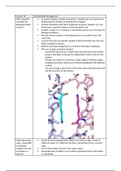
Analysis of BMC crystal structure reveals:
- Lysine (K26) at interference between adjacent copies of pduA in
nanotubes may be key to their interaction
- Yellow shows 2 antiparallel lysine side chain interaction
- Based on this structure, a hypothesis can be made
- HYPOTHESIS:
pduA K23A mutation will prevent nanotube formation
- What happen if mutate lysine to alanine? Currently attempting to
do
Introduction to SDM is a technique that allows us to selectively introduce
SDM - Insertion mutation
- Deletion mutation
- Substitution mutation
Within the nucleotide sequence of a DNA plasmid and not the AA
One of the first is kunkel mutagenesis in 1985
Many variations of SDM exist today.
Amongst most common is cassette mutagenesis
Getting ready for Before carry out SDM need to amplify the plasmid to be able to work
SDM-amplifying on it
our plasmid To do this use a strain of E.coli called DH5alpha, which is the same as
the strain of E.coli in the gut but modified to make suitable to amplify
DNA
There are 3 vital genes modified in this genome:
1. RecA- (recombinant enzyme)
- which recombines DNA inside the cytoplasm because we are
inserting the insert into plasmid and do not want to lose insert.
Therefore, by knocking out this gene =higher stability (less likely
to lose insert from plasmid)
2. endA1- ( endonuclease)
- breaks down extra copies of plasmid in the bacterial cytoplasm
but because trying to purify the plasmid we need to maintain a
high copy of plasmid.
- If knock out this gene we will maintain a high number of the
plasmid copies
3. Dam+/dcm+ (DNA methyl transferase)
- Vital for technique and bacterium as plays important role in the
replication of the plasmid
- Methylates DNA
- Enables efficient DNA replication of plasmid from replication
origin
SDM- powerful In protein biology, protein interaction is studied and are important in
technique for finding specific residues in binding sites of ligand
studying protein Protein interaction with other molecules (proteins, ligands, etc.) are
function often due to specific residues at the interaction site
In SDM, mutate 1 or 2 residues in the binding site to see if it retains its
biological pathway
Mutate several residues in the binding site to see which one is the
most vital
to prove the role of a specific residue at this interaction site, they are
often mutated to alanine.
Alanine scanning mutagenesis is a common technique employed
Why use alanine instead of glycine?
- Alanine like glycine has a simple side chain group but the methyl
group is less likely to disrupt the alpha helix or beta strand in the
protein
- Glycine not chosen as it permits a large range of dihedral angles,
enabling secondary structures not likely possiblewith the wildtype
residue
- The only change to be made in the active site is the Side chain and
not the structure of the protein
Exploring protein Bacterial microcompartments (BMCs) are protein cages, made of
cages- using SDM 1000s of copies of 7 different proteins, interacting to form a closed
to elucidate cage.
(explain) the role One of the proteins found in this cage is pduA
of residues in Overexpression of pduA in vivo (within organism) leads to formation
aprotein of nanotubes
, Nanotubes are tubular molecules composed of large number of
carbon atoms.
Analysis of BMC crystal structure reveals:
- Lysine (K26) at interference between adjacent copies of pduA in
nanotubes may be key to their interaction
- Yellow shows 2 antiparallel lysine side chain interaction
- Based on this structure, a hypothesis can be made
- HYPOTHESIS:
pduA K23A mutation will prevent nanotube formation
- What happen if mutate lysine to alanine? Currently attempting to
do
Introduction to SDM is a technique that allows us to selectively introduce
SDM - Insertion mutation
- Deletion mutation
- Substitution mutation
Within the nucleotide sequence of a DNA plasmid and not the AA
One of the first is kunkel mutagenesis in 1985
Many variations of SDM exist today.
Amongst most common is cassette mutagenesis
Getting ready for Before carry out SDM need to amplify the plasmid to be able to work
SDM-amplifying on it
our plasmid To do this use a strain of E.coli called DH5alpha, which is the same as
the strain of E.coli in the gut but modified to make suitable to amplify
DNA
There are 3 vital genes modified in this genome:
1. RecA- (recombinant enzyme)
- which recombines DNA inside the cytoplasm because we are
inserting the insert into plasmid and do not want to lose insert.
Therefore, by knocking out this gene =higher stability (less likely
to lose insert from plasmid)
2. endA1- ( endonuclease)
- breaks down extra copies of plasmid in the bacterial cytoplasm
but because trying to purify the plasmid we need to maintain a
high copy of plasmid.
- If knock out this gene we will maintain a high number of the
plasmid copies
3. Dam+/dcm+ (DNA methyl transferase)
- Vital for technique and bacterium as plays important role in the
replication of the plasmid
- Methylates DNA
- Enables efficient DNA replication of plasmid from replication
origin