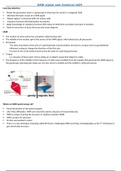
NMR signal and chemical shift
Learning objective:
Relate the precession seen in a gyroscope to that seen for nuclei in a magnetic field
illustrate the basic causes of a NMR signal
Report typical 1H chemical shifts for amino acids
Interpret chemical shift distribution in proteins
Apply knowledge of standard chemical shift values to determine secondary structure in proteins
Need to know how to draw the tocsy and nosey diagram
NMR
The nucleus of some atoms has a property called nuclear spin
The wobble in the nuclear spin is the source of the NMR signal, which physicists call precession
Precession
- The slow movement of the axis of a spinning body around another axis due to a torque (such as gravitational
influence) acting to change the direction of the first axis.
- It is seen in the circle slowly traced out by the pole of a spinning gyroscope.
Torque
- is a measure of how much a force acting on an object causes that object to rotate
The frequency of the wobble is the frequency of radio waves emitted from the sample that generate the NMR signal as
the gyroscope (spinning top) slopes up, the axis starts to wobble and the wobble is called precession.
What can NMR spectroscopy do?
Most informative of the spectroscopies
Like X-Ray diffraction, NMR can reveal the atomic structure of macromolecules
NMR is unique in giving the structure in solution (solution NMR)
NMR can give 3D structure
Protein surrounded in water
There is a new technique emerging called EM that is challenging NMR and X-Ray crystallography as the 3 rd technique to
give atomically structure
, What is NMR
NMR is the measure of radio waves emitted from sample
Radio waves are wobbling precessive nucleus within each atom within a molecule (protein)
Each peak represents a proton in the protein
If there are 1000 peaks then there is 1000 H
Studying the nucleus of H atom is called proton NMR
Protons emit radio waves
The spinning nuclei orientate themselves to the magnet and get an NMR signal
The frequency of the radio waves tell us about the environment of the individual atoms
Frequency= the rate per second of a vibration constituting a wave, either in a material (as in sound waves), or
in an electromagnetic field (as in radio waves and light).
Zinc finger
Small domain from zinc finger (transcription factor)
Transcription factor = a protein that binds to specific DNA sequences, thereby controlling the rate of transcription of genetic
information from DNA to messenger RNA.
Structure shown as ensemble = a group of item viewed as a whole rather than individually
Learning objective:
Relate the precession seen in a gyroscope to that seen for nuclei in a magnetic field
illustrate the basic causes of a NMR signal
Report typical 1H chemical shifts for amino acids
Interpret chemical shift distribution in proteins
Apply knowledge of standard chemical shift values to determine secondary structure in proteins
Need to know how to draw the tocsy and nosey diagram
NMR
The nucleus of some atoms has a property called nuclear spin
The wobble in the nuclear spin is the source of the NMR signal, which physicists call precession
Precession
- The slow movement of the axis of a spinning body around another axis due to a torque (such as gravitational
influence) acting to change the direction of the first axis.
- It is seen in the circle slowly traced out by the pole of a spinning gyroscope.
Torque
- is a measure of how much a force acting on an object causes that object to rotate
The frequency of the wobble is the frequency of radio waves emitted from the sample that generate the NMR signal as
the gyroscope (spinning top) slopes up, the axis starts to wobble and the wobble is called precession.
What can NMR spectroscopy do?
Most informative of the spectroscopies
Like X-Ray diffraction, NMR can reveal the atomic structure of macromolecules
NMR is unique in giving the structure in solution (solution NMR)
NMR can give 3D structure
Protein surrounded in water
There is a new technique emerging called EM that is challenging NMR and X-Ray crystallography as the 3 rd technique to
give atomically structure
, What is NMR
NMR is the measure of radio waves emitted from sample
Radio waves are wobbling precessive nucleus within each atom within a molecule (protein)
Each peak represents a proton in the protein
If there are 1000 peaks then there is 1000 H
Studying the nucleus of H atom is called proton NMR
Protons emit radio waves
The spinning nuclei orientate themselves to the magnet and get an NMR signal
The frequency of the radio waves tell us about the environment of the individual atoms
Frequency= the rate per second of a vibration constituting a wave, either in a material (as in sound waves), or
in an electromagnetic field (as in radio waves and light).
Zinc finger
Small domain from zinc finger (transcription factor)
Transcription factor = a protein that binds to specific DNA sequences, thereby controlling the rate of transcription of genetic
information from DNA to messenger RNA.
Structure shown as ensemble = a group of item viewed as a whole rather than individually