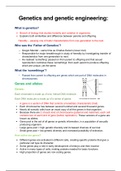
Genetics and genetic engineering:
What is genetics?
Branch of biology that studies heredity and variation in organisms.
Explains both similarities and difference between parents and offspring.
Heredity – passing one of traits/ characteristics from one generation to the next.
Who was the ‘Father of Genetics’?
Gregor Mendel – same time as Charles Darwin (never met)
Responsible for major breakthrough in study of heredity by investigating transfer of
characteristics from one generation to next.
He realised ‘something’ passed on from parent to offspring and that sexual
reproduction combines these ‘somethings’ from each parent to produce offspring
which are unique, yet the same.
What the ‘somethings’?
* Passed from parent to offspring are genes which are part of DNA molecules in
chromosomes.
Genes and alleles:
Genes:
Each chromatid is made up of one, helical DNA molecule.
Each DNA molecule is made up of a series of genes.
- A gene is a section of DNA that controls a hereditary characteristic (trait)
Each chromosome has between several hundred and several thousand genes.
Nearly all somatic cells have an exact copy of all the genes in that organism.
Because there are 2 of each kind of chromosome (paternal and maternal), each cell
contains two of each kind of gene (before replication). These versions of a gene are
known as alleles.
Gene pool is the set of all genes or genetic information, in a population of sexually
producing organism.
- Large gene pool = high genetic diversity and increased chances of survival
- Small gene pool = low genetic diversity and increased possibility of extinction.
How active are genes?
Different genes are activated in different cells, creating specific proteins that give a
particular cell type its character.
Some genes play a role in early development of embryo and then inactive
Active in many types of cells, making proteins needed for basic functions
High proportion of genes are non-coding genes.
,Alleles:
Responsible for controlling different versions of a trait/characteristic found in same
locus on homologous chromosomes.
One/two/more forms of a gene.
How are alleles represented?
Represented by many letters.
Capital letter denotes the dominant allele and a lower case of same letter represents the
recessive allele.
How are alleles passed from parent to offspring?
Alleles are passed from parents to offspring by way of chromosomes in the gametes
that are made by process of meiosis in sex organs.
Gamete is a reproductive cell or sex cell.
Sex cells (gametes are haploid as they have:
- One of a pair of homologous chromosomes
- One of each pair of alleles.
What happens to the gametes?
During fertilisation a male gamete, with its alleles, fuses with
female gamete, with its alleles, to form a diploid zygote
This divides and divides by mitosis to form an entire new
organism made up of cells, each with same set of
chromosomes and alleles as in zygote.
Genotypes and phenotypes:
A genotype is made up of all the genes an organism carries
on its chromosomes which it has inherited from its parents.
A phenotype is physical appearance of an organism (tallness,
hair colour). Partly programmed by genes, its genotype, but also shaped by
external factors (exercise, diet, and environment).
Homozygous and heterozygous:
If pair of alleles at a locus are the same, the organism is homozygous for that
particular trait. E.g. both alleles will determine a black coat in cattle (BB).
If the pair of alleles at a locus are different, organism is heterozygous (a hybrid) for
that particular trait. E.g. one allele = black coat and other= white (Bb)
Dominant and recessive alleles:
Dominant, in that this trait is expressed in the offspring, e.g. black coat.
Recessive, in that the trait is suppressed in presence of dominant allele and not
expressed in offspring.
, Monohybrid crosses:
- A cross between parents with different alleles for a single gene.
Genetic diagrams:
- Show how characteristics are inherited.
- Show how genotype and phenotype of a cross between two parents and helps us
understand why offspring look the way they do.
Generations are shown as follows:
P1 – parent generation
F1 – first filial generation of offspring
F2 – second filial generation of offspring.
Alleles can be show as capital and small letters.
As there are two alleles for each characteristic, one on each chromosome of a
homologous pair, two letters are written, e.g.:
Homozygous tall plant – TT
Homozygous show plant – tt
Heterozygous tall plant – Tt
What is a Punnett square?
- An easy way to represent a cross between two organisms for any number of
characteristics for which the parental genotypes are known.
- Predicts probability of offspring’s genotype and phenotype and is basic tool used for
Mendelian genetics.
For example:
Gametes T t
T TT Tt
T Tt tt
Mendel’s experiment:
An example of Mendel’s experiment:
Mendel transferred pollen grains from stamen of a pure-breeding tall pea plant
and dusted them onto the stigma of the pistil of a pure-breeding short pea plant.
Then collected and sowed seeds
Resulting F1 generation all grew into tall plants
The F1 generation was then allowed to self-pollinate, creating a F2 generation.
Then counted plants in F2 generation, he found that ¾s of them was short. Ratio
of tall plants to short plants 3:1.
Seemed that characteristic for shortness had not completely disappeared in F 1
generation, as it reappeared in F2 generation.
This showed that characteristics are passed on from one generation to another.
What is genetics?
Branch of biology that studies heredity and variation in organisms.
Explains both similarities and difference between parents and offspring.
Heredity – passing one of traits/ characteristics from one generation to the next.
Who was the ‘Father of Genetics’?
Gregor Mendel – same time as Charles Darwin (never met)
Responsible for major breakthrough in study of heredity by investigating transfer of
characteristics from one generation to next.
He realised ‘something’ passed on from parent to offspring and that sexual
reproduction combines these ‘somethings’ from each parent to produce offspring
which are unique, yet the same.
What the ‘somethings’?
* Passed from parent to offspring are genes which are part of DNA molecules in
chromosomes.
Genes and alleles:
Genes:
Each chromatid is made up of one, helical DNA molecule.
Each DNA molecule is made up of a series of genes.
- A gene is a section of DNA that controls a hereditary characteristic (trait)
Each chromosome has between several hundred and several thousand genes.
Nearly all somatic cells have an exact copy of all the genes in that organism.
Because there are 2 of each kind of chromosome (paternal and maternal), each cell
contains two of each kind of gene (before replication). These versions of a gene are
known as alleles.
Gene pool is the set of all genes or genetic information, in a population of sexually
producing organism.
- Large gene pool = high genetic diversity and increased chances of survival
- Small gene pool = low genetic diversity and increased possibility of extinction.
How active are genes?
Different genes are activated in different cells, creating specific proteins that give a
particular cell type its character.
Some genes play a role in early development of embryo and then inactive
Active in many types of cells, making proteins needed for basic functions
High proportion of genes are non-coding genes.
,Alleles:
Responsible for controlling different versions of a trait/characteristic found in same
locus on homologous chromosomes.
One/two/more forms of a gene.
How are alleles represented?
Represented by many letters.
Capital letter denotes the dominant allele and a lower case of same letter represents the
recessive allele.
How are alleles passed from parent to offspring?
Alleles are passed from parents to offspring by way of chromosomes in the gametes
that are made by process of meiosis in sex organs.
Gamete is a reproductive cell or sex cell.
Sex cells (gametes are haploid as they have:
- One of a pair of homologous chromosomes
- One of each pair of alleles.
What happens to the gametes?
During fertilisation a male gamete, with its alleles, fuses with
female gamete, with its alleles, to form a diploid zygote
This divides and divides by mitosis to form an entire new
organism made up of cells, each with same set of
chromosomes and alleles as in zygote.
Genotypes and phenotypes:
A genotype is made up of all the genes an organism carries
on its chromosomes which it has inherited from its parents.
A phenotype is physical appearance of an organism (tallness,
hair colour). Partly programmed by genes, its genotype, but also shaped by
external factors (exercise, diet, and environment).
Homozygous and heterozygous:
If pair of alleles at a locus are the same, the organism is homozygous for that
particular trait. E.g. both alleles will determine a black coat in cattle (BB).
If the pair of alleles at a locus are different, organism is heterozygous (a hybrid) for
that particular trait. E.g. one allele = black coat and other= white (Bb)
Dominant and recessive alleles:
Dominant, in that this trait is expressed in the offspring, e.g. black coat.
Recessive, in that the trait is suppressed in presence of dominant allele and not
expressed in offspring.
, Monohybrid crosses:
- A cross between parents with different alleles for a single gene.
Genetic diagrams:
- Show how characteristics are inherited.
- Show how genotype and phenotype of a cross between two parents and helps us
understand why offspring look the way they do.
Generations are shown as follows:
P1 – parent generation
F1 – first filial generation of offspring
F2 – second filial generation of offspring.
Alleles can be show as capital and small letters.
As there are two alleles for each characteristic, one on each chromosome of a
homologous pair, two letters are written, e.g.:
Homozygous tall plant – TT
Homozygous show plant – tt
Heterozygous tall plant – Tt
What is a Punnett square?
- An easy way to represent a cross between two organisms for any number of
characteristics for which the parental genotypes are known.
- Predicts probability of offspring’s genotype and phenotype and is basic tool used for
Mendelian genetics.
For example:
Gametes T t
T TT Tt
T Tt tt
Mendel’s experiment:
An example of Mendel’s experiment:
Mendel transferred pollen grains from stamen of a pure-breeding tall pea plant
and dusted them onto the stigma of the pistil of a pure-breeding short pea plant.
Then collected and sowed seeds
Resulting F1 generation all grew into tall plants
The F1 generation was then allowed to self-pollinate, creating a F2 generation.
Then counted plants in F2 generation, he found that ¾s of them was short. Ratio
of tall plants to short plants 3:1.
Seemed that characteristic for shortness had not completely disappeared in F 1
generation, as it reappeared in F2 generation.
This showed that characteristics are passed on from one generation to another.