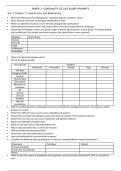
PAPER 2: CONTINUITY OF LIFE BLURT PROMPTS
Year 1 Chapter 7: Classification and Biodiversity
Define the following terms: Phylogenetic, Hierchical, Discrete, Tentative, Taxon
Write down the hierarchy of biological classification in order
What two adjectives would you use to describe phylogenetic classification?
Explain the three-domain system, the groups within it and the characteristics of each group
Explain the five-kingdom system, the groups within it and the characteristics of each group. The following table
may be filled out: (just include some basic features, the table fill later is more detailed)
Kingdom Key Features
Plantae
Animalia
Fungi
Prokaryotes
Protoctista
What is the binomial naming system?
Fill out the following table:
Characteristic Kingdom
Prokaryote Protoctista Plantae Fungi Animalia
Cell type
Number of cells
Nucleus
Mitochondria
Chloroplasts
Ribosomes in
cytoplasm
ER
Vacuole
Cell wall
Nutrition
Nervous
coordination
Define the following terms: Homologous structures, Pentadactyl, Analogous structures, convergent evolution,
divergent evolution
What three different ways can you assess relatedness of species?
Explain the two things that biologists mean when they say ‘Species’ (The concept of species)
Explain the four ways you can assess relatedness with genetic evidence?
What is the definition of biodiversity?
What are the three factors affecting biodiversity?
Why is reduced biodiversity a concern for humans?
How has biodiversity been generated?
What three ways can biodiversity be assessed?
How can biodiversity be assessed within a species?
Complete the following table describing the method for sampling different types of populations
Population Technique Method
Terrestrial animals
Freshwater invertebrates
Plants
What are the three types of adaptations that organisms can have to their environment? Give an example for
each
Year 1 Chapter 7: Classification and Biodiversity
Define the following terms: Phylogenetic, Hierchical, Discrete, Tentative, Taxon
Write down the hierarchy of biological classification in order
What two adjectives would you use to describe phylogenetic classification?
Explain the three-domain system, the groups within it and the characteristics of each group
Explain the five-kingdom system, the groups within it and the characteristics of each group. The following table
may be filled out: (just include some basic features, the table fill later is more detailed)
Kingdom Key Features
Plantae
Animalia
Fungi
Prokaryotes
Protoctista
What is the binomial naming system?
Fill out the following table:
Characteristic Kingdom
Prokaryote Protoctista Plantae Fungi Animalia
Cell type
Number of cells
Nucleus
Mitochondria
Chloroplasts
Ribosomes in
cytoplasm
ER
Vacuole
Cell wall
Nutrition
Nervous
coordination
Define the following terms: Homologous structures, Pentadactyl, Analogous structures, convergent evolution,
divergent evolution
What three different ways can you assess relatedness of species?
Explain the two things that biologists mean when they say ‘Species’ (The concept of species)
Explain the four ways you can assess relatedness with genetic evidence?
What is the definition of biodiversity?
What are the three factors affecting biodiversity?
Why is reduced biodiversity a concern for humans?
How has biodiversity been generated?
What three ways can biodiversity be assessed?
How can biodiversity be assessed within a species?
Complete the following table describing the method for sampling different types of populations
Population Technique Method
Terrestrial animals
Freshwater invertebrates
Plants
What are the three types of adaptations that organisms can have to their environment? Give an example for
each