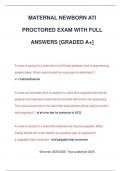
2026/2027 HESI Med Surg Exit Exam (V1 Version 1) Brand New
(160Q&As) 100% Correctly Verified Answers Best Exam Solution
Satisfaction Guaranteed Success Latest Update 2026/2027 With
ASSURANCE OF GRADE A+
TEST 1
Multiple Choice
1. While assessing a client with diabetes mellitus, the nurse observes an absence of
hair growth on the client's legs. What additional assessment provides further data
to support this finding?
a. Palpate for the presence of femoral pulses bilaterally.
b. Assess for the presence of a positive Homan's sign.
c. Observe the appearance of the skin on the client's legs.
d. Watch the client's posture and balance during ambulation.
2. The healthcare provider prescribes 15 mg/kg of Streptomycin for an infant weighing
4 pounds.
The drug is diluted in 25 ml of D5W to run over 8 hours. How much
Streptomycin will theinfant receive?
a. 9 mg.
, b. 18 mg.
c. 27 mg.
d. 36 mg.
3. In assessing a client with preeclampsia who is receiving magnesium sulfate, the
nurse determines that her deep tendon reflexes are 1+; respiratory rate is 12
breaths/minute; urinary output is 90 ml in 4 hours; magnesium sulfate level is 9
mg/dl. Based on these findings,what intervention should the nurse implement?
a. Continue the magnesium sulfate infusion as prescribed.
b. Decrease the magnesium sulfate infusion by one-half.
c. Stop the magnesium sulfate infusion immediately.
d. Administer calcium gluconate immediately.
4. A client is on a mechanical ventilator. Which client response indicates that the
neuromuscularblocker tubocurarine chloride (Tubarine) is effective?
a. The client’s expremities are paralyzed.
b. The peripheral nerve stimulator causes twitching.
c. The client clinches fist upon command.
d. The client’s Glagow Coma Scale score is 14.
5. An elderly female client comes to the clinic for a regular check-up. The client tells
the nurse that she has increased her daily doses of acetaminophen (Tylenol) for
the past month to control joint pain. Based on this client's comment, what
previous lab values should the nursecompare with today's lab report?
a. Look at last quarter's hemoglobin and hematocrit, expecting an
increase today dueto dehydration.
,b. Look for an increase in today's LDH compared to the previous one
to assess forpossible liver damage.
c. Expect to find an increase in today's APTT as compared to last
quarter's due tobleeding.
d. Determine if there is a decrease in serum potassium due to renal compromise.
, 6. Aspirin is prescribed for a 9-year-old child with rheumatic fever to control the
inflammatory process, promote comfort, and reduce fever. What intervention is
most important for the nurse to implement?
a. Instruct the parents to hold the aspirin until the child has first had
a tepid spongebath.
b. Administer the aspirin with at least two ounces of water or juice.
c. Notify the healthcare provider if the child complains of ringing in the ears.
d. Advise the parents to question the child about seeing yellow halos around
objects.
7. Which signs or symptoms are characteristic of an adult client diagnosed with
Cushing'ssyndrome?
a. Husky voice and complaints of hoarseness.
b. Warm, soft, moist, salmon-colored skin.
c. Visible swelling of the neck, with no pain.
d. Central-type obesity, with thin extremities.
8. A charge nurse agrees to cover another nurse’s assignment during a lunch break.
Based on the status report provided by the nurse who is leaving for lunch, which
client should be checked first by the charge nurse? The client
a. admitted yesterday with diabetec ketoacidosis whose blood
glucose level isnow 195 mg/dl.
b. with an ileal conduit created two days ago with a scant amount
of blood inthe drainage pouch.
(160Q&As) 100% Correctly Verified Answers Best Exam Solution
Satisfaction Guaranteed Success Latest Update 2026/2027 With
ASSURANCE OF GRADE A+
TEST 1
Multiple Choice
1. While assessing a client with diabetes mellitus, the nurse observes an absence of
hair growth on the client's legs. What additional assessment provides further data
to support this finding?
a. Palpate for the presence of femoral pulses bilaterally.
b. Assess for the presence of a positive Homan's sign.
c. Observe the appearance of the skin on the client's legs.
d. Watch the client's posture and balance during ambulation.
2. The healthcare provider prescribes 15 mg/kg of Streptomycin for an infant weighing
4 pounds.
The drug is diluted in 25 ml of D5W to run over 8 hours. How much
Streptomycin will theinfant receive?
a. 9 mg.
, b. 18 mg.
c. 27 mg.
d. 36 mg.
3. In assessing a client with preeclampsia who is receiving magnesium sulfate, the
nurse determines that her deep tendon reflexes are 1+; respiratory rate is 12
breaths/minute; urinary output is 90 ml in 4 hours; magnesium sulfate level is 9
mg/dl. Based on these findings,what intervention should the nurse implement?
a. Continue the magnesium sulfate infusion as prescribed.
b. Decrease the magnesium sulfate infusion by one-half.
c. Stop the magnesium sulfate infusion immediately.
d. Administer calcium gluconate immediately.
4. A client is on a mechanical ventilator. Which client response indicates that the
neuromuscularblocker tubocurarine chloride (Tubarine) is effective?
a. The client’s expremities are paralyzed.
b. The peripheral nerve stimulator causes twitching.
c. The client clinches fist upon command.
d. The client’s Glagow Coma Scale score is 14.
5. An elderly female client comes to the clinic for a regular check-up. The client tells
the nurse that she has increased her daily doses of acetaminophen (Tylenol) for
the past month to control joint pain. Based on this client's comment, what
previous lab values should the nursecompare with today's lab report?
a. Look at last quarter's hemoglobin and hematocrit, expecting an
increase today dueto dehydration.
,b. Look for an increase in today's LDH compared to the previous one
to assess forpossible liver damage.
c. Expect to find an increase in today's APTT as compared to last
quarter's due tobleeding.
d. Determine if there is a decrease in serum potassium due to renal compromise.
, 6. Aspirin is prescribed for a 9-year-old child with rheumatic fever to control the
inflammatory process, promote comfort, and reduce fever. What intervention is
most important for the nurse to implement?
a. Instruct the parents to hold the aspirin until the child has first had
a tepid spongebath.
b. Administer the aspirin with at least two ounces of water or juice.
c. Notify the healthcare provider if the child complains of ringing in the ears.
d. Advise the parents to question the child about seeing yellow halos around
objects.
7. Which signs or symptoms are characteristic of an adult client diagnosed with
Cushing'ssyndrome?
a. Husky voice and complaints of hoarseness.
b. Warm, soft, moist, salmon-colored skin.
c. Visible swelling of the neck, with no pain.
d. Central-type obesity, with thin extremities.
8. A charge nurse agrees to cover another nurse’s assignment during a lunch break.
Based on the status report provided by the nurse who is leaving for lunch, which
client should be checked first by the charge nurse? The client
a. admitted yesterday with diabetec ketoacidosis whose blood
glucose level isnow 195 mg/dl.
b. with an ileal conduit created two days ago with a scant amount
of blood inthe drainage pouch.