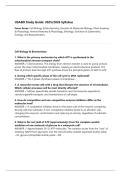
USABO Study Guide: 2025/2026 Syllabus
Focus Areas: Cell Biology & Biochemistry, Genetics & Molecular Biology, Plant Anatomy
& Physiology, Animal Anatomy & Physiology, Ethology, Evolution & Systematics,
Ecology, and Biosystematics.
Cell Biology & Biochemistry
1. What is the primary mechanism by which ATP is synthesized in the
mitochondrial electron transport chain?
ANSWER ✓ Chemiosmosis. The energy from electron transfer is used to pump protons
across the inner mitochondrial membrane, creating an electrochemical gradient. The
flow of protons back through ATP synthase drives the phosphorylation of ADP to ATP.
2. During which specific phase of the cell cycle is DNA replicated?
ANSWER ✓ The S phase (Synthesis phase) of interphase.
3. A researcher treats cells with a drug that disrupts the structure of microtubules.
Which cellular processes will be most directly affected?
ANSWER ✓ Mitosis (specifically spindle formation and chromosome separation),
vesicle/organelle transport, and maintenance of cell shape.
4. How do competitive and non-competitive enzyme inhibitors differ at the
molecular level?
ANSWER ✓ A competitive inhibitor binds to the active site of the enzyme, competing
directly with the substrate. A non-competitive inhibitor binds to an allosteric site,
changing the enzyme's conformation and reducing its activity, regardless of substrate
concentration.
5. What is the net yield of ATP (approximately) from the complete aerobic
oxidation of one molecule of glucose in a eukaryotic cell?
ANSWER ✓ Approximately 30-32 ATP molecules. The variation arises from the "cost" of
shuttling NADH from glycolysis into the mitochondria (malate-aspartate shuttle yields
~32, glycerol phosphate shuttle yields ~30).
, 6. What is the primary function of the Golgi apparatus?
ANSWER ✓ Modification, sorting, and packaging of proteins and lipids for secretion or
delivery to other organelles.
7. What is the role of chaperone proteins like HSP70?
ANSWER ✓ They assist in the proper folding of nascent polypeptide chains and the
refolding of misfolded proteins, often using ATP.
8. Describe the signal hypothesis for the targeting of proteins to the endoplasmic
reticulum.
ANSWER ✓ Proteins destined for the ER, secretion, or membranes have an N-terminal
signal peptide. This peptide is recognized by a Signal Recognition Particle (SRP), which
pauses translation and docks the ribosome complex onto an SRP receptor on the ER
membrane. Translation then resumes, and the polypeptide is translocated into the ER
lumen.
9. Why is the fluidity of the cell membrane critical for function?
ANSWER ✓ It allows for membrane protein movement, proper membrane assembly,
vesicle formation, and cell division. Fluidity is modulated by cholesterol and the
saturation of fatty acid tails.
10. What is the fundamental difference between prokaryotic and eukaryotic
ribosomes?
ANSWER ✓ Prokaryotic ribosomes are 70S (composed of 50S and 30S subunits), while
eukaryotic ribosomes are 80S (composed of 60S and 40S subunits). This difference is the
basis for many antibiotics.
Genetics & Molecular Biology
11. A woman is heterozygous for an autosomal dominant disorder (Aa). She has a
child with an unaffected man (aa). What is the probability their child will be
affected?
ANSWER ✓ 50%. The cross is Aa x aa. The possible genotypes are Aa (affected) and aa
(unaffected), each with a 1/2 probability.
12. In a dihybrid cross (AaBb x AaBb) with independent assortment, what is the
expected phenotypic ratio?
ANSWER ✓ 9:3:3:1.
Focus Areas: Cell Biology & Biochemistry, Genetics & Molecular Biology, Plant Anatomy
& Physiology, Animal Anatomy & Physiology, Ethology, Evolution & Systematics,
Ecology, and Biosystematics.
Cell Biology & Biochemistry
1. What is the primary mechanism by which ATP is synthesized in the
mitochondrial electron transport chain?
ANSWER ✓ Chemiosmosis. The energy from electron transfer is used to pump protons
across the inner mitochondrial membrane, creating an electrochemical gradient. The
flow of protons back through ATP synthase drives the phosphorylation of ADP to ATP.
2. During which specific phase of the cell cycle is DNA replicated?
ANSWER ✓ The S phase (Synthesis phase) of interphase.
3. A researcher treats cells with a drug that disrupts the structure of microtubules.
Which cellular processes will be most directly affected?
ANSWER ✓ Mitosis (specifically spindle formation and chromosome separation),
vesicle/organelle transport, and maintenance of cell shape.
4. How do competitive and non-competitive enzyme inhibitors differ at the
molecular level?
ANSWER ✓ A competitive inhibitor binds to the active site of the enzyme, competing
directly with the substrate. A non-competitive inhibitor binds to an allosteric site,
changing the enzyme's conformation and reducing its activity, regardless of substrate
concentration.
5. What is the net yield of ATP (approximately) from the complete aerobic
oxidation of one molecule of glucose in a eukaryotic cell?
ANSWER ✓ Approximately 30-32 ATP molecules. The variation arises from the "cost" of
shuttling NADH from glycolysis into the mitochondria (malate-aspartate shuttle yields
~32, glycerol phosphate shuttle yields ~30).
, 6. What is the primary function of the Golgi apparatus?
ANSWER ✓ Modification, sorting, and packaging of proteins and lipids for secretion or
delivery to other organelles.
7. What is the role of chaperone proteins like HSP70?
ANSWER ✓ They assist in the proper folding of nascent polypeptide chains and the
refolding of misfolded proteins, often using ATP.
8. Describe the signal hypothesis for the targeting of proteins to the endoplasmic
reticulum.
ANSWER ✓ Proteins destined for the ER, secretion, or membranes have an N-terminal
signal peptide. This peptide is recognized by a Signal Recognition Particle (SRP), which
pauses translation and docks the ribosome complex onto an SRP receptor on the ER
membrane. Translation then resumes, and the polypeptide is translocated into the ER
lumen.
9. Why is the fluidity of the cell membrane critical for function?
ANSWER ✓ It allows for membrane protein movement, proper membrane assembly,
vesicle formation, and cell division. Fluidity is modulated by cholesterol and the
saturation of fatty acid tails.
10. What is the fundamental difference between prokaryotic and eukaryotic
ribosomes?
ANSWER ✓ Prokaryotic ribosomes are 70S (composed of 50S and 30S subunits), while
eukaryotic ribosomes are 80S (composed of 60S and 40S subunits). This difference is the
basis for many antibiotics.
Genetics & Molecular Biology
11. A woman is heterozygous for an autosomal dominant disorder (Aa). She has a
child with an unaffected man (aa). What is the probability their child will be
affected?
ANSWER ✓ 50%. The cross is Aa x aa. The possible genotypes are Aa (affected) and aa
(unaffected), each with a 1/2 probability.
12. In a dihybrid cross (AaBb x AaBb) with independent assortment, what is the
expected phenotypic ratio?
ANSWER ✓ 9:3:3:1.