
Tissues and Organs
Definitions
Cells – Basic unit of all living things
Tissue – are groups of cells that carry out the same function
Organ – A structural unit made up of several types of tissue grouped to carry out one or more functions
Organ System – A group of organs working together to carry out a specific function
Both plants and animals have organs
Animals
Organ Systems in animals are:
o Respiratory system
o Nervous system
o Skeletal system
o Reproductive system
o Digestive system
o Excretory system
o Circulatory system
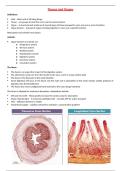
The Ileum
The ileum is an organ that is part of the digestive system
The alimentary canal runs from the mouth to the anus, and it is a long, hollow tube
The ileum is the final part of the small intestine
Some digestion will occur in the ileum, but the main role is absorption of the small, simple, soluble products of
digestion into the bloodstream
The ileum also moves undigested food material to the colon (large intestine)
The ileum is adapted for maximum absorption. Adaptations include:
Villi and microvilli – these greatly increase the surface area for absorption
Many mitochondria – in columnar epithelial cells – provide ATP for active transport
Thin – diffusion distance is smaller
Good blood supply – capillary network to maintain a concentration gradient
, Mucosa
The mucosa is the innermost layer of the ileum that is
in contact with the food in the gut lumen
Most digestive enzymes will be secreted into the
lumen of the ileum, but a lot of digestive enzymes
occur within the cell surface membrane of the
epidermal cells.
Villi
The internal lining of the ileum is folded into finger-like
projections called villi.
The villi extend into the gut lumen
The villi greatly increase the surface area of the
mucosa for the absorption of digested food molecules
The cells lining the villi are columnar epithelium cells.
The surface of the columnar epithelial cells has microvilli which further increase the surface area for absorption
The presence of the microvilli gives the cells a brush border appearance.
Therefore, the microvilli increase the number of digestive enzymes that would be in contact with food molecules
The products of digestion are absorbed by facilitated diffusion and active transport – protein carriers are involved
Each villus has a capillary network and a lacteal
The villi ‘waft’ in the lumen – this happens because small strands of muscle from the muscularis mucosa extend up
through each villus – when these strands contract, the villi move from side to side
Goblet Cells
Within the columnar epithelium cells are goblet cells. Goblet cells secrete mucus.
The mucus provides a slimy, protective layer that lubricates the lining of the alimentary canal – this allows food to
move easily through the ileum (reduces friction).
The mucus also protects the columnar epithelial cells from the actions of the digestive enzymes – protects the lining
of the gut from the digestive enzymes
Crypts of Lieberkühn
The Crypts of Lieberkühn are intestinal glands that are embedded in the tissue between the villi. At the bottom of
the crypts, the epithelial cells are continually dividing by mitosis.
These cells will then move up towards the surface of the villi as the new columnar epithelial cells.
The cells of the mucosa are continually replaced – they must be replaced as they are constantly worn away due to
friction as the food moves through the gut
Paneth Cells
Paneth cells are found at the base of the crypts.
They are responsible for the production of the new epithelial cells and have an anti-microbial function to protect the
actively diving cells that neighbour them at the bottom of the crypt.
Other cells in the crypt are involved in secreting mucus.
Definitions
Cells – Basic unit of all living things
Tissue – are groups of cells that carry out the same function
Organ – A structural unit made up of several types of tissue grouped to carry out one or more functions
Organ System – A group of organs working together to carry out a specific function
Both plants and animals have organs
Animals
Organ Systems in animals are:
o Respiratory system
o Nervous system
o Skeletal system
o Reproductive system
o Digestive system
o Excretory system
o Circulatory system
The Ileum
The ileum is an organ that is part of the digestive system
The alimentary canal runs from the mouth to the anus, and it is a long, hollow tube
The ileum is the final part of the small intestine
Some digestion will occur in the ileum, but the main role is absorption of the small, simple, soluble products of
digestion into the bloodstream
The ileum also moves undigested food material to the colon (large intestine)
The ileum is adapted for maximum absorption. Adaptations include:
Villi and microvilli – these greatly increase the surface area for absorption
Many mitochondria – in columnar epithelial cells – provide ATP for active transport
Thin – diffusion distance is smaller
Good blood supply – capillary network to maintain a concentration gradient
, Mucosa
The mucosa is the innermost layer of the ileum that is
in contact with the food in the gut lumen
Most digestive enzymes will be secreted into the
lumen of the ileum, but a lot of digestive enzymes
occur within the cell surface membrane of the
epidermal cells.
Villi
The internal lining of the ileum is folded into finger-like
projections called villi.
The villi extend into the gut lumen
The villi greatly increase the surface area of the
mucosa for the absorption of digested food molecules
The cells lining the villi are columnar epithelium cells.
The surface of the columnar epithelial cells has microvilli which further increase the surface area for absorption
The presence of the microvilli gives the cells a brush border appearance.
Therefore, the microvilli increase the number of digestive enzymes that would be in contact with food molecules
The products of digestion are absorbed by facilitated diffusion and active transport – protein carriers are involved
Each villus has a capillary network and a lacteal
The villi ‘waft’ in the lumen – this happens because small strands of muscle from the muscularis mucosa extend up
through each villus – when these strands contract, the villi move from side to side
Goblet Cells
Within the columnar epithelium cells are goblet cells. Goblet cells secrete mucus.
The mucus provides a slimy, protective layer that lubricates the lining of the alimentary canal – this allows food to
move easily through the ileum (reduces friction).
The mucus also protects the columnar epithelial cells from the actions of the digestive enzymes – protects the lining
of the gut from the digestive enzymes
Crypts of Lieberkühn
The Crypts of Lieberkühn are intestinal glands that are embedded in the tissue between the villi. At the bottom of
the crypts, the epithelial cells are continually dividing by mitosis.
These cells will then move up towards the surface of the villi as the new columnar epithelial cells.
The cells of the mucosa are continually replaced – they must be replaced as they are constantly worn away due to
friction as the food moves through the gut
Paneth Cells
Paneth cells are found at the base of the crypts.
They are responsible for the production of the new epithelial cells and have an anti-microbial function to protect the
actively diving cells that neighbour them at the bottom of the crypt.
Other cells in the crypt are involved in secreting mucus.


