
Lipids
Lipids are large molecules but they are not polymers
They are non-polar, hydrophobic molecules – they are insoluble in water
All lipids contain Carbon, Hydrogen and Oxygen
A very high proportion of hydrogen relative to oxygen
The main types of lipids are:
o Triglycerides
o Phospholipids
o Waxes
o Steroids
Triglycerides
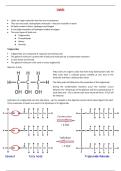
Triglycerides are composed of 1 glycerol and 3 fatty acids
The glycerol molecule is joined with 3 fatty acid molecules by 3 condensation reactions
3 ester bonds are formed
The glycerol molecule is the same in every triglyceride
Glycerol: C3H8O3
Fatty acids are organic acids that form long hydrocarbon tails. All
fatty acids have a carboxyl group (-COOH) at one end of the
molecule and then a hydrocarbon chain.
The fatty acids will determine the properties of the triglyceride
During the condensation reactions occur the reaction occurs
between the -OH groups of the glycerol and the carboxyl group of
each fatty acid – this is where each ester bond will form. 3 H 2O will
be released.
Hydrolysis of a triglyceride can also take place – eg: for example in the digestive system when lipase digests the lipid.
Three molecules of water are used in the hydrolysis of a triglyceride.
Lipids are large molecules but they are not polymers
They are non-polar, hydrophobic molecules – they are insoluble in water
All lipids contain Carbon, Hydrogen and Oxygen
A very high proportion of hydrogen relative to oxygen
The main types of lipids are:
o Triglycerides
o Phospholipids
o Waxes
o Steroids
Triglycerides
Triglycerides are composed of 1 glycerol and 3 fatty acids
The glycerol molecule is joined with 3 fatty acid molecules by 3 condensation reactions
3 ester bonds are formed
The glycerol molecule is the same in every triglyceride
Glycerol: C3H8O3
Fatty acids are organic acids that form long hydrocarbon tails. All
fatty acids have a carboxyl group (-COOH) at one end of the
molecule and then a hydrocarbon chain.
The fatty acids will determine the properties of the triglyceride
During the condensation reactions occur the reaction occurs
between the -OH groups of the glycerol and the carboxyl group of
each fatty acid – this is where each ester bond will form. 3 H 2O will
be released.
Hydrolysis of a triglyceride can also take place – eg: for example in the digestive system when lipase digests the lipid.
Three molecules of water are used in the hydrolysis of a triglyceride.


