

Lecture notes
Class 11th chemistry chapter 1 structure of atom
NewComplete handwritten notes for Class 11 Chemistry Chapter 2 – Structure of Atom. These notes cover important concepts from the CBSE/NCERT syllabus in an easy-to-understand format. Useful for revision, exam preparation and quick study. Topics include atomic models, Thomson model, Rutherford model, Bohr model, quantum numbers, atomic orbitals, electronic configuration, dual nature of matter and hydrogen spectrum.
 ushadevi4

Lecture notes
Basic notes for understanding some basic concepts iof chemistry
NewDefine chemistry in very short and well defined way. It also contains numericals which is essential for your examination
 sadhnadevi80499
Lecture notes
Some Basic Concepts of Chemistry | Nature of Matter| Law of Chemical Combinations | Gay- Loussac's Law | Avogadro's Number | Molarity & Molality | Stoichiometry and much more compiled in a PDF
This is the ULTIMATE NOITES Guide for High School Level CHEMISTRY BASICS. These notes include Topics which are written on the first page which you can see right now as a sample. These Notes Highly Valuable For Acing Your EXAMS. Hope This Helps!! The Price is set to its MINIMUM, with our MAXIMUM efforts!! Thank You!!
 class11material

Lecture notes
Ionic Equilibrium (PART-B) Buffer Solution| Common Ion Effect | Henderson's Law | Solubility Product | Arrhenius Acid & Base | Lewis Acid & Base | pH Scale | Ostwald's Dilution Law
This is the ULTIMATE NOITES Guide for IONIC EQUILIBRIUM PART -B. These notes include Topics which are written on the first page which you can see right now as a sample. These Notes Highly Valuable For Acing Your EXAMS. Hope This Helps!! The Price is set to its MINIMUM, with our MAXIMUM efforts!! Thank You!!
class11material
Lecture notes
Thermodynamics Internal Energy | Gibb's Free Equations | Enthalpy | Entropy | Work Energy | Heat Capacity | Spontaneity Criteria | Laws of Thermodynamics | System & Surroundings and Exercises all combined in this pdf
This is the ULTIMATE NOTES for CHEMISTRY chapter THERMODYNAMICS with detailed paragraphs of each topic + extra questions at the end of this paper. Hope it Helps!! The Price is set to its MINIMUM, with MAXIMUM efforts!! Thank You!!
class11material

Lecture notes
Chemical Equilibrium (PART- A) Henry's Law | Le Chatelier's Principles | Law of Mass Actions | Types of exercise and Exercise all combined in this pdf
This is the ULTIMATE NOTES Guide for CHEMICAL EQUILIBRIUM PART-B. These notes include Topics which are written on the first page CONTENTS/INDEX which you can see right now as a sample. These Notes Highly Valuable For Acing Your EXAMS. Hope This Helps!! The Price is set to its MINIMUM, with our MAXIMUM efforts!! Thank You!!
class11material
Lecture notes
Periodic Table Electronegativity | Electron gain Enthalpy | Electron Affinity | Periodicity | Transition Elements | Diagonal relationships | Exercise etc. All Important questions combined in this pdf
This is the ULTIMATE NOTES for chapter PERIODIC TABLE with detailed paragraphs of each Topics + extra exercise questions number of pages are 22. The price is set to its MINIMUM, with our MAXIMUM efforts Hope it Helps!! Thank You!!
class11material

Lecture notes
Atomic Structure Chemistry | Heisenberg's Principle | Hund's Rule | Aufbau's Rule | Rutherford's Model | Dalton's Model | J.J. Thompson's Model | Line Spectra Etc. Detailed NOTES for higher study in this PDF
This is the ULTIMATE NOTES for CHEMISTRY chapter ATOMIC STRUCTURE with detailed paragraphs of each topic + extra questions at the end of this paper. Hope it Helps!! The price is set to its MINIMUM, with our MAXIMUM efforts
class11material
Lecture notes
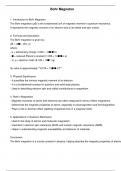
Chemistry class 12th Bohr magneton
The Bohr magneton (μB) is the fundamental unit of magnetic moment in atomic physics, defined as 9.274 × 10⁻²⁴ J/T. It represents the magnetic moment of an electron due to its orbital and spin angular momentum. The formula is μB = (eħ) / (2mₑ), where e is the electron charge, ħ is the reduced Planck’s constant, and mₑ is the electron mass. It is crucial in quantum mechanics, solid-state physics, and magnetism, used to describe paramagnetic and ferromagnetic materials. Magnetic mom...
manishshaw929
Lecture notes
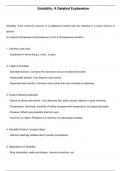
Chemistry class 12th Solubility explanation
Solubility is the ability of a substance (solute) to dissolve in a solvent to form a homogeneous solution. It depends on factors like temperature, pressure, and the nature of both solute and solvent. For solids in liquids, solubility usually increases with temperature, while for gases, it decreases. Polar solutes dissolve in polar solvents (e.g., sugar in water), while non-polar solutes dissolve in non-polar solvents (e.g., oil in benzene). A solution becomes saturated when it holds the maximum ...
manishshaw929
Lecture notes
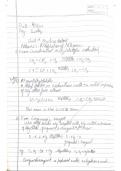
Hydrocarbons
It's class 11th chemistry Hydrocarbons
 harshitmahajan

Lecture notes
Class 11th chemistry
The notes is about class 11th basic chemistry
g9908961
Summary
Some basis concept of chemistry
These note are many by experienced teacher and approved by topper
tyagisandhya50

Lecture notes
Sample question paper
This chemistry sample paper is made for only class 12th students . For practice purpose
 sunnyjack
Interview
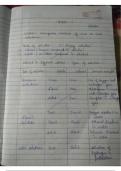
Class 12 Chemistry NCERT solutions short notes
Class 12 Chemistry NCERT solutions short notes chapter 2 and 3
 paras1