

1
The Diagnoses and DSM-5 Diagnostic Criteria
Competency Assessment and Discussion Questions: Elliot
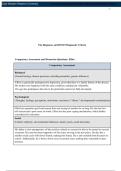
Competency Assessment
Biological
(Normal biology; disease processes, including metabolic; genetic influence)
Elliot is genetically predisposed to depression, given that there is a family history of the disease.
His mother was diagnosed with the same condition, making him vulnerable.
His age also predisposes him due to his prefrontal context not fully developed.
Psychological
(Thoughts, feelings, perceptions, motivation, reactions to “illness,” developmental considerations)
Elliot has separation grief and trauma from not seeing his mother for so long. He also has low
self-esteem and a poor sense of worth. Elliot also has poor coping mechanisms, which further
exacerbates his outcomes.
Social
(Culture; ethnicity, environmental influences, family, peers, social networks)
His father is also unsupportive of him and has refused to consent for him to be treated on several
occasions. His aunt has been supportive of him since moving to the new place. He also has a
smaller social cycle with fewer friends, making him lonely. He is also isolated from his peers in
school. Additionally, he is from a lower socio-economic class, making him vulnerable to peer
pressure.
, 2
Assessing for competency
(Coping and adaptation, influencing factors, available supports)
Elliot has poor coping mechanisms, such as isolating himself when he is depressed, predisposing
him to adverse outcomes such as suicide ideations.
Adapted from Figure 1.4: The Competency-Based Assessment Model, p. 23 of Gray, S. (2016).
Psychopathology: A competency-based assessment model for social workers (4th ed.). Boston,
MA: Cengage Learning.
Diagnosis: Major Depressive Disorder
The diagnosis for this client is major depressive disorder (MDD), recurrent depressive
disorder, and current episode severe with psychotic symptoms. The ICD Code for this diagnosis
is F33.3. (Definitions manual, n.d.). This is described as depressive episodes whereby there are
psychotic symptoms such as delusions, distorted thoughts, and hallucinations. The depression is
recurrent and with manic episodes. These episodes are accompanied by depressed mood and
declining interest in activities one usually enjoys partaking in (World Health Organization,
2019). Individuals also experience significant weight loss or weight gain and insomnia. They
also experience recurrent suicidal ideation, feelings of worthlessness, and reduced self-esteem
and confidence in their abilities (Park et al., 2020).
Application to Elliot's Case
Elliot met the majority of the symptoms and criteria identified above. He has been
experiencing significant depressive symptoms where he has lost interest in interacting with his
friend and fixing the car he was to use for the road trip to visit his mother. He has no interest in
The Diagnoses and DSM-5 Diagnostic Criteria
Competency Assessment and Discussion Questions: Elliot
Competency Assessment
Biological
(Normal biology; disease processes, including metabolic; genetic influence)
Elliot is genetically predisposed to depression, given that there is a family history of the disease.
His mother was diagnosed with the same condition, making him vulnerable.
His age also predisposes him due to his prefrontal context not fully developed.
Psychological
(Thoughts, feelings, perceptions, motivation, reactions to “illness,” developmental considerations)
Elliot has separation grief and trauma from not seeing his mother for so long. He also has low
self-esteem and a poor sense of worth. Elliot also has poor coping mechanisms, which further
exacerbates his outcomes.
Social
(Culture; ethnicity, environmental influences, family, peers, social networks)
His father is also unsupportive of him and has refused to consent for him to be treated on several
occasions. His aunt has been supportive of him since moving to the new place. He also has a
smaller social cycle with fewer friends, making him lonely. He is also isolated from his peers in
school. Additionally, he is from a lower socio-economic class, making him vulnerable to peer
pressure.
, 2
Assessing for competency
(Coping and adaptation, influencing factors, available supports)
Elliot has poor coping mechanisms, such as isolating himself when he is depressed, predisposing
him to adverse outcomes such as suicide ideations.
Adapted from Figure 1.4: The Competency-Based Assessment Model, p. 23 of Gray, S. (2016).
Psychopathology: A competency-based assessment model for social workers (4th ed.). Boston,
MA: Cengage Learning.
Diagnosis: Major Depressive Disorder
The diagnosis for this client is major depressive disorder (MDD), recurrent depressive
disorder, and current episode severe with psychotic symptoms. The ICD Code for this diagnosis
is F33.3. (Definitions manual, n.d.). This is described as depressive episodes whereby there are
psychotic symptoms such as delusions, distorted thoughts, and hallucinations. The depression is
recurrent and with manic episodes. These episodes are accompanied by depressed mood and
declining interest in activities one usually enjoys partaking in (World Health Organization,
2019). Individuals also experience significant weight loss or weight gain and insomnia. They
also experience recurrent suicidal ideation, feelings of worthlessness, and reduced self-esteem
and confidence in their abilities (Park et al., 2020).
Application to Elliot's Case
Elliot met the majority of the symptoms and criteria identified above. He has been
experiencing significant depressive symptoms where he has lost interest in interacting with his
friend and fixing the car he was to use for the road trip to visit his mother. He has no interest in


