
Chapter 9 Lipids I: Fatty Acids and Steroids
1. This section will focus on the structure and biological functions of lipids—not
metabolism. Lipids are structurally very diverse (there is no common structure), so what
is the one thing all lipids have in common? All lipids have long chains/tails of carboxylic
acids
9.1. Properties, Nomenclature, and Biological Functions of Lipid Molecules
2. Describe the overall structure of fatty acids—why are they “fatty”, and where is the “acid”
moiety? The FATTY part comes from their long hydrocarbon tails and the acid moiety is
the carboxylic acid; they are found in animal + plant fats (like butters and oils)
- What structural characteristics define fatty acids? Their long hydrocarbon
hydrophobic tails and their carboxylic (COOH) group at their heads
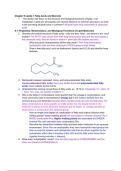
- Draw a free fatty acid, such as dodecanoic (lauric) acid (12:0) and identify those
features:
3. Distinguish between saturated, mono- and polyunsaturated fatty acids:
monounsaturated fatty acids; have one double bond and polyunsaturated fatty
acids; have multiple double bonds
4. Understand the naming conventions of fatty acids, ex. 18:19 or -3 basically 12 = tetra; 16
= hexa, 18 = octa, etc (LOOK at table 9.1)
5. Why is the delta () nomenclature more specific than the omega () nomenclature, and
more commonly used in biochemistry? Omega (ω) is the Carbon farthest from the
carboxyl group and delta (Δ) indicates where double bonds are w/in the fatty acid. The
delta nomenclature is more specific as it tells where ALL the double bonds in the
molecule is telling us more about the molecule and its shape, vs. omega just tells us
what carbon is furthest from the carbonyl group
- How do length and degree of unsaturation of fatty acid chains influence their
melting points? lower melting points are associated w/ Shorter chained FAs +
MORE unsaturated FAs. Higher melting points are associated w/LONGER
chained FAs and saturated (less unsaturated) FAs.
- Describe the interactions between fatty acid and water molecules in an aqueous
environment. Since FAs are amphipathic they have hydrophilic head groups that
stick out into the solution and hydrophobic tails that are driven together by the
hydrophobic effect (the H-bonding of the H2O and the fatty acids drives them
together forming micelles + bilayers)
6. What does “amphipathic” mean? One end (the long tail) is HYDROPHOBIC and the
other end (head) is HYDROPHILLIC
, 7. What kinds of chemical interactions/bonds occur between water and a single fatty acid
molecule? Water H-bonds with water molecules and interacts with the hydrophilic
portions of the fatty acid… the carboxyl group. The interactions b/w H20 and the
carboxyl group is the oxygen atom and the hydroxyl group are both strongly EN and will
H-bond w/H atoms in water. The carboxyl grp is negatively charged at a physiological pH
(COO⁻) and will create ion-dipole interactions with water. Water around the molecule will
form cages around the FA driving their hydrophobic tails together and these hydrophobic
tails will weakly interact with each other through van der Waals forces.
8. Define what micelles are: the structure formed from amphipathic molecules (like FAs &
detergents), have hydrophobic cores and hydrophilic exteriors.
9. Micelles are more ordered than single molecules in solution—how can the
highly-ordered structures of micelles be energetically favourable compared with
randomly-distributed molecules? Micelles maximize the ints of polar groups w/H2O as
they also protect the hydrophobic tails, when the molecules are clustered together water
does not have to “cage” the muscles. There is a gain in entropy (as there is less
organization/more randomness), the free energy is negative and the process is
spontaneous.
10.Be able to describe some biologically important neutral lipids: monoglyceride,
diglyceride, and triglycerides; which store carbohydrates and lack carboxylic acid groups.
- What are mono-, di-, and triacylglycerols (aka triglycerides) and what is their
fundamental structure? These are NEUTRAL lipids; they lack a carboxylic acid
group as they are esterified to a glycerol or cholesterol. Monoglycerols have
one FA, Diaglycerols have 2 FAs. and Triglycerals have 3 FAs. These are the
storage forms of glycerol or cholesterol.
- Distinguish between fats and oils: Fats are solid at room temp and oils are liquid
at room temp. Saturated fats are SOLID at room temp b/c they LACK double
bonds so the molecules pack together tightly forming a solid formation.
Unsaturated fats (oils?) are LIQUID at room temp b/c they have cis DOUBLE
bonds with form kinks so the molecules are unable to be solid and pack together
tightly. Many oils are partially hydrogenated (with chemicals) cis fatty acids are
isomerized to trans fatty acids, forming trans fats.
11.What is the general structure of triacylglycerols and what 3-carbon molecule serves as
their “backbone”? Backbone = glycerol molecule with an ester bond through the oxygen
atom
1. This section will focus on the structure and biological functions of lipids—not
metabolism. Lipids are structurally very diverse (there is no common structure), so what
is the one thing all lipids have in common? All lipids have long chains/tails of carboxylic
acids
9.1. Properties, Nomenclature, and Biological Functions of Lipid Molecules
2. Describe the overall structure of fatty acids—why are they “fatty”, and where is the “acid”
moiety? The FATTY part comes from their long hydrocarbon tails and the acid moiety is
the carboxylic acid; they are found in animal + plant fats (like butters and oils)
- What structural characteristics define fatty acids? Their long hydrocarbon
hydrophobic tails and their carboxylic (COOH) group at their heads
- Draw a free fatty acid, such as dodecanoic (lauric) acid (12:0) and identify those
features:
3. Distinguish between saturated, mono- and polyunsaturated fatty acids:
monounsaturated fatty acids; have one double bond and polyunsaturated fatty
acids; have multiple double bonds
4. Understand the naming conventions of fatty acids, ex. 18:19 or -3 basically 12 = tetra; 16
= hexa, 18 = octa, etc (LOOK at table 9.1)
5. Why is the delta () nomenclature more specific than the omega () nomenclature, and
more commonly used in biochemistry? Omega (ω) is the Carbon farthest from the
carboxyl group and delta (Δ) indicates where double bonds are w/in the fatty acid. The
delta nomenclature is more specific as it tells where ALL the double bonds in the
molecule is telling us more about the molecule and its shape, vs. omega just tells us
what carbon is furthest from the carbonyl group
- How do length and degree of unsaturation of fatty acid chains influence their
melting points? lower melting points are associated w/ Shorter chained FAs +
MORE unsaturated FAs. Higher melting points are associated w/LONGER
chained FAs and saturated (less unsaturated) FAs.
- Describe the interactions between fatty acid and water molecules in an aqueous
environment. Since FAs are amphipathic they have hydrophilic head groups that
stick out into the solution and hydrophobic tails that are driven together by the
hydrophobic effect (the H-bonding of the H2O and the fatty acids drives them
together forming micelles + bilayers)
6. What does “amphipathic” mean? One end (the long tail) is HYDROPHOBIC and the
other end (head) is HYDROPHILLIC
, 7. What kinds of chemical interactions/bonds occur between water and a single fatty acid
molecule? Water H-bonds with water molecules and interacts with the hydrophilic
portions of the fatty acid… the carboxyl group. The interactions b/w H20 and the
carboxyl group is the oxygen atom and the hydroxyl group are both strongly EN and will
H-bond w/H atoms in water. The carboxyl grp is negatively charged at a physiological pH
(COO⁻) and will create ion-dipole interactions with water. Water around the molecule will
form cages around the FA driving their hydrophobic tails together and these hydrophobic
tails will weakly interact with each other through van der Waals forces.
8. Define what micelles are: the structure formed from amphipathic molecules (like FAs &
detergents), have hydrophobic cores and hydrophilic exteriors.
9. Micelles are more ordered than single molecules in solution—how can the
highly-ordered structures of micelles be energetically favourable compared with
randomly-distributed molecules? Micelles maximize the ints of polar groups w/H2O as
they also protect the hydrophobic tails, when the molecules are clustered together water
does not have to “cage” the muscles. There is a gain in entropy (as there is less
organization/more randomness), the free energy is negative and the process is
spontaneous.
10.Be able to describe some biologically important neutral lipids: monoglyceride,
diglyceride, and triglycerides; which store carbohydrates and lack carboxylic acid groups.
- What are mono-, di-, and triacylglycerols (aka triglycerides) and what is their
fundamental structure? These are NEUTRAL lipids; they lack a carboxylic acid
group as they are esterified to a glycerol or cholesterol. Monoglycerols have
one FA, Diaglycerols have 2 FAs. and Triglycerals have 3 FAs. These are the
storage forms of glycerol or cholesterol.
- Distinguish between fats and oils: Fats are solid at room temp and oils are liquid
at room temp. Saturated fats are SOLID at room temp b/c they LACK double
bonds so the molecules pack together tightly forming a solid formation.
Unsaturated fats (oils?) are LIQUID at room temp b/c they have cis DOUBLE
bonds with form kinks so the molecules are unable to be solid and pack together
tightly. Many oils are partially hydrogenated (with chemicals) cis fatty acids are
isomerized to trans fatty acids, forming trans fats.
11.What is the general structure of triacylglycerols and what 3-carbon molecule serves as
their “backbone”? Backbone = glycerol molecule with an ester bond through the oxygen
atom


