
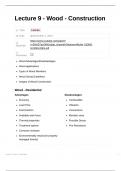
Lecture 9 - Wood - Construction
Type Lecture
Date @November 2, 2023
https://www.youtube.com/watch?
Materials v=DVpSTgzOMQo&ab_channel=ShannonHilchie SIZING
GUIDELINES.pdf
Reviewed
Wood Advantages/Disadvantages
Wood applications
Types of Wood Members
Wood Sizing Guidelines
Images of Wood Construction
Wood - Residential
Advantages Disadvantages
Economy Combustible
Lead Time Vibration
Fast Erection Connections
Available work force Member sizes
Thermal properties Possible Decay
Treatment options Fire Resistance
Corrosion resistant
Environmentally neutral (in properly
managed forests)
Lecture 9 - Wood - Construction 1
, Wood - Timber
Advantages Disadvantages
Fast Erection Combustible
Thermal properties Vibration
Treatment options Connections
Corrosion resistant Member sizes
Fire Resistant/Fire Rating (Large Possible Decay
Dimensions)
Lead Time
Environmentally neutral (in properly
managed forests)
Wood - Applications
Nominal Lumber (2x material) Mass Timber
Small Residential Buildings Libraries
Farm Buildings Arenas
Temporary Structures Condos
Special Structures Schools
High rises
The possibilities are still being explored,
included very tall structures, as long as
they are submitted to the Building
Department under “Alternative Solutions”
Types of Structural Wood
Dimensional (Nominal) Lumber
Lecture 9 - Wood - Construction 2
, Used for
Joists and Studs (@ 16” c/c, typically)
Beams
Built up Beams (screw multiple plys together - Use at least 2 plys)
Posts (at least 4x4)
Built-up Posts (screw multiple plys together)
*Can get Full Sized - Hard to find
Types of Structural Wood
i-Joists
Depth sized by Engineer
Actual members designed by supplier
and would replace “joists” for longer
spans (16” c/c, typically)
Depths
9 1/2” (241 mm)
11 7/8” (302 mm)
14” (356 mm)
Lecture 9 - Wood - Construction 3
Type Lecture
Date @November 2, 2023
https://www.youtube.com/watch?
Materials v=DVpSTgzOMQo&ab_channel=ShannonHilchie SIZING
GUIDELINES.pdf
Reviewed
Wood Advantages/Disadvantages
Wood applications
Types of Wood Members
Wood Sizing Guidelines
Images of Wood Construction
Wood - Residential
Advantages Disadvantages
Economy Combustible
Lead Time Vibration
Fast Erection Connections
Available work force Member sizes
Thermal properties Possible Decay
Treatment options Fire Resistance
Corrosion resistant
Environmentally neutral (in properly
managed forests)
Lecture 9 - Wood - Construction 1
, Wood - Timber
Advantages Disadvantages
Fast Erection Combustible
Thermal properties Vibration
Treatment options Connections
Corrosion resistant Member sizes
Fire Resistant/Fire Rating (Large Possible Decay
Dimensions)
Lead Time
Environmentally neutral (in properly
managed forests)
Wood - Applications
Nominal Lumber (2x material) Mass Timber
Small Residential Buildings Libraries
Farm Buildings Arenas
Temporary Structures Condos
Special Structures Schools
High rises
The possibilities are still being explored,
included very tall structures, as long as
they are submitted to the Building
Department under “Alternative Solutions”
Types of Structural Wood
Dimensional (Nominal) Lumber
Lecture 9 - Wood - Construction 2
, Used for
Joists and Studs (@ 16” c/c, typically)
Beams
Built up Beams (screw multiple plys together - Use at least 2 plys)
Posts (at least 4x4)
Built-up Posts (screw multiple plys together)
*Can get Full Sized - Hard to find
Types of Structural Wood
i-Joists
Depth sized by Engineer
Actual members designed by supplier
and would replace “joists” for longer
spans (16” c/c, typically)
Depths
9 1/2” (241 mm)
11 7/8” (302 mm)
14” (356 mm)
Lecture 9 - Wood - Construction 3


