

1
THEME Bricks, Beads and Bones
ONE The Harappan Civilisation
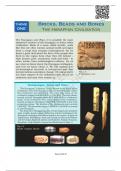
The Harappan seal (Fig.1.1) is possibly the most
distinctive artefact of the Harappan or Indus valley
civilisation. Made of a stone called steatite, seals
like this one often contain animal motifs and signs
from a script that remains undeciphered. Yet we
know a great deal about the lives of the people who
lived in the region from what they left behind –
their houses, pots, ornaments, tools and seals – in
other words, from archaeological evidence. Let us
see what we know about the Harappan civilisation,
and how we know about it. We will explore how
archaeological material is interpreted and how
interpretations sometimes change. Of course, there Fig. 1.1
are some aspects of the civilisation that are as yet A Harappan seal
unknown and may even remain so.
Terminologies, Places and Time
“The Harappan Civilisation” is also known as the Indus Valley
Civilisation. The term Harappa is derived from the place where
the civilization was identified. The total time span of the
civilisation ranges from 6000 BCE to 1300 BCE. The early phase,
termed as Early Harappan (6000 BCE-2600 BCE) is a formative
phase of the civilisation. The urban phase of the civilisation,
termed as Mature Harappan (2600 BCE-1900 BCE) is the most
prosperous phase. The decline of the civilisation starts around
1900 BCE. This decadent phase (1900 BCE-1300 BCE) is termed
as Late Harappan.
The distinctive Harappan pottery, bricks (baked and unbaked)
seals, weights, beads, copper and bronze articles, belonging to the
Harappan civilisation have been found in the region, as apart as
Afghanistan, Baluchistan, Sind and Punjab provinces of Pakistan
and the Indian States of Jammu and Kashmir, Punjab, Haryana,
Rajasthan, Uttar Pradesh, Gujarat and Maharashtra (Map 1).
Fig. 1.2
Beads, weights, blades
Reprint 2024-25
,2 THEMES IN INDIAN HISTORY
Manda
e lum
Jh ab
en
Ch
i
av
R
Harappa
j Rakhigarhi
le
S ut Banawali
Gan
Mitathal
Kalibangan
Yam
ga
s
du
Ganweriwala
In
una
You will find certain
abbreviations, related to Mohenjodaro Kot Diji
dates, in this book. l
ba
BP stands for Before h am
Sutkagendor Amri Chanhudaro C
Present
Balakot
BCE stands for Before
Common Era
rmati
CE stands for the Common Arabian Sea Dholavira
Saba
i
Era. The present year is
ah
M
2015 according to this
dating system. Map 1 Lothal
c. stands for the Latin Some important Nageshwar Rangpur
da
Mature Harappan sites ma
word circa and means Nar
“approximate.” Sketch map not to scale
1. Beginnings
There were several archaeological cultures in the
Harappan Settlements region prior to the Mature Harappan. These cultures
S o f a r, m o re t h a n 2 0 0 0 were associated with distinctive pottery, evidence of
Harappan archaeological agriculture and pastoralism, and some crafts.
sites have been discovered in Settlements were generally small, and there were
the Indian sub-continent. virtually no large buildings. The recent
Most of the sites are found archaeological evidences also indicate the emergence
located between The Indus of Harappan culture from early farming communities
a n d The S a r a s w a t i r i v e r dated around 7000 BCE. The urban phase (Mature
basins. Nearly two-thirds of Harappan) was a consequent result of the gradual
these settlements are in the transformation and internal development of the
Saraswati basin, suggesting its
immense importance for the
civilisation during the early Harappan phase.
Harappan Civilisation.
Among these, five major cities 2. Subsistence Strategies
have been identified. These If you look at Maps 1 and 2 you will notice that the
are Rakhigarhi, Mohenjodaro, Mature Harappan culture developed in some of the
Harappa, Dholavira and areas occupied by the Early Harappan cultures.
Ganweriwala. The remaining These cultures also shared certain common elements
sites come under different
including subsistence strategies. The Harappans ate
categories such as Regional
Centres, agricultural villages, a wide range of plant and animal products, including
ports and manufacturing fish. A rchaeologists have been able to reconstruct
centres. dietary practices from finds of charred grains and
seeds. These are studied by archaeo-botanists, who
are specialists in ancient plant remains. Grains
Reprint 2024-25
, BRICKS, BEADS AND BONES 3
found at Harappan sites include
wheat, barley, lentil, chickpea
and sesame. Millets are found
from sites in Gujarat. Finds of
rice are relatively rare.
Animal bones found at Harappan
sites include those of cattle, sheep,
goat, buffalo and pig. Studies
s
Indu
done by archaeo-zoologists or zoo- DAMB SISWAL
archaeologists indicate that these SADAAT
animals were domesticated.
KOT
Bones of wild species such as DIJI
boar, deer and gharial are
also found. We do not know AMRI-NAL
whether the Harappans hunted
these animals themselves or
obtained meat from other hunting Arabian Sea
communities. Bones of fish and
fowl are also found.
Map 2
Areas of Early Harappan
2.1 Agricultural technologies occupation
While the prevalence of
Sketch map not to scale
agriculture is indicated by finds
of grain, it is more difficult to
reconstruct actual agricultural practices. Were
seeds broadcast (scattered) on ploughed lands?
Representations on seals and terracotta sculpture
indicate that the bull was known, and
archaeologists extrapolate from this that oxen Fig. 1.3
were used for ploughing. Moreover, terracotta A terracotta bull
models of the plough have been found at sites in
Cholistan and at Banawali (Haryana).
Archaeologists have also found evidence of a
ploughed field at Kalibangan (Rajasthan),
associated with Early Harappan levels (see p. 20).
The field had two sets of furrows at right angles to
each other, suggesting that two different crops
were grown together.
Archaeologists have also tried to identify the
tools used for harvesting. Did the Harappans use
stone blades set in wooden handles or did they use
metal tools?
Most Harappan sites are located in semi-arid Ü Discuss...
lands, where irrigation was probably required for Are there any similarities or
agriculture. Traces of canals have been found at differences in the distribution
the Harappan site of Shortughai in Afghanistan, but of settlements shown on Maps
not in Punjab or Sind. It is possible that ancient 1 and 2?
Reprint 2024-25
THEME Bricks, Beads and Bones
ONE The Harappan Civilisation
The Harappan seal (Fig.1.1) is possibly the most
distinctive artefact of the Harappan or Indus valley
civilisation. Made of a stone called steatite, seals
like this one often contain animal motifs and signs
from a script that remains undeciphered. Yet we
know a great deal about the lives of the people who
lived in the region from what they left behind –
their houses, pots, ornaments, tools and seals – in
other words, from archaeological evidence. Let us
see what we know about the Harappan civilisation,
and how we know about it. We will explore how
archaeological material is interpreted and how
interpretations sometimes change. Of course, there Fig. 1.1
are some aspects of the civilisation that are as yet A Harappan seal
unknown and may even remain so.
Terminologies, Places and Time
“The Harappan Civilisation” is also known as the Indus Valley
Civilisation. The term Harappa is derived from the place where
the civilization was identified. The total time span of the
civilisation ranges from 6000 BCE to 1300 BCE. The early phase,
termed as Early Harappan (6000 BCE-2600 BCE) is a formative
phase of the civilisation. The urban phase of the civilisation,
termed as Mature Harappan (2600 BCE-1900 BCE) is the most
prosperous phase. The decline of the civilisation starts around
1900 BCE. This decadent phase (1900 BCE-1300 BCE) is termed
as Late Harappan.
The distinctive Harappan pottery, bricks (baked and unbaked)
seals, weights, beads, copper and bronze articles, belonging to the
Harappan civilisation have been found in the region, as apart as
Afghanistan, Baluchistan, Sind and Punjab provinces of Pakistan
and the Indian States of Jammu and Kashmir, Punjab, Haryana,
Rajasthan, Uttar Pradesh, Gujarat and Maharashtra (Map 1).
Fig. 1.2
Beads, weights, blades
Reprint 2024-25
,2 THEMES IN INDIAN HISTORY
Manda
e lum
Jh ab
en
Ch
i
av
R
Harappa
j Rakhigarhi
le
S ut Banawali
Gan
Mitathal
Kalibangan
Yam
ga
s
du
Ganweriwala
In
una
You will find certain
abbreviations, related to Mohenjodaro Kot Diji
dates, in this book. l
ba
BP stands for Before h am
Sutkagendor Amri Chanhudaro C
Present
Balakot
BCE stands for Before
Common Era
rmati
CE stands for the Common Arabian Sea Dholavira
Saba
i
Era. The present year is
ah
M
2015 according to this
dating system. Map 1 Lothal
c. stands for the Latin Some important Nageshwar Rangpur
da
Mature Harappan sites ma
word circa and means Nar
“approximate.” Sketch map not to scale
1. Beginnings
There were several archaeological cultures in the
Harappan Settlements region prior to the Mature Harappan. These cultures
S o f a r, m o re t h a n 2 0 0 0 were associated with distinctive pottery, evidence of
Harappan archaeological agriculture and pastoralism, and some crafts.
sites have been discovered in Settlements were generally small, and there were
the Indian sub-continent. virtually no large buildings. The recent
Most of the sites are found archaeological evidences also indicate the emergence
located between The Indus of Harappan culture from early farming communities
a n d The S a r a s w a t i r i v e r dated around 7000 BCE. The urban phase (Mature
basins. Nearly two-thirds of Harappan) was a consequent result of the gradual
these settlements are in the transformation and internal development of the
Saraswati basin, suggesting its
immense importance for the
civilisation during the early Harappan phase.
Harappan Civilisation.
Among these, five major cities 2. Subsistence Strategies
have been identified. These If you look at Maps 1 and 2 you will notice that the
are Rakhigarhi, Mohenjodaro, Mature Harappan culture developed in some of the
Harappa, Dholavira and areas occupied by the Early Harappan cultures.
Ganweriwala. The remaining These cultures also shared certain common elements
sites come under different
including subsistence strategies. The Harappans ate
categories such as Regional
Centres, agricultural villages, a wide range of plant and animal products, including
ports and manufacturing fish. A rchaeologists have been able to reconstruct
centres. dietary practices from finds of charred grains and
seeds. These are studied by archaeo-botanists, who
are specialists in ancient plant remains. Grains
Reprint 2024-25
, BRICKS, BEADS AND BONES 3
found at Harappan sites include
wheat, barley, lentil, chickpea
and sesame. Millets are found
from sites in Gujarat. Finds of
rice are relatively rare.
Animal bones found at Harappan
sites include those of cattle, sheep,
goat, buffalo and pig. Studies
s
Indu
done by archaeo-zoologists or zoo- DAMB SISWAL
archaeologists indicate that these SADAAT
animals were domesticated.
KOT
Bones of wild species such as DIJI
boar, deer and gharial are
also found. We do not know AMRI-NAL
whether the Harappans hunted
these animals themselves or
obtained meat from other hunting Arabian Sea
communities. Bones of fish and
fowl are also found.
Map 2
Areas of Early Harappan
2.1 Agricultural technologies occupation
While the prevalence of
Sketch map not to scale
agriculture is indicated by finds
of grain, it is more difficult to
reconstruct actual agricultural practices. Were
seeds broadcast (scattered) on ploughed lands?
Representations on seals and terracotta sculpture
indicate that the bull was known, and
archaeologists extrapolate from this that oxen Fig. 1.3
were used for ploughing. Moreover, terracotta A terracotta bull
models of the plough have been found at sites in
Cholistan and at Banawali (Haryana).
Archaeologists have also found evidence of a
ploughed field at Kalibangan (Rajasthan),
associated with Early Harappan levels (see p. 20).
The field had two sets of furrows at right angles to
each other, suggesting that two different crops
were grown together.
Archaeologists have also tried to identify the
tools used for harvesting. Did the Harappans use
stone blades set in wooden handles or did they use
metal tools?
Most Harappan sites are located in semi-arid Ü Discuss...
lands, where irrigation was probably required for Are there any similarities or
agriculture. Traces of canals have been found at differences in the distribution
the Harappan site of Shortughai in Afghanistan, but of settlements shown on Maps
not in Punjab or Sind. It is possible that ancient 1 and 2?
Reprint 2024-25



