
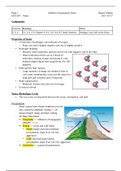
Page 1 Midterm Examination Notes Hassan Alibhai
EES A07 – Water 2017-10-17
Components
Lectures Readings Films
2, 3, 4 2.1, 2.2, 2.3, Chapter 3, 9.1, 9.2, 9.4, 9.5 (only Arsenic) Senegal, Last Call at the Oasis
Properties of Water
• 2 molecules of hydrogen, one molecule of oxygen
◦ Polar, one end is slightly negative and one is slightly positive
• Hydrogen bonding
◦ Between water molecules, positive end of one with negative end of the other
◦ Water molecules tend to act as a bunch of
molecules, making it larger and giving it a one
hundred degree liquid state range (from 0 to 100
degrees)
• High specific heat capacity
◦ Large amounts of energy are needed to heat or
cool water, meaning that it can stay the same for a
long time and variation takes a long time
• High vapourization
◦ Moderate climates stay that way for longer
• Universal solvent
Water (Hydrologic Cycle)
• The way water is transported between the ocean, atmosphere, and land
Precipitation
◦ Water vapour from clouds condenses to form
rain, caused by adiabatic cooling => air
masses heated, rising, and then cooling
◦ Air Mass Movement
▪ Orographic => influence of topography
(RIGHT ==>>)
▪ Frontal => warm and cold fronts
• Warm: longer and more moderate
precipitation, slope of air rise less
aggressive
• Cold: short and more intense
precipitation, slope of air rise very aggressive
▪ Convective => summer thunderstorms
,Page 2 Midterm Examination Notes Hassan Alibhai
EES A07 – Water 2017-10-17
Evapotranspiration
• The physical movement of water from a liquid to a gas form, from liquid water to gas or from
plants to water vapour (evaporation and transpiration grouped as one)
• Factors that affect evapotranspiration
◦ Surface area
◦ Wind
◦ Relative humidity (on top of water bodies, the air is very humid
and evaporation slows down)
• 90% of all water vapour originates from water bodies (evaporation)
• 10% of all water vapour originates from plants => evaporating from
leaves => (transpiration)
• Transpiration
◦ The movement of water through a plant: taken in from the roots, going through the plant
and hydrating it, and then evaporating through the leaves
◦ Roots take in water from the plants via osmosis, creating a high water potential, while the
evaporation that follows from the leaves creates a lower water potential (vascular tissue)
▪ Xylem, phloem, stomata => to obtain CO2, the plant needs to release water via stomata
◦ A large oak tree can release 150,000 liters of water via transpiration per year
, Page 3 Midterm Examination Notes Hassan Alibhai
EES A07 – Water 2017-10-17
Percolation and Groundwater
• Groundwater is the water found underground in the cracks and spaces in soil, sand and rock.
• There are two ways the water level in groundwater is maintained
◦ Diffuse recharge is the widespread movement of water from land surface to the water table
as a result of precipitation over large areas infiltrating and percolating (moving slowly)
through the unsaturated (or vadose) zone.
◦ Localized recharge refers to the movement of water from surface water bodies to the ground
water system and is less uniform in space than diffuse recharge
Deep Water Table Hydraulic Conductivity
=> never recharges, (Aquifer Porosity)
called fossil water => more gaps between
=> non-renewable sediment, more cracks
resource means high porosity!
Diffuse Vadose zone
recharge
Elevation of WT=
Hydraulic head
Groundwater
IMPERMEABLE
(TOP is unconfined aquifer)
Localized (BOT is confined aquifer)
recharge
Saturated zone
• When groundwater does reach a lake, it can cause localized recharge or discharge of the
groundwater onto the surface water, depending on elevation, causing two different streams
◦ An influent stream is positioned above the water table and discharges into the underlying
groundwater system (this is localized recharge)
◦ An effluent stream is positioned below the water table and water from the surface. It gains
water from inflow of groundwater through the stream-bed.
Influent => feeds groundwater Effluent => fed by groundwater
EES A07 – Water 2017-10-17
Components
Lectures Readings Films
2, 3, 4 2.1, 2.2, 2.3, Chapter 3, 9.1, 9.2, 9.4, 9.5 (only Arsenic) Senegal, Last Call at the Oasis
Properties of Water
• 2 molecules of hydrogen, one molecule of oxygen
◦ Polar, one end is slightly negative and one is slightly positive
• Hydrogen bonding
◦ Between water molecules, positive end of one with negative end of the other
◦ Water molecules tend to act as a bunch of
molecules, making it larger and giving it a one
hundred degree liquid state range (from 0 to 100
degrees)
• High specific heat capacity
◦ Large amounts of energy are needed to heat or
cool water, meaning that it can stay the same for a
long time and variation takes a long time
• High vapourization
◦ Moderate climates stay that way for longer
• Universal solvent
Water (Hydrologic Cycle)
• The way water is transported between the ocean, atmosphere, and land
Precipitation
◦ Water vapour from clouds condenses to form
rain, caused by adiabatic cooling => air
masses heated, rising, and then cooling
◦ Air Mass Movement
▪ Orographic => influence of topography
(RIGHT ==>>)
▪ Frontal => warm and cold fronts
• Warm: longer and more moderate
precipitation, slope of air rise less
aggressive
• Cold: short and more intense
precipitation, slope of air rise very aggressive
▪ Convective => summer thunderstorms
,Page 2 Midterm Examination Notes Hassan Alibhai
EES A07 – Water 2017-10-17
Evapotranspiration
• The physical movement of water from a liquid to a gas form, from liquid water to gas or from
plants to water vapour (evaporation and transpiration grouped as one)
• Factors that affect evapotranspiration
◦ Surface area
◦ Wind
◦ Relative humidity (on top of water bodies, the air is very humid
and evaporation slows down)
• 90% of all water vapour originates from water bodies (evaporation)
• 10% of all water vapour originates from plants => evaporating from
leaves => (transpiration)
• Transpiration
◦ The movement of water through a plant: taken in from the roots, going through the plant
and hydrating it, and then evaporating through the leaves
◦ Roots take in water from the plants via osmosis, creating a high water potential, while the
evaporation that follows from the leaves creates a lower water potential (vascular tissue)
▪ Xylem, phloem, stomata => to obtain CO2, the plant needs to release water via stomata
◦ A large oak tree can release 150,000 liters of water via transpiration per year
, Page 3 Midterm Examination Notes Hassan Alibhai
EES A07 – Water 2017-10-17
Percolation and Groundwater
• Groundwater is the water found underground in the cracks and spaces in soil, sand and rock.
• There are two ways the water level in groundwater is maintained
◦ Diffuse recharge is the widespread movement of water from land surface to the water table
as a result of precipitation over large areas infiltrating and percolating (moving slowly)
through the unsaturated (or vadose) zone.
◦ Localized recharge refers to the movement of water from surface water bodies to the ground
water system and is less uniform in space than diffuse recharge
Deep Water Table Hydraulic Conductivity
=> never recharges, (Aquifer Porosity)
called fossil water => more gaps between
=> non-renewable sediment, more cracks
resource means high porosity!
Diffuse Vadose zone
recharge
Elevation of WT=
Hydraulic head
Groundwater
IMPERMEABLE
(TOP is unconfined aquifer)
Localized (BOT is confined aquifer)
recharge
Saturated zone
• When groundwater does reach a lake, it can cause localized recharge or discharge of the
groundwater onto the surface water, depending on elevation, causing two different streams
◦ An influent stream is positioned above the water table and discharges into the underlying
groundwater system (this is localized recharge)
◦ An effluent stream is positioned below the water table and water from the surface. It gains
water from inflow of groundwater through the stream-bed.
Influent => feeds groundwater Effluent => fed by groundwater


