
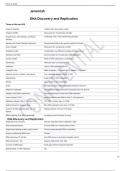
DNA Discovery and Replication Terms in this set (40) Friedrich Miescher Credited with discovering nuclein Frederick Griffith Discovered the 'Transforming Principle' Oswald Avery, Colin Macleod, and Maclyn McCarty Conducted work on the transforming
DNA Discovery and Replication Terms in this set (40) Friedrich Miescher Credited with discovering nuclein Frederick Griffith Discovered the 'Transforming Principle' Oswald Avery, Colin Macleod, and Maclyn McCarty Conducted work on the transforming principle Hershey and Chase's Blender Experiment Demonstrated DNA as the genetic material of viruses Erwin Chargaff Discovered the components of DNA Rosalind Franklin Contributed X-ray diffraction images of DNA structure Meselson and Stahl Demonstrated semi-conservative DNA replication Circular model Model of DNA replication in prokaryotes Telomerase Maintains linear chromosome ends Mutations Lead to DNA replication errors Chargaff's rules States % adenine = % thymine and % cytosine = % guanine Adenine, thymine, cytosine, and guanine Four nucleotide building blocks of DNA Deoxyribose Sugar found in DNA nucleotides Ribose Sugar found in RNA nucleotides Uracil Nitrogenous base in RNA nucleotides instead of thymine Dispersive replication Parent strands fragmented and incorporated into new strands Meselson and Stahl's experiment Demonstrated semi-conservative DNA replication Heavy nitrogen (15 N) Used by Meselson and Stahl in their E. coli experiment Difference between DNA in 15 N and 14 N 15 N DNA is heavier than 14 N DNA Sediment levels in ultracentrifuge 15 N DNA sediments lower than 14 N DNA Location of DNA sediment after one cell division Halfway between 15 N and 14 N levels DNA containing 14 N after subsequent Increasing amount contains 14 N only DNA Discovery and Replication Replication fork formation Helicase separates DNA at replication origin Role of topoisomerase Prevents DNA over-winding ahead of fork Single-strand binding proteins (ssb) function Prevent single-stranded DNA re-annealing Enzyme synthesizing RNA primer Primase DNA polymerase III function Uses RNA primer to synthesize daughter strand DNA polymerase I role Replaces RNA primer with DNA Function of DNA ligase Seals gaps between Okazaki fragments Bidirectionality of DNA replication Yes Direction of DNA synthesis 5' - 3' Origin binding proteins in replication Initiate unwinding of origin DNA DNA helicase role Unwinds DNA at replication fork Sliding clamp function Holds DNA pol III to template DNA DNA gyrase (topoisomerase) role Relieves strain ahead of the fork Telomerase role in chromosomes Maintains ends of linear chromosomes Mismatch repair process Detects and corrects replication errors Nucleotide excision repair Removes and replaces damaged nucleotides Thymine dimers in UV exposure Form covalently linked thymine dimers Mutations from uncorrected errors Changes in DNA sequence leading to mutations
Document information
- Uploaded on
- July 13, 2024
- Number of pages
- 2
- Written in
- 2023/2024
- Type
- Exam (elaborations)
- Contains
- Questions & answers


