

CHAPTER 5
- Motivation: the desire to achieve a goal or a certain performance level, leading to goal-
directed behaviour
- Ability: having the skills and knowledge required to perform the job is sometimes the key
determinant of effectiveness
- Environment: factors such as having the resources, information, and support one needs to
perform well are critical to determine performance
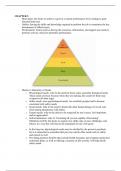
- Maslow’s Hierarchy of Needs
o Physiological needs: refer to the need for food, water, and other biological needs.
These needs are basic because when they are lacking, the search for them may
overpower all other urges
o Safety needs: once psychological needs. Are satisfied, people tend to become
concerned with safety needs
o Social needs: refer to the need to bond with other human beings, be loved, and
form lasting attachments with others
o Esteem needs: refer to the desire to be respected by one’s peers, feel important,
and be appreciated
o Self-actualization: refer to “becoming all you are capable of becoming”.
Manifests itself by the desire to acquire new skills, take on new challenges, and
behave in a way that will lead to the attainment of one’s life goals
o In the long run, physiological needs may be satisfied by the person’s paycheck,
but it is important to remember that pay may satisfy other needs such as safety
and esteem as well
o Providing generous benefits that include health insurance and company-sponsored
retirement plans, as well as offering a measure of job security, will help satisfy
safety needs
, o Social needs may be satisfied by having a friendly environment and providing a
workplace conducive to collaboration and communication with others
o Self-actualization needs may be satisfied by the provision of development and
growth opportunities on or off the job, as well as by work that is interesting and
challenging
- ERG Theory:
o Existence: corresponds to Maslow’s physiological and safety needs
o Relatedness: corresponds to social needs
o Growth: refers to Maslow’s esteem and self-actualization
o ERG theory does not rank needs in any particular order and explicitly recognizes
that more than one need may operate at a given time
- Two-Factor Theory:
o Hygiene factors: include company policies, supervision, working conditions,
salary, safety, and security on the job
o Motivators: factors that are intrinsic to the job, such as achievement, recognition,
interesting work, increased responsibilities, advancement, and growth
opportunities
- Acquired-Needs Theory:
o Thematic Apperception Test (TAT): entails presenting research subjects an
ambiguous picture asking them to write a story based on it
§ If the story you come up with contains themes of success, meeting
deadlines, or coming up with brilliant ideas, you may be high in need for
achievement. Those who have high need for achievement have a strong
need to be successful
§ If the story you created in relation to the picture you are analyzing
contains elements of making plans to be with friends or family, you may
have a high need for affiliation. Individuals who have a high need for
affiliation want to be liked and accepted by others. When given a choice,
they prefer to interact with others and be with friends
§ If your story contains elements of getting work done by influencing other
people or desiring to make an impact on the organization, you may have a
high need for power. Those with a high need for power want to influence
others and control their environment. A need for power may in fact be a
destructive element in relationships with colleagues if it takes the form of
seeking and using power for one’s own good and prestige
- Equity Theory:
o Individuals are motivated by a sense of fairness in their interactions. Moreover,
our sense of fairness is a result of the social comparisons we make. Specifically,
we compare our inputs and outcomes with other people’s inputs and outcomes.
We perceive fairness if we believe that the input-to-outcome ratio we are bringing
into the situation is similar to the input-to-outcome ratio of a comparison person,
or a referent
o Distributive Justice: the degree to which the outcomes received from the
organization are perceived to be fair
, o Procedural Justice: the degree to which fair decision-making procedures are used
to arrive at a decision
o Interactional Justice: the degree to which people are treated with respect,
kindness, and dignity in interpersonal interactions. We expect to be treated with
dignity by our peers, supervisors, and customers
- Expectancy Theory:
o Expectancy: whether the person believes that high levels of effort will lead to
outcomes of interest, such as performance or success
o Instrumentality: the degree to which the person believes that performance is
related to subsequent outcomes, such as rewards
o Valence: individuals are also concerned about the value of the rewards awaiting
them as a result of performance
- Reinforcement Theory:
o Behavior is a function of its outcomes
- Motivation: the desire to achieve a goal or a certain performance level, leading to goal-
directed behaviour
- Ability: having the skills and knowledge required to perform the job is sometimes the key
determinant of effectiveness
- Environment: factors such as having the resources, information, and support one needs to
perform well are critical to determine performance
- Maslow’s Hierarchy of Needs
o Physiological needs: refer to the need for food, water, and other biological needs.
These needs are basic because when they are lacking, the search for them may
overpower all other urges
o Safety needs: once psychological needs. Are satisfied, people tend to become
concerned with safety needs
o Social needs: refer to the need to bond with other human beings, be loved, and
form lasting attachments with others
o Esteem needs: refer to the desire to be respected by one’s peers, feel important,
and be appreciated
o Self-actualization: refer to “becoming all you are capable of becoming”.
Manifests itself by the desire to acquire new skills, take on new challenges, and
behave in a way that will lead to the attainment of one’s life goals
o In the long run, physiological needs may be satisfied by the person’s paycheck,
but it is important to remember that pay may satisfy other needs such as safety
and esteem as well
o Providing generous benefits that include health insurance and company-sponsored
retirement plans, as well as offering a measure of job security, will help satisfy
safety needs
, o Social needs may be satisfied by having a friendly environment and providing a
workplace conducive to collaboration and communication with others
o Self-actualization needs may be satisfied by the provision of development and
growth opportunities on or off the job, as well as by work that is interesting and
challenging
- ERG Theory:
o Existence: corresponds to Maslow’s physiological and safety needs
o Relatedness: corresponds to social needs
o Growth: refers to Maslow’s esteem and self-actualization
o ERG theory does not rank needs in any particular order and explicitly recognizes
that more than one need may operate at a given time
- Two-Factor Theory:
o Hygiene factors: include company policies, supervision, working conditions,
salary, safety, and security on the job
o Motivators: factors that are intrinsic to the job, such as achievement, recognition,
interesting work, increased responsibilities, advancement, and growth
opportunities
- Acquired-Needs Theory:
o Thematic Apperception Test (TAT): entails presenting research subjects an
ambiguous picture asking them to write a story based on it
§ If the story you come up with contains themes of success, meeting
deadlines, or coming up with brilliant ideas, you may be high in need for
achievement. Those who have high need for achievement have a strong
need to be successful
§ If the story you created in relation to the picture you are analyzing
contains elements of making plans to be with friends or family, you may
have a high need for affiliation. Individuals who have a high need for
affiliation want to be liked and accepted by others. When given a choice,
they prefer to interact with others and be with friends
§ If your story contains elements of getting work done by influencing other
people or desiring to make an impact on the organization, you may have a
high need for power. Those with a high need for power want to influence
others and control their environment. A need for power may in fact be a
destructive element in relationships with colleagues if it takes the form of
seeking and using power for one’s own good and prestige
- Equity Theory:
o Individuals are motivated by a sense of fairness in their interactions. Moreover,
our sense of fairness is a result of the social comparisons we make. Specifically,
we compare our inputs and outcomes with other people’s inputs and outcomes.
We perceive fairness if we believe that the input-to-outcome ratio we are bringing
into the situation is similar to the input-to-outcome ratio of a comparison person,
or a referent
o Distributive Justice: the degree to which the outcomes received from the
organization are perceived to be fair
, o Procedural Justice: the degree to which fair decision-making procedures are used
to arrive at a decision
o Interactional Justice: the degree to which people are treated with respect,
kindness, and dignity in interpersonal interactions. We expect to be treated with
dignity by our peers, supervisors, and customers
- Expectancy Theory:
o Expectancy: whether the person believes that high levels of effort will lead to
outcomes of interest, such as performance or success
o Instrumentality: the degree to which the person believes that performance is
related to subsequent outcomes, such as rewards
o Valence: individuals are also concerned about the value of the rewards awaiting
them as a result of performance
- Reinforcement Theory:
o Behavior is a function of its outcomes


