

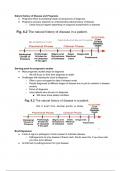
Natural history of Disease and Prognosis
● Prognosis refers to predicting health consequences of diagnosis
● Prognosis accuracy depends on understanding natural history of disease
○ Likely thing to happen depending on prognosis study(history is disease)
Starting point for prognostic studies
● Most prognostic studies begin at diagnosis
○ We will focus on time from diagnosis to death
● Challenges with starting the clock at diagnosis
○ Often a poor surrogate for date of disease onset
○ People diagnosed at different stages of disease due in part to variation in disease
severity
○ Errors of diagnosis
○ miss patients who die prior to diagnosis
■ Will never know patient condition
Brief Digression
● A test of signs is pathogenic if when present it indicates disease
○ Pathogenomic to lyme disease if there's rash. Doctor sees this, if you have rash,
you have lyme disease
● An EM rash is pathognomonic for lyme disease
, Question
EM rash appears in about 60%~80% of cases so if used as a diagnostic test for lyme disease
will have no more than 80%
1. Specificity
2. Sensitivity
3. Negative predictive value
4. Positive predictive value
ANS) 2)Given that you have rash, you have lyme disease, but only 80% detectible because it
only occurs to 80% of lyme has rash
Methods of Quantify Natural History of Disease
● Natural history of disease may be highly variable even for patients with identical
diagnosis
● There is no fixed time scale for prognoses
● Methods used to quantify natural history of disease must all be thought of as average
Case fatality(Rate)
𝑛𝑢𝑚𝑏𝑒𝑟 𝑜𝑓 𝑝𝑒𝑜𝑝𝑙𝑒 𝑤ℎ𝑜 𝑑𝑖𝑒 𝑓𝑟𝑜𝑚 𝑎 𝑑𝑖𝑠𝑒𝑎𝑠𝑒
● 𝐶𝑎𝑠𝑒 𝑓𝑎𝑡𝑎𝑙𝑖𝑡𝑦 = 𝑁𝑢𝑚𝑏𝑒𝑟 𝑜𝑓 𝑝𝑒𝑜𝑝𝑙𝑒 𝑤𝑖𝑡ℎ 𝑑𝑖𝑠𝑒𝑎𝑠𝑒
● Is proportion and not a true rate
○ Varies between zero and one
○ No units
● Implicit time frame
● Sometimes called a case-fatality ratio
● Optimal when death if it occurs, is relatively soon after diagnosis
SARS Case-fatality by Country November 1, 2002~July 31, 2003
Reasons for variation in case-fatality between countries
1. Difference in case reporting might miss less severe cases
2. Do not use a common case definition
3. Supportive care might not be consistent
4. Might SARS virus virulence vary?
5. Variation in health(or age)or people sick with SARS
6. Random variation
Case fatality and cause of death: Cholera
● Cholera case fatality is less than 1% for patients who receive prompt medical attention
● Death from cholera may occur very quickly
● Prognosis refers to predicting health consequences of diagnosis
● Prognosis accuracy depends on understanding natural history of disease
○ Likely thing to happen depending on prognosis study(history is disease)
Starting point for prognostic studies
● Most prognostic studies begin at diagnosis
○ We will focus on time from diagnosis to death
● Challenges with starting the clock at diagnosis
○ Often a poor surrogate for date of disease onset
○ People diagnosed at different stages of disease due in part to variation in disease
severity
○ Errors of diagnosis
○ miss patients who die prior to diagnosis
■ Will never know patient condition
Brief Digression
● A test of signs is pathogenic if when present it indicates disease
○ Pathogenomic to lyme disease if there's rash. Doctor sees this, if you have rash,
you have lyme disease
● An EM rash is pathognomonic for lyme disease
, Question
EM rash appears in about 60%~80% of cases so if used as a diagnostic test for lyme disease
will have no more than 80%
1. Specificity
2. Sensitivity
3. Negative predictive value
4. Positive predictive value
ANS) 2)Given that you have rash, you have lyme disease, but only 80% detectible because it
only occurs to 80% of lyme has rash
Methods of Quantify Natural History of Disease
● Natural history of disease may be highly variable even for patients with identical
diagnosis
● There is no fixed time scale for prognoses
● Methods used to quantify natural history of disease must all be thought of as average
Case fatality(Rate)
𝑛𝑢𝑚𝑏𝑒𝑟 𝑜𝑓 𝑝𝑒𝑜𝑝𝑙𝑒 𝑤ℎ𝑜 𝑑𝑖𝑒 𝑓𝑟𝑜𝑚 𝑎 𝑑𝑖𝑠𝑒𝑎𝑠𝑒
● 𝐶𝑎𝑠𝑒 𝑓𝑎𝑡𝑎𝑙𝑖𝑡𝑦 = 𝑁𝑢𝑚𝑏𝑒𝑟 𝑜𝑓 𝑝𝑒𝑜𝑝𝑙𝑒 𝑤𝑖𝑡ℎ 𝑑𝑖𝑠𝑒𝑎𝑠𝑒
● Is proportion and not a true rate
○ Varies between zero and one
○ No units
● Implicit time frame
● Sometimes called a case-fatality ratio
● Optimal when death if it occurs, is relatively soon after diagnosis
SARS Case-fatality by Country November 1, 2002~July 31, 2003
Reasons for variation in case-fatality between countries
1. Difference in case reporting might miss less severe cases
2. Do not use a common case definition
3. Supportive care might not be consistent
4. Might SARS virus virulence vary?
5. Variation in health(or age)or people sick with SARS
6. Random variation
Case fatality and cause of death: Cholera
● Cholera case fatality is less than 1% for patients who receive prompt medical attention
● Death from cholera may occur very quickly


