Ch. 1- Intro/ Speech Systems
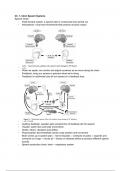
Speech Chain
- Feed forward system: a speech plan is constructed and carried out
- Articulations: vocal tract movements that produce acoustic output
-
- When we speak, we monitor and adjust ourselves as we move along the chain
- Feedback: using our senses to perceive what we’re doing
- Feedback is multimodal (use all our senses) in a feedback loop
-
- Auditory feedback: speaker gets constant flow of feedback abt his speech
- Visually: watch face and body movements
- Tactile: others’ vibrations and airflow
- Proprioception aka kinesthetic sense: body position and movement
- Brain comes up w speech plan→ nerve impulses→ contracts muscles→ expands and
contracts our lungs→ moves air→ blocks or releases airflow to produce different speech
sounds
- Speech production chain: brain→ respiratory system
, Building blocks of articulatory phonetics
- Midsagittal plane: divides a body down the middle into 2 halves
- Sinistrad: leftward
- Dextrad: rightward
- 2 axes of the sagittal plane are vertical and anterior-posterior
- Coronal slices body into anterior and posterior
- Axes: vertical and side to side
- Transverse cuts body into superior (top) and inferior (bottom)
- Cranial: direction of head
- Caudal: direction of tail
- Ventral: belly
- Dorsal: back
-
- Proximal areas: close to the trunk
- Distal areas: close to hands and feet
- Hard parts: bones and cartilages
- Muscles: can contract
- Striated muscles: combining the bone to which they attach
- Insertion: the part that moves most when muscles contract
- Agonist: produces main movement of an articulator
- Antagonist: pulls in the opposite direction (controls main movement)
- Other muscles are synergists
- Synergist: does not create movement. Lends stability by preventing other unwanted
motion
- Higher mechanical advantage: a muscle attached farther from a joint, greater muscle
strength, less speed, smaller range of motion
- Lower mechanical advantage is the opposite of all of that
Tools for articulatory phonetics
- Temporal resolution: how often an event happens
Speech Chain
- Feed forward system: a speech plan is constructed and carried out
- Articulations: vocal tract movements that produce acoustic output
-
- When we speak, we monitor and adjust ourselves as we move along the chain
- Feedback: using our senses to perceive what we’re doing
- Feedback is multimodal (use all our senses) in a feedback loop
-
- Auditory feedback: speaker gets constant flow of feedback abt his speech
- Visually: watch face and body movements
- Tactile: others’ vibrations and airflow
- Proprioception aka kinesthetic sense: body position and movement
- Brain comes up w speech plan→ nerve impulses→ contracts muscles→ expands and
contracts our lungs→ moves air→ blocks or releases airflow to produce different speech
sounds
- Speech production chain: brain→ respiratory system
, Building blocks of articulatory phonetics
- Midsagittal plane: divides a body down the middle into 2 halves
- Sinistrad: leftward
- Dextrad: rightward
- 2 axes of the sagittal plane are vertical and anterior-posterior
- Coronal slices body into anterior and posterior
- Axes: vertical and side to side
- Transverse cuts body into superior (top) and inferior (bottom)
- Cranial: direction of head
- Caudal: direction of tail
- Ventral: belly
- Dorsal: back
-
- Proximal areas: close to the trunk
- Distal areas: close to hands and feet
- Hard parts: bones and cartilages
- Muscles: can contract
- Striated muscles: combining the bone to which they attach
- Insertion: the part that moves most when muscles contract
- Agonist: produces main movement of an articulator
- Antagonist: pulls in the opposite direction (controls main movement)
- Other muscles are synergists
- Synergist: does not create movement. Lends stability by preventing other unwanted
motion
- Higher mechanical advantage: a muscle attached farther from a joint, greater muscle
strength, less speed, smaller range of motion
- Lower mechanical advantage is the opposite of all of that
Tools for articulatory phonetics
- Temporal resolution: how often an event happens