
According to Germ theory of disease:
1. All smell is disease
2. All people infected with a microorganisms will become ill
3. Infectious diseases are caused by humoral imbalance
4. Infectious diseases are caused by living microorganisms
Infectious vs Communicable disease
● Following Gordis, we use these terms as synonyms
● Distinction relevant for diseases caused by living organisms which cannot be transmitted
from person-to-person
○ Tetanus caused by Clostridium tetani
○ Infected through rust and iron, not person-person
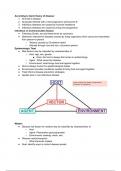
Epidemiologic Triad
● Risk factors may be classified by characteristics of
○ Host: age, sex, gender
■ Here, the host is always the human in epidemiology
○ Agent : What cause the disease
○ Environment: what brings host and agents together
● Host is always human for epidemiological strides
● Environment provides conditions needed to bring host and agent together
● Triad informs disease prevention strategies
● Applies also to non-infectious disease
Malaria
● Disease risk factors for malaria may be classified by characteristics of
○ Host
○ Agent: Plasmodium genus(parasite)
○ Environment: swampy, warm, wet
● Disease vector(mosquito)
○ What transmits malaria
● Goal: identify ways to control disease spread
, Epidemiologic triad: Malaria
● May control malaria by affecting one of
○ Host: vaccine, insecticides-treated bed nets
○ Agents: eliminate parasite
○ Environment: drain swamps
○ Vectors: release genetically modified mosquitoes
Modes of transmission
● Distinguish diseases by how they spread
● Disease outbreak(possibility, size) depend on
○ Mode of transmission of agent
○ Rate of growth in the population
○ Number of susceptible people in a population
● Outbreak of tetanus
○ Cant be spread person to person
○ Can control it by informing lifestyle, vaccine
1. All smell is disease
2. All people infected with a microorganisms will become ill
3. Infectious diseases are caused by humoral imbalance
4. Infectious diseases are caused by living microorganisms
Infectious vs Communicable disease
● Following Gordis, we use these terms as synonyms
● Distinction relevant for diseases caused by living organisms which cannot be transmitted
from person-to-person
○ Tetanus caused by Clostridium tetani
○ Infected through rust and iron, not person-person
Epidemiologic Triad
● Risk factors may be classified by characteristics of
○ Host: age, sex, gender
■ Here, the host is always the human in epidemiology
○ Agent : What cause the disease
○ Environment: what brings host and agents together
● Host is always human for epidemiological strides
● Environment provides conditions needed to bring host and agent together
● Triad informs disease prevention strategies
● Applies also to non-infectious disease
Malaria
● Disease risk factors for malaria may be classified by characteristics of
○ Host
○ Agent: Plasmodium genus(parasite)
○ Environment: swampy, warm, wet
● Disease vector(mosquito)
○ What transmits malaria
● Goal: identify ways to control disease spread
, Epidemiologic triad: Malaria
● May control malaria by affecting one of
○ Host: vaccine, insecticides-treated bed nets
○ Agents: eliminate parasite
○ Environment: drain swamps
○ Vectors: release genetically modified mosquitoes
Modes of transmission
● Distinguish diseases by how they spread
● Disease outbreak(possibility, size) depend on
○ Mode of transmission of agent
○ Rate of growth in the population
○ Number of susceptible people in a population
● Outbreak of tetanus
○ Cant be spread person to person
○ Can control it by informing lifestyle, vaccine


