

Costal Processes
Over 1 billion people live on coasts that are at risk from flooding.
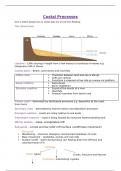
The Littoral zone:
Rocky
coastline – Cliffs varying in height from a few metres to hundreds of metres e.g.
Hangmans cliffs in Devon
Coastal plains – Beach, sand dunes and mud flats
Cliffed coast Transition between land and sea is abrupt
Cliffs are vertical
Foreshore is exposed at low tide as a wave-cut platform
Sandy coastline Sand dunes
Dune vegetation
Estuarine coastline Found at the mouth of a river
Mud flats
Gradual transition from land to sea
Primary coast – dominated by land-based processes e.g. deposition at the coast
from rivers
Secondary coast – dominated by marine erosion and deposition processes
Emergent coastline – coasts are rising relative to sea levels
Submergent coastline – coast is being flooded by rising sea levels/subsiding land
Marine erosion – steep, unvegetated cliff
Sub-aerial – curved and low relief cliff (surface runoff/mass movement)
Sub-aerial:
Weathering – chemical, biological, mechanical breakdown of rocks
Mass movement – landslides, slumps and rock falls
Surface runoff – water during heavy rain flowing down the cliff face and
causing erosion of it
Lithology
Clastic (glue) Cracks, fractures and fissures
Crystalline (interlocking crystals)
,Weathered
Calcite in Limestone
by solution
Igneous and metamorphic rocks
Quartz in sandstone
Dynamic equilibrium
Coastal plains Balance of inputs and outputs e.g.
deposition and erosion at same rate
Low-lying and low-relief
Wetlands and marshes
Deposition so coastal
accretion
Low energy environments
E.g. Atlantic Coastal Plain
USA
Strata – different layers of rock
Deformation – degree to which rocks have been deformed by tectonic activity
Faulting – presence of major faults
Discordant Coastline
Form where rock strata is perpendicular to the coastlines
Dominated by headlands and bays
Less-resistant rock is eroded to form bays
More-resistant geology remains as headlands protruding into the sea. E.g.
West Cork coast in Ireland
Wave refraction
In deep water, wave crests are parallel
Waves slow down + wave height increases as waves approach shallow
water
Wave crests refract, becoming curved, spreading out in bays +
concentrating on headlands
Overall effect is to concentrate powerful waves at headlands (greater
erosion and create lower, diverging wave crests in bays, reducing erosion
Holocene – geological era that begun ~12,000 years ago at the end of the last
Pleistocene era
Concordant Coastline
Rock strata runs parallel to coastline e.g. Dalmatian coast of Croatia
Folded by tectonic activity in a series of anticlines and synclines
Submerged – drowned by rising sea levels
Creation of narrow, long islands
arranged in lines offshore
, Lulworth in Dorset (limestone)
At Lulworth cove and Worbarrow Bay, marine erosion has broken through
the resistant beds, and then rapidly eroded the wide coves behind
Behind these coves is resistant chalk which prevents erosion further inland
Cliff Profiles
Rates of Erosion
Igneous e.g. granite, basalt, dolerite
Very slow erosion
Igneous rocks are crystalline – interlocking crystals make strong, hard,
erosion-resistant rocks
Often have few joints so limited weaknesses can be exploited
Metamorphic e.g. slate, marble
Slow erosion
Many metamorphic rocks exhibit a feature called foliation, where all
crystals are orientated in one
direction which promotes
weaknesses
Often folded and heavily fractures
Sedimentary e.g. sandstone,
limestone, shale
Moderate to fast erosion
Most are clastic and erode faster
than crystalline rocks
Geologically, younger rocks tend
to be weaker
Rocks with many bedding planes
and fractures are most vulnerable
to erosion
Over 1 billion people live on coasts that are at risk from flooding.
The Littoral zone:
Rocky
coastline – Cliffs varying in height from a few metres to hundreds of metres e.g.
Hangmans cliffs in Devon
Coastal plains – Beach, sand dunes and mud flats
Cliffed coast Transition between land and sea is abrupt
Cliffs are vertical
Foreshore is exposed at low tide as a wave-cut platform
Sandy coastline Sand dunes
Dune vegetation
Estuarine coastline Found at the mouth of a river
Mud flats
Gradual transition from land to sea
Primary coast – dominated by land-based processes e.g. deposition at the coast
from rivers
Secondary coast – dominated by marine erosion and deposition processes
Emergent coastline – coasts are rising relative to sea levels
Submergent coastline – coast is being flooded by rising sea levels/subsiding land
Marine erosion – steep, unvegetated cliff
Sub-aerial – curved and low relief cliff (surface runoff/mass movement)
Sub-aerial:
Weathering – chemical, biological, mechanical breakdown of rocks
Mass movement – landslides, slumps and rock falls
Surface runoff – water during heavy rain flowing down the cliff face and
causing erosion of it
Lithology
Clastic (glue) Cracks, fractures and fissures
Crystalline (interlocking crystals)
,Weathered
Calcite in Limestone
by solution
Igneous and metamorphic rocks
Quartz in sandstone
Dynamic equilibrium
Coastal plains Balance of inputs and outputs e.g.
deposition and erosion at same rate
Low-lying and low-relief
Wetlands and marshes
Deposition so coastal
accretion
Low energy environments
E.g. Atlantic Coastal Plain
USA
Strata – different layers of rock
Deformation – degree to which rocks have been deformed by tectonic activity
Faulting – presence of major faults
Discordant Coastline
Form where rock strata is perpendicular to the coastlines
Dominated by headlands and bays
Less-resistant rock is eroded to form bays
More-resistant geology remains as headlands protruding into the sea. E.g.
West Cork coast in Ireland
Wave refraction
In deep water, wave crests are parallel
Waves slow down + wave height increases as waves approach shallow
water
Wave crests refract, becoming curved, spreading out in bays +
concentrating on headlands
Overall effect is to concentrate powerful waves at headlands (greater
erosion and create lower, diverging wave crests in bays, reducing erosion
Holocene – geological era that begun ~12,000 years ago at the end of the last
Pleistocene era
Concordant Coastline
Rock strata runs parallel to coastline e.g. Dalmatian coast of Croatia
Folded by tectonic activity in a series of anticlines and synclines
Submerged – drowned by rising sea levels
Creation of narrow, long islands
arranged in lines offshore
, Lulworth in Dorset (limestone)
At Lulworth cove and Worbarrow Bay, marine erosion has broken through
the resistant beds, and then rapidly eroded the wide coves behind
Behind these coves is resistant chalk which prevents erosion further inland
Cliff Profiles
Rates of Erosion
Igneous e.g. granite, basalt, dolerite
Very slow erosion
Igneous rocks are crystalline – interlocking crystals make strong, hard,
erosion-resistant rocks
Often have few joints so limited weaknesses can be exploited
Metamorphic e.g. slate, marble
Slow erosion
Many metamorphic rocks exhibit a feature called foliation, where all
crystals are orientated in one
direction which promotes
weaknesses
Often folded and heavily fractures
Sedimentary e.g. sandstone,
limestone, shale
Moderate to fast erosion
Most are clastic and erode faster
than crystalline rocks
Geologically, younger rocks tend
to be weaker
Rocks with many bedding planes
and fractures are most vulnerable
to erosion


