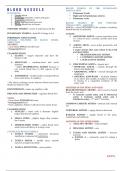
BLOOD VESSELS OF THE PULMONARY
BLOOD VESSELS CIRCULATION
FUNCTIONS: • Pulmonary Trunk
1. Carries blood • Right and Left pulmonary arteries
2. Exchanges nutrients, wastes and gases • Pulmonary veins
3. Transports substances
4. Helps regulate blood pressure BLOOD VESSELS OF THE SYSTEMIC
5. Directs blood flow to tissues CIRCULATION – ARTERIES
AORTA – where all arteries of the systemic circulation
SYSTEMIC VESSELS – from LV and back to the RA branch directly or indirectly
PULMONARY VESSELS – from RV to lungs to LA 3 PARTS:
1. ASCENDING AORTA – passes superiorly from
PERIPHERAL CIRCULATION LV; where R and L coronary arteries arise from
GENERAL FEATURES OF BLOOD VESSEL its base
STRUCTURE
ARTERIES 2. AORTIC ARCH – aorta arches posteriorly and
- carry blood AWAY from the heart to the left
- Oxygenated blood 3 major arteries that carry blood to the head
and upper limbs:
CLASSIFICATION:
• BRACHIOCEPHALIC ARTERY
1. ELASTIC – largest diameter and have the
thickest walls • L COMMON CAROTID ARTERY
• L SUBCLAVIAN ARTERY
2. MUSCULAR – medium-sized and small
diameter 3. DESCENDING AORTA – longest part
- called DISTRIBUTING ARTERY because it • THORACIC AORTA – extends through the
can control blood flow to diff. regions of the thorax and diaphragm
body • ABDOMINAL AORTA – extends through the
diaphragm
3. ARTERIOLES – smallest artery; transport blood • ARTERIAL ANEURYSM – localized dilation
from small artery to capillary of an artery that usually develops in response
to trauma or a congenital weakness of the
- Site where exchange occurs between blood and tissue artery wall
fluids; has thinner walls
ARTERIES OF THE HEAD AND NECK
ENDOTHELIUM – makes up capillary walls BRACHIOCEPHALIC ARTERY – first vessel to branch
from the aortic arch
PRECAPILLARY SPHINCTERS – regulates blood flow
• R Common carotid artery and R Subclavian
artery; L Common carotid artery and L
VEINS
Subclavian artery – 2nd and 3rd branches
- Carry blood TOWARD the heart
- Deoxygenated blood
COMMON CAROTID ARTERY – internal and external
- From capillaries; thinner walls & has less elastic tissue
CA
CLASSIFICATION:
VERTEBRAL ARTERY – supply blood to the brain
1. VENULES – tubes with a diameter slightly
larger than that of capillary
BASILAR ARTERY – supply blood to the pons,
cerebellum and midbrain
2. SMALL VEINS – slightly larger than venules;
has 3 tunics
ARTERIES OF THE UPPER LIMBS
1. AXILLARY ARTERY – axilla (armpit)
3. MEDIUM-SIZED VEINS – collect blood from
small veins and deliver it to large veins
2. BRACHIAL ARTERY – arm
3 TUNICS OF BLOOD VESSELS
3. ULNAR AND RADIAL ARTERY – forearm
1. TUNICA INTIMA – innermost; basement
and arm
membrane; composed of Endothelium
a. RADIAL A – commonly used for taking a
pulse
2. TUNICA MEDIA – middle layer; smooth
muscles arranged circularly
3. TUNICA ADVENTITIA – outer portion
ACPS.
BLOOD VESSELS CIRCULATION
FUNCTIONS: • Pulmonary Trunk
1. Carries blood • Right and Left pulmonary arteries
2. Exchanges nutrients, wastes and gases • Pulmonary veins
3. Transports substances
4. Helps regulate blood pressure BLOOD VESSELS OF THE SYSTEMIC
5. Directs blood flow to tissues CIRCULATION – ARTERIES
AORTA – where all arteries of the systemic circulation
SYSTEMIC VESSELS – from LV and back to the RA branch directly or indirectly
PULMONARY VESSELS – from RV to lungs to LA 3 PARTS:
1. ASCENDING AORTA – passes superiorly from
PERIPHERAL CIRCULATION LV; where R and L coronary arteries arise from
GENERAL FEATURES OF BLOOD VESSEL its base
STRUCTURE
ARTERIES 2. AORTIC ARCH – aorta arches posteriorly and
- carry blood AWAY from the heart to the left
- Oxygenated blood 3 major arteries that carry blood to the head
and upper limbs:
CLASSIFICATION:
• BRACHIOCEPHALIC ARTERY
1. ELASTIC – largest diameter and have the
thickest walls • L COMMON CAROTID ARTERY
• L SUBCLAVIAN ARTERY
2. MUSCULAR – medium-sized and small
diameter 3. DESCENDING AORTA – longest part
- called DISTRIBUTING ARTERY because it • THORACIC AORTA – extends through the
can control blood flow to diff. regions of the thorax and diaphragm
body • ABDOMINAL AORTA – extends through the
diaphragm
3. ARTERIOLES – smallest artery; transport blood • ARTERIAL ANEURYSM – localized dilation
from small artery to capillary of an artery that usually develops in response
to trauma or a congenital weakness of the
- Site where exchange occurs between blood and tissue artery wall
fluids; has thinner walls
ARTERIES OF THE HEAD AND NECK
ENDOTHELIUM – makes up capillary walls BRACHIOCEPHALIC ARTERY – first vessel to branch
from the aortic arch
PRECAPILLARY SPHINCTERS – regulates blood flow
• R Common carotid artery and R Subclavian
artery; L Common carotid artery and L
VEINS
Subclavian artery – 2nd and 3rd branches
- Carry blood TOWARD the heart
- Deoxygenated blood
COMMON CAROTID ARTERY – internal and external
- From capillaries; thinner walls & has less elastic tissue
CA
CLASSIFICATION:
VERTEBRAL ARTERY – supply blood to the brain
1. VENULES – tubes with a diameter slightly
larger than that of capillary
BASILAR ARTERY – supply blood to the pons,
cerebellum and midbrain
2. SMALL VEINS – slightly larger than venules;
has 3 tunics
ARTERIES OF THE UPPER LIMBS
1. AXILLARY ARTERY – axilla (armpit)
3. MEDIUM-SIZED VEINS – collect blood from
small veins and deliver it to large veins
2. BRACHIAL ARTERY – arm
3 TUNICS OF BLOOD VESSELS
3. ULNAR AND RADIAL ARTERY – forearm
1. TUNICA INTIMA – innermost; basement
and arm
membrane; composed of Endothelium
a. RADIAL A – commonly used for taking a
pulse
2. TUNICA MEDIA – middle layer; smooth
muscles arranged circularly
3. TUNICA ADVENTITIA – outer portion
ACPS.