Sample Exam Questions – MGEC71
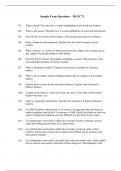
Q1. What is barter? Describe how it works highlighting its good and bad features.
Q2. What is fiat money? Describe how it works highlighting its good and bad features.
Q3. Describe the net social welfare impact of the introduction and use of cheques.
Q4. What is financial intermediation? Explain how this activity impacts social
welfare.
Q5. What is money (i.e. define it)? Many assets provide a higher rate of return, given
this explain why people bother to hold money.
Q6. Describe the key features that define something as money. Which feature is the
most important property of money? Explain.
Q7. What is the primary market? Explain and provide an example of a primary
market.
Q8. What is the secondary market? Explain and provide an example of a secondary
market.
Q9. Explain what is meant by the term direct finance. Explain what is meant by
indirect finance.
Q10. A dollar in the future is worth more than, the same, or less than a dollar today?
Explain why this is so.
Q11. What is asymmetric information? Describe the main ways it impacts financial
markets.
Q12. The PBS Frontline video posted on the course web page describes the financial
market meltdown that hit the US economy in 2008. Briefly describe how and why
some US financial institutions ran into difficulty (as described in this video).
Q13. Use mathematics and words to define the concept of yield to maturity, present
value and holding period return of a coupon bond.
Q14. Use mathematics and words to define the concepts of current yield, yield to
maturity and the rate of return for a coupon bond. Which one do investors care
most about? Explain.
Q15. Use mathematics and words to describe how a discount bond works. Name (label)
its key features and explain what each of these things are. What happens to the
, price of this bond if interest rates fall? Explain. What happens to the price of this
bond as time (measured on a calendar) approaches the maturity date? Explain.
Q16. If simple and fixed-payment loans are transferable then there can be a secondary
market. Suppose in response to the sale of bonds backed toxic mortgages the
government passes a law forcing lenders to keep all loans they make (originate).
While valuing/pricing such loans how might lenders respond to such a law?
Explain.
Q17. Use mathematics and words to describe how a coupon bond works. Name (label)
its key features and explain what each of these things are. What happens to the
price of this bond if interest rates fall? Explain. What happens to the price of this
bond as time (measured on a calendar) approaches the maturity date? Explain.
Q18. Use mathematics and words to define a bond’s current yield. How does this
compare to the bond’s yield to maturity. Describe if and when these two are
equal.
Q19. Recently the following advertisement for Ontario Savings Bonds appeared in the
press. Read it and then answer the questions that appear below it.
2009 Ontario Savings Bonds rates announced
New investment options include 2-year and 5-year Fixed-Rate Bonds
Monday, June 1, 2009
Ontario Savings Bonds are building blocks for Ontario. Your guaranteed investment
earns a competitive interest rate and at the same time helps support provincial
initiatives like health care for you and your neighbors, infrastructure and skills
training for our workers. So while you’re building your financial future, you’re also
helping build a stronger Ontario.
Ontario has announced interest rates for the 2009 issue of Ontario Savings Bonds
(OSBs), which go on sale Monday for the next three weeks.
Three different savings bond options are available.
STEP-UP RATE BOND
The competitive interest rate continues to rise with each year over it’s 5-year term.
You can redeem every six months.
The interest rates for the step-up rate bond are:
0.75% for the first year;
1.50% in the second year;
2.50% in the third year;
3.50% in the fourth year; and
4.50% in the final year.
VARIABLE-RATE BOND
Q1. What is barter? Describe how it works highlighting its good and bad features.
Q2. What is fiat money? Describe how it works highlighting its good and bad features.
Q3. Describe the net social welfare impact of the introduction and use of cheques.
Q4. What is financial intermediation? Explain how this activity impacts social
welfare.
Q5. What is money (i.e. define it)? Many assets provide a higher rate of return, given
this explain why people bother to hold money.
Q6. Describe the key features that define something as money. Which feature is the
most important property of money? Explain.
Q7. What is the primary market? Explain and provide an example of a primary
market.
Q8. What is the secondary market? Explain and provide an example of a secondary
market.
Q9. Explain what is meant by the term direct finance. Explain what is meant by
indirect finance.
Q10. A dollar in the future is worth more than, the same, or less than a dollar today?
Explain why this is so.
Q11. What is asymmetric information? Describe the main ways it impacts financial
markets.
Q12. The PBS Frontline video posted on the course web page describes the financial
market meltdown that hit the US economy in 2008. Briefly describe how and why
some US financial institutions ran into difficulty (as described in this video).
Q13. Use mathematics and words to define the concept of yield to maturity, present
value and holding period return of a coupon bond.
Q14. Use mathematics and words to define the concepts of current yield, yield to
maturity and the rate of return for a coupon bond. Which one do investors care
most about? Explain.
Q15. Use mathematics and words to describe how a discount bond works. Name (label)
its key features and explain what each of these things are. What happens to the
, price of this bond if interest rates fall? Explain. What happens to the price of this
bond as time (measured on a calendar) approaches the maturity date? Explain.
Q16. If simple and fixed-payment loans are transferable then there can be a secondary
market. Suppose in response to the sale of bonds backed toxic mortgages the
government passes a law forcing lenders to keep all loans they make (originate).
While valuing/pricing such loans how might lenders respond to such a law?
Explain.
Q17. Use mathematics and words to describe how a coupon bond works. Name (label)
its key features and explain what each of these things are. What happens to the
price of this bond if interest rates fall? Explain. What happens to the price of this
bond as time (measured on a calendar) approaches the maturity date? Explain.
Q18. Use mathematics and words to define a bond’s current yield. How does this
compare to the bond’s yield to maturity. Describe if and when these two are
equal.
Q19. Recently the following advertisement for Ontario Savings Bonds appeared in the
press. Read it and then answer the questions that appear below it.
2009 Ontario Savings Bonds rates announced
New investment options include 2-year and 5-year Fixed-Rate Bonds
Monday, June 1, 2009
Ontario Savings Bonds are building blocks for Ontario. Your guaranteed investment
earns a competitive interest rate and at the same time helps support provincial
initiatives like health care for you and your neighbors, infrastructure and skills
training for our workers. So while you’re building your financial future, you’re also
helping build a stronger Ontario.
Ontario has announced interest rates for the 2009 issue of Ontario Savings Bonds
(OSBs), which go on sale Monday for the next three weeks.
Three different savings bond options are available.
STEP-UP RATE BOND
The competitive interest rate continues to rise with each year over it’s 5-year term.
You can redeem every six months.
The interest rates for the step-up rate bond are:
0.75% for the first year;
1.50% in the second year;
2.50% in the third year;
3.50% in the fourth year; and
4.50% in the final year.
VARIABLE-RATE BOND