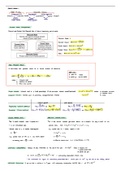
MGEC71 Sample Questions – Sketch Solutions (for full marks
additional detail may be required)
1. Explain in words how pricing a stock is similar to pricing a bond. Assume the stock is held for n
periods and then is sold AND does not pay any dividends. What kind of bond is this like? Hint:
You may write down the mathematics if this helps.
Solution
Deriving the price (called pricing or valuing) a unit of stock (in a corporation) is very much like pricing
(valuing) a bond. At any moment in time the value (price) is equal to the present discounted value of the
expected future cash flow derived using an appropriate discount rate. Of course key issues are:
- what do those cash flows consist of and how many periods do they occur over;
- since these monies are not certain what is their expected timing & size; and
- considering the riskiness and uncertainty surrounding this cash flow how to arrive at an
appropriate risk adjusted discount rate (to employ when doing our NPV).
If the stock pays no dividends and is held for n periods and then sold this is like pricing an n-period pure
discount bond.
Price of an n-period pure discount bond
Where: P = the bond price today = NPV of the future cash flow coming from the bond
F = Face value of the bond (i.e. how much it is worth when it matures)
i = (annualised) n-period discount rate = comparable n-period nominal rate of interest
n = number of periods/years (from now) until the bond matures (& F is paid)
Price of a unit of stock
Where: P0 = the price of the stock today = NPV of the future cash flow coming from the stock
Pn = the expected price of the stock n-periods from now (when you sell it)
ke = (annualised) n-period discount rate on equity (of this degree of riskiness)
n = number of periods/years (from now) until the stock is sold
2. Explain in words how pricing a stock is similar to pricing a bond. Assume the stock is held for n
periods and then is sold AND pays a dividend of $D per year. What kind of bond is this like? Hint:
You may write down the mathematics if this helps.
Solution
Pricing a unit of stock is like pricing a bond (see Q1 above).
1
, If the stock pays dividends of $D per year and is held for n periods and then sold this is like pricing an n-
period coupon discount bond.
Price of an n-period coupon bond
Where: P = the bond price today = NPV of the future cash flow coming from the bond
F = Face value of the bond (i.e. how much it is worth when it matures)
i = (annualised) n-period discount rate = comparable n-period nominal rate of interest
C = (annual) coupon payment
n = number of periods/years (from now) until the bond matures (& F is paid)
Price of a unit of dividend paying stock
Where: P0 = the price of the stock today = NPV of the future cash flow coming from the stock
Pn = the expected price of the stock n-periods from now (when you sell it)
ke = (annualised) n-period discount rate on equity (of this degree of riskiness)
D = (annual) dividend payment
n = number of periods/years (from now) until the stock is sold
3. Explain in words how pricing a stock is similar to pricing a bond. Assume the stock is held forever
AND pays a dividend of $D per year. What kind of bond is this like? Hint: You may write down
the mathematics if this helps.
Solution
Pricing a unit of stock is like pricing a bond (see Q1 above).
If the stock pays dividends of $D per year and is held forever (i.e. it is never sold) this is like pricing a
perpetual bond (i.e. a consol).
Price of a perpetual bond
Where: P = the bond price today = NPV of the future cash flow coming from the bond
i = (annualised) n-period discount rate = comparable n-period nominal rate of interest
C = (annual) coupon payment
Price of dividend paying stock
Where: P0 = the price of the stock today = NPV of the future cash flow coming from the stock
ke = (annualised) n-period discount rate on equity (of this degree of riskiness)
D = (annual) dividend payment
Note: This is the answer coming from the Gordon growth model with a dividend growth rate (g) of zero.
2
additional detail may be required)
1. Explain in words how pricing a stock is similar to pricing a bond. Assume the stock is held for n
periods and then is sold AND does not pay any dividends. What kind of bond is this like? Hint:
You may write down the mathematics if this helps.
Solution
Deriving the price (called pricing or valuing) a unit of stock (in a corporation) is very much like pricing
(valuing) a bond. At any moment in time the value (price) is equal to the present discounted value of the
expected future cash flow derived using an appropriate discount rate. Of course key issues are:
- what do those cash flows consist of and how many periods do they occur over;
- since these monies are not certain what is their expected timing & size; and
- considering the riskiness and uncertainty surrounding this cash flow how to arrive at an
appropriate risk adjusted discount rate (to employ when doing our NPV).
If the stock pays no dividends and is held for n periods and then sold this is like pricing an n-period pure
discount bond.
Price of an n-period pure discount bond
Where: P = the bond price today = NPV of the future cash flow coming from the bond
F = Face value of the bond (i.e. how much it is worth when it matures)
i = (annualised) n-period discount rate = comparable n-period nominal rate of interest
n = number of periods/years (from now) until the bond matures (& F is paid)
Price of a unit of stock
Where: P0 = the price of the stock today = NPV of the future cash flow coming from the stock
Pn = the expected price of the stock n-periods from now (when you sell it)
ke = (annualised) n-period discount rate on equity (of this degree of riskiness)
n = number of periods/years (from now) until the stock is sold
2. Explain in words how pricing a stock is similar to pricing a bond. Assume the stock is held for n
periods and then is sold AND pays a dividend of $D per year. What kind of bond is this like? Hint:
You may write down the mathematics if this helps.
Solution
Pricing a unit of stock is like pricing a bond (see Q1 above).
1
, If the stock pays dividends of $D per year and is held for n periods and then sold this is like pricing an n-
period coupon discount bond.
Price of an n-period coupon bond
Where: P = the bond price today = NPV of the future cash flow coming from the bond
F = Face value of the bond (i.e. how much it is worth when it matures)
i = (annualised) n-period discount rate = comparable n-period nominal rate of interest
C = (annual) coupon payment
n = number of periods/years (from now) until the bond matures (& F is paid)
Price of a unit of dividend paying stock
Where: P0 = the price of the stock today = NPV of the future cash flow coming from the stock
Pn = the expected price of the stock n-periods from now (when you sell it)
ke = (annualised) n-period discount rate on equity (of this degree of riskiness)
D = (annual) dividend payment
n = number of periods/years (from now) until the stock is sold
3. Explain in words how pricing a stock is similar to pricing a bond. Assume the stock is held forever
AND pays a dividend of $D per year. What kind of bond is this like? Hint: You may write down
the mathematics if this helps.
Solution
Pricing a unit of stock is like pricing a bond (see Q1 above).
If the stock pays dividends of $D per year and is held forever (i.e. it is never sold) this is like pricing a
perpetual bond (i.e. a consol).
Price of a perpetual bond
Where: P = the bond price today = NPV of the future cash flow coming from the bond
i = (annualised) n-period discount rate = comparable n-period nominal rate of interest
C = (annual) coupon payment
Price of dividend paying stock
Where: P0 = the price of the stock today = NPV of the future cash flow coming from the stock
ke = (annualised) n-period discount rate on equity (of this degree of riskiness)
D = (annual) dividend payment
Note: This is the answer coming from the Gordon growth model with a dividend growth rate (g) of zero.
2