, 2
UTSC: MGE C71 – SAMPLE EXAM: Solutions
Question 1. (15 Marks)
SOLUTION:
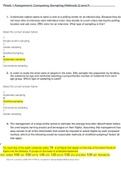
A) As covered in class the impacts of rising interest rates on bonds with different
maturities when all bonds are purchased at par are:
i) the only bond whose return equals the initial yield to maturity is one whose
time to maturity is the same as the holding period. (2 marks)
ii) a rise in interest rates is associated with a fall in bond prices, resulting in
capital losses on bonds whose terms to maturity are longer than the holding
period. (2 marks)
iii) the more distant a bond’s maturity, the greater the size of the percentage
price change associated with an interest-rate change. (2 marks)
iv) the more distant a bond’s maturity, the lower the rate of return that occurs as
a result of the increase in interest rate. (2 marks)
v) even though a bond has a substantial initial interest rate, its return can turn
out to be negative if interest rate rises (enough). (2 marks)
B) Most students are puzzled by the fact that a rise in interest rates can mean that a
bond has been a poor investment, it is important for them to recognize that a rise in
the interest rate means that the price of a bond has fallen and hence a capital loss,
which can be significant to make a bond poor investment. (3 marks)
C) There would be no change to the answer to part A if all bonds were purchased at a
discount rather than at par. (2 marks)
UTSC: MGE C71 – SAMPLE EXAM: Solutions
Question 1. (15 Marks)
SOLUTION:
A) As covered in class the impacts of rising interest rates on bonds with different
maturities when all bonds are purchased at par are:
i) the only bond whose return equals the initial yield to maturity is one whose
time to maturity is the same as the holding period. (2 marks)
ii) a rise in interest rates is associated with a fall in bond prices, resulting in
capital losses on bonds whose terms to maturity are longer than the holding
period. (2 marks)
iii) the more distant a bond’s maturity, the greater the size of the percentage
price change associated with an interest-rate change. (2 marks)
iv) the more distant a bond’s maturity, the lower the rate of return that occurs as
a result of the increase in interest rate. (2 marks)
v) even though a bond has a substantial initial interest rate, its return can turn
out to be negative if interest rate rises (enough). (2 marks)
B) Most students are puzzled by the fact that a rise in interest rates can mean that a
bond has been a poor investment, it is important for them to recognize that a rise in
the interest rate means that the price of a bond has fallen and hence a capital loss,
which can be significant to make a bond poor investment. (3 marks)
C) There would be no change to the answer to part A if all bonds were purchased at a
discount rather than at par. (2 marks)