
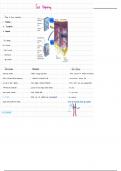
Cell Signaling
Stages of
Signal transduction
1 .
Reception
.
2 Transduction
3 .
Response
Cell Adhesion
Cell Junctions :
-
Light Junctions
desmosomes
gabjunctions
Tight Junctions Desmosomes Cap Junctions
adhere c re a t e for chemical and electrical
restricting movement
strongly to each other channels
made up of
protein that
pull membranes
tgt cadherins a re
important in des . communication between cells
can
dynamic h ave integral a l l ows ions (amino
:
open or close membrane attachment wa t e r ,
,
s m all molecules
watertight Seal :
between cells proteins that for m
bridges between proteins to pass
re s t r i c t passive movement inside adjacent cells in heart
your
bladder anchor
-
in
at
t wo
adjacent and
nontouching cells t wo c o n n exo n s
bladder than
*
cells are closer intestine animal cell communicate
through gap junctions A
ene
.
, Plasmodesmata
plants are connected
by this
travels membrane AND ce ll Walls
Cell
Signaling
molecular transmitted from outside of the to interior
siquals a re cell cell
· response to st i m u l i
factor Stimulates division
growth cell
Autocrine Paracrine Endrocrine
Signaling Signaling Signaling
signals bind to
receptors on same cell t h at secretes them
signals bind to receptors on
nearby cells re l e a s e of hormones that travel LONG DISTANCE
t u m or cells reproduce uncontrollably , respond to
signals
·
target / no
targel cell
through bloodstream to target organs
that st i m u late cell division
·
target cells
/
target targel cell
·
no
c o o rd i n a te b e h av i o u r of in dividu al cells
no dead
cell
signaling
:
signals :
ke e p cells a l i ve and
functioning
-regulates inter nal environment
st i m u l a te ce ll division and differentiation
, a l l ow cells to respond to in environment
changes the
cell
siqualining : all wo r k
tgt
external and internal environment at cellular level relies on
signal transduc tion
Mechanism
1 .
Reception :
cell detects a signaling molecule from the outside of the cell
↑
chemical
siqual ligand
:
signal is detected when
ligand binds to
receptor
receptor is on s u r fa c e of cell inside of the cell
* cell
respond to
signal
ONLY to a specific receptor proteins that can
bind to those
signals *
Ere
&
eptors
Receptors 1 Receptor ligand
Membrane .
binding
transmembrane protein .
2
Signal transduction
large/polar ligands that don't cross
bilayer 3 .
Cellular response
polar ligands bind to transmembrane receptors to transmit 4 .
Changes in
gene expression
into from ou t to inside cell
stimulates produc tion of 2nd signal
Stages of
Signal transduction
1 .
Reception
.
2 Transduction
3 .
Response
Cell Adhesion
Cell Junctions :
-
Light Junctions
desmosomes
gabjunctions
Tight Junctions Desmosomes Cap Junctions
adhere c re a t e for chemical and electrical
restricting movement
strongly to each other channels
made up of
protein that
pull membranes
tgt cadherins a re
important in des . communication between cells
can
dynamic h ave integral a l l ows ions (amino
:
open or close membrane attachment wa t e r ,
,
s m all molecules
watertight Seal :
between cells proteins that for m
bridges between proteins to pass
re s t r i c t passive movement inside adjacent cells in heart
your
bladder anchor
-
in
at
t wo
adjacent and
nontouching cells t wo c o n n exo n s
bladder than
*
cells are closer intestine animal cell communicate
through gap junctions A
ene
.
, Plasmodesmata
plants are connected
by this
travels membrane AND ce ll Walls
Cell
Signaling
molecular transmitted from outside of the to interior
siquals a re cell cell
· response to st i m u l i
factor Stimulates division
growth cell
Autocrine Paracrine Endrocrine
Signaling Signaling Signaling
signals bind to
receptors on same cell t h at secretes them
signals bind to receptors on
nearby cells re l e a s e of hormones that travel LONG DISTANCE
t u m or cells reproduce uncontrollably , respond to
signals
·
target / no
targel cell
through bloodstream to target organs
that st i m u late cell division
·
target cells
/
target targel cell
·
no
c o o rd i n a te b e h av i o u r of in dividu al cells
no dead
cell
signaling
:
signals :
ke e p cells a l i ve and
functioning
-regulates inter nal environment
st i m u l a te ce ll division and differentiation
, a l l ow cells to respond to in environment
changes the
cell
siqualining : all wo r k
tgt
external and internal environment at cellular level relies on
signal transduc tion
Mechanism
1 .
Reception :
cell detects a signaling molecule from the outside of the cell
↑
chemical
siqual ligand
:
signal is detected when
ligand binds to
receptor
receptor is on s u r fa c e of cell inside of the cell
* cell
respond to
signal
ONLY to a specific receptor proteins that can
bind to those
signals *
Ere
&
eptors
Receptors 1 Receptor ligand
Membrane .
binding
transmembrane protein .
2
Signal transduction
large/polar ligands that don't cross
bilayer 3 .
Cellular response
polar ligands bind to transmembrane receptors to transmit 4 .
Changes in
gene expression
into from ou t to inside cell
stimulates produc tion of 2nd signal


