
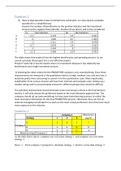
Question 1
b) Have to skip Question A due to limited time constraints, so I also need to complete
question B in a simplified way
Assume the number of beneficiaries as the positive indicator and the investment
amount as the negative flow indicator. Another three factors will not be considered
Po Normalization Ne Normalization
A 2.5 0.278 4.9 0.563
B 9 1.000 8.7 1.000
C 1 0.111 5.9 0.678
D 0.7 0.078 2.8 0.322
E 4 0.444 8 0.920
F 3.5 0.389 6.9 0.793
The table shows that project B has the highest beneficiaries and spending amount. So we
cannot conclude that project B is a cost-effective project.
Project F looks like it has the lowest return on investment because it has relatively low
beneficiaries and a high investment amount.
C) Selecting the ideal criteria for the PROMETHEE analysis is very overwhelming. Since three
improvements are measured in the qualitative metrics as high, medium, low, and very low, it
would be pretty time-consuming to convert it to the quantitative scale. Most importantly,
stakeholders from various streams will have their interests and evaluate scale. Setting up a
modest rating scale to accommodate everyone’s different perspectives would be difficult.
The potential improvement should eliminate some unnecessary criteria in the final decision
metrics. It will only choose the preference based on the most dominant approval rate. The
company should set up some workshops to have some brainstorming sessions to collect the
most necessary information for the final PROMETHEE process. Otherwise, they can hire an
external managing consulting firm to work on the most critical preference since they have much
more exposure to the industry.
Question 2
Company 2 Minimumm
Strategy 1 2 3 payoff
1 2 3 1 1
Company 1
2 1 4 0 0
3 3 -2 -1 -2
Maximum Payoff Company 2 3 4 1
As the table shows above, company one will select strategy 1, and company two will select
strategy 3.
Step 1.1 – From company 2 perspective, eliminate strategy 1, which is worse than strategy 2.
, Company 2 Minimumm
Strategy 1 2 3 payoff
1 2 3 1 1
Company 1
2 1 4 0 0
3 3 -2 -1 -2
Maximum Payoff Company 2 3 4 1
Step 1.2 – From company 1 perspective, eliminate strategy 3, which is worse than strategy 2.
Minimumm
Strategy 2 3 payoff
1 3 1 1
Company 1
2 4 0 0
3 -2 -1 -2
Maximum Payoff Company 2 4 1
Step 2.1 – From company 1 perspective, eliminate strategy 2, which is worse than strategy 3.
Minimumm
Strategy 2 3 payoff
1 3 1 1
Company 1
2 4 0 0
Maximum Payoff Company 2 4 1
Step 2.2 – From company 2 perspective, eliminate strategy 2, which is worse than strategy.
Minimumm
payoff
Strategy 3 Company 1
Company 1 1 1
1
2 0 0
Maximum Payoff Company 2 1
b) Have to skip Question A due to limited time constraints, so I also need to complete
question B in a simplified way
Assume the number of beneficiaries as the positive indicator and the investment
amount as the negative flow indicator. Another three factors will not be considered
Po Normalization Ne Normalization
A 2.5 0.278 4.9 0.563
B 9 1.000 8.7 1.000
C 1 0.111 5.9 0.678
D 0.7 0.078 2.8 0.322
E 4 0.444 8 0.920
F 3.5 0.389 6.9 0.793
The table shows that project B has the highest beneficiaries and spending amount. So we
cannot conclude that project B is a cost-effective project.
Project F looks like it has the lowest return on investment because it has relatively low
beneficiaries and a high investment amount.
C) Selecting the ideal criteria for the PROMETHEE analysis is very overwhelming. Since three
improvements are measured in the qualitative metrics as high, medium, low, and very low, it
would be pretty time-consuming to convert it to the quantitative scale. Most importantly,
stakeholders from various streams will have their interests and evaluate scale. Setting up a
modest rating scale to accommodate everyone’s different perspectives would be difficult.
The potential improvement should eliminate some unnecessary criteria in the final decision
metrics. It will only choose the preference based on the most dominant approval rate. The
company should set up some workshops to have some brainstorming sessions to collect the
most necessary information for the final PROMETHEE process. Otherwise, they can hire an
external managing consulting firm to work on the most critical preference since they have much
more exposure to the industry.
Question 2
Company 2 Minimumm
Strategy 1 2 3 payoff
1 2 3 1 1
Company 1
2 1 4 0 0
3 3 -2 -1 -2
Maximum Payoff Company 2 3 4 1
As the table shows above, company one will select strategy 1, and company two will select
strategy 3.
Step 1.1 – From company 2 perspective, eliminate strategy 1, which is worse than strategy 2.
, Company 2 Minimumm
Strategy 1 2 3 payoff
1 2 3 1 1
Company 1
2 1 4 0 0
3 3 -2 -1 -2
Maximum Payoff Company 2 3 4 1
Step 1.2 – From company 1 perspective, eliminate strategy 3, which is worse than strategy 2.
Minimumm
Strategy 2 3 payoff
1 3 1 1
Company 1
2 4 0 0
3 -2 -1 -2
Maximum Payoff Company 2 4 1
Step 2.1 – From company 1 perspective, eliminate strategy 2, which is worse than strategy 3.
Minimumm
Strategy 2 3 payoff
1 3 1 1
Company 1
2 4 0 0
Maximum Payoff Company 2 4 1
Step 2.2 – From company 2 perspective, eliminate strategy 2, which is worse than strategy.
Minimumm
payoff
Strategy 3 Company 1
Company 1 1 1
1
2 0 0
Maximum Payoff Company 2 1


