100% satisfaction guarantee Immediately available after payment Both online and in PDF No strings attached 4.2 TrustPilot
logo-home
Exam (elaborations)

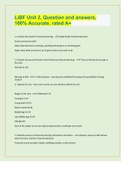
LiBF Unit 2, Question and answers, 100% Accurate, rated A+

Rating
-
Sold
-
Pages
12
Grade
A+
Uploaded on
21-02-2023
Written in
2022/2023

LiBF Unit 2, Question and answers, 100% Accurate, rated A+ 1.1 Outline the need for financial planning. - -Make better financial decisions Avoid unnecessary debt Help make decisions on savings, spending and progress in reaching goals Helps show what you have to do to get to where you want to be 1.2 Explain the personal factors which influence financial planning. - -Factors influenced by stage in life cycle Attitude to risk Attitude to Risk - -a. Risk tolerance - how does the individual feel about the possibility of losing money? b. Capacity for loss - how much money can the individual afford to lose? Stages in life cycle - -Childhood 0-12 Teenage 13-19 Young Adult 18-25 Mature Adult 26-40 Middle Age 41-54 Late Middle Age 55-65 Old Age 65+ Each of the stages has its own typical opportunities, challenges and needs. 1.3 Identify sources of financial planning information and advice. - -Advisory services (CAB, Money Advice Service, charities, financial advisers) Financial service providers (banks, building societies, credit unions) Citizens Advice Bureau - -Citizens Advice provides free, confidential and independent advice to help people make the right choices, including help to deal with debt problems, how to avoid losing their home and how to get their finances back into shape. Money Advice Service - -Free and impartial money advice, set up by government. Offers advice and guides to help improve finances. Tools and calculators to help keep track and plan ahead. Support over the phone and online The Money Charity - -empower people across the UK to build the skills, knowledge, attitudes and behaviours, to make the most of their money throughout their lives Financial Advisers - -Independent financial advisers (IFAs) must recommend products and solutions from the whole of the market Restricted advisers can offer products from one company or a limited number of companies Short-term planning - -a period of between one week and 12 months Medium-term planning - -a period of between one year and five years Long-term planning - -a period of five years or more a need - -something that we should - or must - have as part of our life e.g. food, shelter and clothes. a want - -something that a person would like or would aspire to, rather than something that they absolutely need e.g. the latest smartphone personal objectives - -what the individual needs or wants financial objectives - -how much money a person needs to achieve what they want and how best to get there Prudential Regulation Authority (PRU) - -the UK regulator responsible for making sure that financial firms are authorised to operate in the UK and are financially sound Financial Conduct Authority (FCA) - -the UK regulator responsible for the way in which financial firms market and sell their products Financial Services Compensation Scheme (FSCS) - -protects savers' money up to £85,000 per person 1.5 Describe the need to review and adjust financial plans linked to the various stages of the personal life cycle. - -Priorities change when moving from one stage of life cycle to another Anticipating foreseen and unforeseen events Emergency fund Plan should be fluid Emergency Fund - -a pot of money that can be used to cover emergencies, such as unexpected spending, loss of income or other unexpected financial problems Budgeting - -managing day-to-day money to pay bills, buy food, save and pay for other essential spending 2.2 Tools used to manage a personal financial budget - -bank statements; balances; online and telephone banking; keeping track of expenditure; cash flow forecasts Savings options - -deposit accounts, instant access, notice accounts, bonds, Sharia compliant, credit union, ISAs Corporate bonds - -similar to gilts, but the borrower would be a large company, rather than the government. Gilts - -The government issues gilts when it needs to borrow money, and promises to pay a guaranteed rate of interest each year and repay the money at the end of the term. Gilts usually have a fixed term of between 5 and 30 years and are usually bought by large organisations and investment companies Shares - -the shareholder actually owns a share in the company. Shares will go up or down in value, according to how investors and large financial organisations think the company is doing. Deposit - -cash in a savings account Bond - -a savings account that offers a fixed rate of interest for a fixed term Individual savings account (ISA) - -a tax-free savings and investment account Instant access - -a savings account that allows the saver to take out money as and when they need it Notice Account - -a restricted deposit account where you can only withdraw money after giving a notice period Savings interest - -money earned by putting money in a deposit account Personal savings allowance - -the amount of interest that someone can earn on their savings tax-free in a tax year Surplus - -When there is some money left in your account after paying all of your expenditure Shortfall - -When you don't have enough money in your account to cover the amount of all of your expenditure Deficit - -The amount of money that is overspent if expenditure is greater than income Balanced budget - -when expenditure equals the same amount in income 2.3 Calculate the impact of different interest rates on a budget. - -Fluctuation in costs Could result in surpluses and shortfalls Adjust budget accordingly Cash flow forecast - -a tool used to monitor and estimate the money flowing into and out of your bank account over a period of time Credit card - -a form of borrowing offered by banks, building societies and some specialist firms. It allows the cardholder to borrow money by paying for things using the credit card, but is generally the most expensive way to borrow, unless the balance is paid in full every month Mortgage - -a secured loan to help people buy houses or flats. They are offered mainly by banks and building societies and can last for up to 30 years Variable-rate mortgage - -where the interest rate changes whenever the lender changes its rate. It will usually change because the Bank of England base rate changes or because the lender decides to change it for commercial reasons Tracker mortgage - -a type of variable-rate mortgage, but this time the rate will only change if the Bank of England rate changes, because it follows (tracks) the base rate. The interest rate is usually set at a percentage above the base rate. Fixed-rate mortgage - -where the interest rate (and so the monthly payment) is fixed for a number of years - usually for two, three or five years. This is good for people who need to budget carefully, because they know exactly how much they will have to pay each month for a set period Personal loan - -offered by banks, building societies and some specialist firms. It is usually paid back over a much shorter term than a mortgage, and tends to be unsecured, so the providers charge higher interest rates to cover the risk Borrowing interest - -The charge for borrowing money from a financial provider 3.3 Outline the impact of personal spending on society - -Can stimulate economy Savings provide investment in economy Impacts of increased or reduced consumer spending 4.1 Compare the different channels for managing money. - -Paper statements Internet and telephone banking inclu

Show more Read less
Institution
LiBF
Course
LiBF


Whoops! We can’t load your doc right now. Try again or contact support.

Document information

Uploaded on
February 21, 2023
Number of pages
12
Written in
2022/2023
Type
Exam (elaborations)
Contains
Questions & answers

Subjects

Content preview

LiBF Unit 2, Question and answers,
100% Accurate, rated A+

1.1 Outline the need for financial planning. - ✔✔-Make better financial decisions

Avoid unnecessary debt

Help make decisions on savings, spending and progress in reaching goals

Helps show what you have to do to get to where you want to be


1.2 Explain the personal factors which influence financial planning. - ✔✔-Factors influenced by stage in
life cycle

Attitude to risk


Attitude to Risk - ✔✔-a. Risk tolerance - how does the individual feel about the possibility of losing
money?

b. Capacity for loss - how much money can the individual afford to lose?


Stages in life cycle - ✔✔-Childhood 0-12

Teenage 13-19

Young Adult 18-25

Mature Adult 26-40

Middle Age 41-54

Late Middle Age 55-65

Old Age 65+

Each of the stages has its own typical opportunities, challenges and needs.


1.3 Identify sources of financial planning information and advice. - ✔✔-Advisory services (CAB, Money
Advice Service, charities, financial advisers)

Financial service providers (banks, building societies, credit unions)

, Citizens Advice Bureau - ✔✔-Citizens Advice provides free, confidential and independent advice to help
people make the right choices, including help to deal with debt problems, how to avoid losing their
home and how to get their finances back into shape.


Money Advice Service - ✔✔-Free and impartial money advice, set up by government. Offers advice and
guides to help improve finances. Tools and calculators to help keep track and plan ahead. Support over
the phone and online


The Money Charity - ✔✔-empower people across the UK to build the skills, knowledge, attitudes and
behaviours, to make the most of their money throughout their lives


Financial Advisers - ✔✔-Independent financial advisers (IFAs) must recommend products and solutions
from the whole of the market


Restricted advisers can offer products from one

company or a limited number of companies


Short-term planning - ✔✔-a period of between one week and 12 months


Medium-term planning - ✔✔-a period of between one year and five years


Long-term planning - ✔✔-a period of five years or more


a need - ✔✔-something that we should - or must - have as part of our life e.g. food, shelter and clothes.


a want - ✔✔-something that a person would like or would aspire to, rather than something that they
absolutely need e.g. the latest smartphone


personal objectives - ✔✔-what the individual needs or wants

Get to know the seller

Seller avatar
Reputation scores are based on the amount of documents a seller has sold for a fee and the reviews they have received for those documents. There are three levels: Bronze, Silver and Gold. The better the reputation, the more your can rely on the quality of the sellers work.
QuickPass Chamberlain College Of Nursing
View profile
Follow You need to be logged in order to follow users or courses
Sold
410
Member since
3 year
Number of followers
304
Documents
6372
Last sold
1 month ago
Get all Documents you need at discount.

All nursing docs available: question banks, summaries, study guide and test banks

3.8

97 reviews

5
52
4
11
3
10
2
10
1
14

Recently viewed by you

Why students choose Stuvia

Created by fellow students, verified by reviews

Quality you can trust: written by students who passed their tests and reviewed by others who've used these notes.

Didn't get what you expected? Choose another document

No worries! You can instantly pick a different document that better fits what you're looking for.

Pay as you like, start learning right away

No subscription, no commitments. Pay the way you're used to via credit card and download your PDF document instantly.

Student with book image

“Bought, downloaded, and aced it. It really can be that simple.”

Alisha Student

Frequently asked questions