

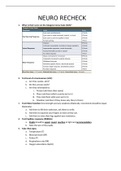
NEURO RECHECK
1. What is their score on the Glasgow Coma Scale (GCS)?
2. Test level of consciousness (LOC)
a. Are they awake, alert?
b. Do they arouse easily?
c. Are they orientated to:
i. Person (ask them their name)
ii. Place (ask them which country we’re in)
iii. Time (ask them what year we’re in)
iv. Situation (ask them if they know why they’re there)
3. Test Motor function (test strength and any weakness bilaterally, movements should be equal
bilaterally)
a. Ask them to lift their eyebrows, ask them to smile.
b. Ask them to squeeze your fingers as hard as they can.
c. Ask them to raise their legs against your resistance.
4. Test Pupillary response (PERRLA)
a. Pupils should be equal, round, reactive to light and accommodation.
b. Note the size of the pupils.
5. Take Vital signs.
a. Temperature (T)
b. Blood pressure (BP)
c. Pulses (P)
d. Respirations rate (RR)
e. Oxygen saturations (SpO2)
1. What is their score on the Glasgow Coma Scale (GCS)?
2. Test level of consciousness (LOC)
a. Are they awake, alert?
b. Do they arouse easily?
c. Are they orientated to:
i. Person (ask them their name)
ii. Place (ask them which country we’re in)
iii. Time (ask them what year we’re in)
iv. Situation (ask them if they know why they’re there)
3. Test Motor function (test strength and any weakness bilaterally, movements should be equal
bilaterally)
a. Ask them to lift their eyebrows, ask them to smile.
b. Ask them to squeeze your fingers as hard as they can.
c. Ask them to raise their legs against your resistance.
4. Test Pupillary response (PERRLA)
a. Pupils should be equal, round, reactive to light and accommodation.
b. Note the size of the pupils.
5. Take Vital signs.
a. Temperature (T)
b. Blood pressure (BP)
c. Pulses (P)
d. Respirations rate (RR)
e. Oxygen saturations (SpO2)


