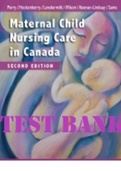
,Test Bank for Maternal Child Nursing Care in
Canada, 1e Shannon Perry, Marilyn Deitra,
Leonard David Wilson (All Chapters)
Chapter 01: Contemporary Perinatal Nursing in Canada
MULTIPLE CHOICE
1. Which medical risk factor contributes to a higher infant mortality rate?
a. Diabetes mellitus
b. Mitral valve prolapse (MVP)
c. Chronic hypertension
d. Anemia
ANS: C
Poor maternal health or chronic conditions such as hypertension are important contributors to
a high infant mortality rate. Although diabetes mellitus, MVP, and anemia are concerns in
pregnancy, they are not one of the most frequently reported maternal medical risk factors that
contribute to a higher infant mortality.
DIF: Cognitive Level: Knowledge REF: page 5 OBJ: 4
TOP: Nursing Process: Assessment MSC: CRNE: CH-7
2. Which woman would be most at risk for the poorest perinatal outcome?
a. A 25-year-old single mother on maternity leave with two existing children
b. An unemployed 32-year-old lawyer in an inner city neighbourhood
c. An Inuit woman in her mid-20s with no high school education
d. A 19-year-old college student who lives at home with her parents
ANS: C
Both the Canadian Perinatal Surveillance System (CPSS) and the Maternity Experiences
Survey note that poor women, Aboriginal women, and young women with less education
consistently have the poorest perinatal outcomes.
DIF: Cognitive Level: Analysis REF: page 3 OBJ: 4
TOP: Nursing Process: Assessment MSC: CRNE: CH-9
3. Which is the main characteristic of the evolved role of the professional perinatal nurse?
a. Providing care to patients directly at the bedside
b. Planning patient care to cover longer hospital stays
c. Leading the activities of a team of interdisciplinary health care providers
d. Managing care to cure health problems once they have occurred
ANS: C
, Professional nurses are part of the team of health and social care providers who
collaboratively care for perinatal patients and their families. Providing care to patients directly
at the bedside is one of a nurse’s tasks, but it does not encompass the concept of the evolved
professional nurse. Patient hospital stays are decreasing in length of time rather than
becoming longer stays. Nurses do not cure health problems; they work to promote well-being.
DIF: Cognitive Level: Knowledge REF: page 2 OBJ: 1
TOP: Nursing Process: Implementation MSC: CRNE: PP-9
4. Ms. Kiyawasew, a 23-year-old First Nations woman, is pregnant with her first child. Based on
the statistics for infant mortality, which intervention is most important for the nurse to
implement?
a. Perform a nutrition assessment.
b. Refer the woman to a social worker.
c. Advise the woman to see an obstetrician, not a midwife.
d. Explain to the woman the importance of keeping her prenatal care appointments.
ANS: D
Consistent prenatal care is the best method of preventing or controlling risk factors associated
with infant mortality. Nutritional status is an important modifiable risk factor, but it is not the
most important action a nurse should take in this situation. The patient may need assistance
from a social worker at some time during her pregnancy, but a referral to a social worker is
not the most important aspect the nurse should address at this time. If the woman has
identifiable high-risk problems, her health care may need to be provided by a physician.
However, it cannot be assumed that all First Nations women have high-risk issues. In
addition, advising the woman to see an obstetrician is not the most important aspect on which
the nurse should focus at this time.
DIF: Cognitive Level: Application REF: page 3 OBJ: 4
TOP: Nursing Process: Planning MSC: CRNE: CH-13
5. The nurse knows that teaching to promote healthy living has been effective when the patient
makes which comment?
a. “I’ll do whatever you say; you’re the nurse.”
b. “I don’t think I can quit smoking.”
c. “I exercise for 30 minutes, 3 days a week.”
d. “What do you think I should do?”
ANS: C
“I exercise for 30 minutes, 3 days a week” indicates the patient’s willing participation and
understanding of healthy living behaviours. Doing is different from comprehension. The goal
of teaching about healthy living is to make sure the patient understands the factors associated
with her care. Smoking cessation is only one behaviour associated with healthy living in
pregnancy. The patient’s question, “What do you think I should do?” indicates that she does
not understand what measures she can take to practice healthy living behaviours.
DIF: Cognitive Level: Application REF: page 12 OBJ: 5
TOP: Nursing Process: Evaluation MSC: CRNE: NCP-14
6. When managing health care for pregnant women at a prenatal clinic, which barrier to access
prenatal care is considered most significant?
, a. Age
b. Minority status
c. Educational level
d. Geographic location
ANS: D
The most significant barrier to health care access is geographic location. Inequities in access
to good quality prenatal care have developed particularly in rural, remote, inner city, and
Aboriginal communities. Although adolescent pregnant patients statistically receive less
prenatal care, age is not the most significant barrier. Significant disparities in morbidity and
mortality rates exist for minority women; however, minority status is not the most significant
barrier to access of care. Disparities in educational level are associated with morbidity and
mortality rates; however, educational level is not the most significant barrier to access of care.
DIF: Cognitive Level: Knowledge REF: page 3 OBJ: 1
TOP: Nursing Process: Assessment MSC: CRNE: HW-11
7. What is the primary role of practicing nurses in the research process?
a. Designing research studies
b. Collecting data for other researchers
c. Identifying areas for further research
d. Seeking funding to support research studies
ANS: C
The primary role of the practicing nurse is to identify areas for further research. When
problems are identified, research can be conducted properly. Research of health care issues
leads to evidence-informed practice guidelines. Designing research studies is only one factor
of the research process. Data collection is one factor of research. Financial support is
necessary to conduct research, but it is not the primary role of the nurse in the research
process.
DIF: Cognitive Level: Comprehension REF: pages 13-14 OBJ: 3
TOP: Nursing Process: Diagnosis | Nursing Process: Evaluation
MSC: CRNE: PP-14
8. Which event shifted the focus of the Public Health Agency of Canada (PHAC) away from a
population health and health promotion focus?
a. Shift to home births
b. Emergence of avian influenza
c. United Nations Millennium Goals
d. Increase in the maternal mortality rate
ANS: B
The emergence of the avian influenza shifted the focus of the PHAC from population health
and a health promotion focus to a focus on planning for a pandemic. There has been no shift
to home births from hospital births in Canada. The United Nations Millennium Goals did not
cause a focal shift for the PHAC. There has not been an increase in the maternal mortality
rate.
DIF: Cognitive Level: Comprehension REF: page 3 OBJ: 7
TOP: Nursing Process: Implementation MSC: CRNE: HW-16
Canada, 1e Shannon Perry, Marilyn Deitra,
Leonard David Wilson (All Chapters)
Chapter 01: Contemporary Perinatal Nursing in Canada
MULTIPLE CHOICE
1. Which medical risk factor contributes to a higher infant mortality rate?
a. Diabetes mellitus
b. Mitral valve prolapse (MVP)
c. Chronic hypertension
d. Anemia
ANS: C
Poor maternal health or chronic conditions such as hypertension are important contributors to
a high infant mortality rate. Although diabetes mellitus, MVP, and anemia are concerns in
pregnancy, they are not one of the most frequently reported maternal medical risk factors that
contribute to a higher infant mortality.
DIF: Cognitive Level: Knowledge REF: page 5 OBJ: 4
TOP: Nursing Process: Assessment MSC: CRNE: CH-7
2. Which woman would be most at risk for the poorest perinatal outcome?
a. A 25-year-old single mother on maternity leave with two existing children
b. An unemployed 32-year-old lawyer in an inner city neighbourhood
c. An Inuit woman in her mid-20s with no high school education
d. A 19-year-old college student who lives at home with her parents
ANS: C
Both the Canadian Perinatal Surveillance System (CPSS) and the Maternity Experiences
Survey note that poor women, Aboriginal women, and young women with less education
consistently have the poorest perinatal outcomes.
DIF: Cognitive Level: Analysis REF: page 3 OBJ: 4
TOP: Nursing Process: Assessment MSC: CRNE: CH-9
3. Which is the main characteristic of the evolved role of the professional perinatal nurse?
a. Providing care to patients directly at the bedside
b. Planning patient care to cover longer hospital stays
c. Leading the activities of a team of interdisciplinary health care providers
d. Managing care to cure health problems once they have occurred
ANS: C
, Professional nurses are part of the team of health and social care providers who
collaboratively care for perinatal patients and their families. Providing care to patients directly
at the bedside is one of a nurse’s tasks, but it does not encompass the concept of the evolved
professional nurse. Patient hospital stays are decreasing in length of time rather than
becoming longer stays. Nurses do not cure health problems; they work to promote well-being.
DIF: Cognitive Level: Knowledge REF: page 2 OBJ: 1
TOP: Nursing Process: Implementation MSC: CRNE: PP-9
4. Ms. Kiyawasew, a 23-year-old First Nations woman, is pregnant with her first child. Based on
the statistics for infant mortality, which intervention is most important for the nurse to
implement?
a. Perform a nutrition assessment.
b. Refer the woman to a social worker.
c. Advise the woman to see an obstetrician, not a midwife.
d. Explain to the woman the importance of keeping her prenatal care appointments.
ANS: D
Consistent prenatal care is the best method of preventing or controlling risk factors associated
with infant mortality. Nutritional status is an important modifiable risk factor, but it is not the
most important action a nurse should take in this situation. The patient may need assistance
from a social worker at some time during her pregnancy, but a referral to a social worker is
not the most important aspect the nurse should address at this time. If the woman has
identifiable high-risk problems, her health care may need to be provided by a physician.
However, it cannot be assumed that all First Nations women have high-risk issues. In
addition, advising the woman to see an obstetrician is not the most important aspect on which
the nurse should focus at this time.
DIF: Cognitive Level: Application REF: page 3 OBJ: 4
TOP: Nursing Process: Planning MSC: CRNE: CH-13
5. The nurse knows that teaching to promote healthy living has been effective when the patient
makes which comment?
a. “I’ll do whatever you say; you’re the nurse.”
b. “I don’t think I can quit smoking.”
c. “I exercise for 30 minutes, 3 days a week.”
d. “What do you think I should do?”
ANS: C
“I exercise for 30 minutes, 3 days a week” indicates the patient’s willing participation and
understanding of healthy living behaviours. Doing is different from comprehension. The goal
of teaching about healthy living is to make sure the patient understands the factors associated
with her care. Smoking cessation is only one behaviour associated with healthy living in
pregnancy. The patient’s question, “What do you think I should do?” indicates that she does
not understand what measures she can take to practice healthy living behaviours.
DIF: Cognitive Level: Application REF: page 12 OBJ: 5
TOP: Nursing Process: Evaluation MSC: CRNE: NCP-14
6. When managing health care for pregnant women at a prenatal clinic, which barrier to access
prenatal care is considered most significant?
, a. Age
b. Minority status
c. Educational level
d. Geographic location
ANS: D
The most significant barrier to health care access is geographic location. Inequities in access
to good quality prenatal care have developed particularly in rural, remote, inner city, and
Aboriginal communities. Although adolescent pregnant patients statistically receive less
prenatal care, age is not the most significant barrier. Significant disparities in morbidity and
mortality rates exist for minority women; however, minority status is not the most significant
barrier to access of care. Disparities in educational level are associated with morbidity and
mortality rates; however, educational level is not the most significant barrier to access of care.
DIF: Cognitive Level: Knowledge REF: page 3 OBJ: 1
TOP: Nursing Process: Assessment MSC: CRNE: HW-11
7. What is the primary role of practicing nurses in the research process?
a. Designing research studies
b. Collecting data for other researchers
c. Identifying areas for further research
d. Seeking funding to support research studies
ANS: C
The primary role of the practicing nurse is to identify areas for further research. When
problems are identified, research can be conducted properly. Research of health care issues
leads to evidence-informed practice guidelines. Designing research studies is only one factor
of the research process. Data collection is one factor of research. Financial support is
necessary to conduct research, but it is not the primary role of the nurse in the research
process.
DIF: Cognitive Level: Comprehension REF: pages 13-14 OBJ: 3
TOP: Nursing Process: Diagnosis | Nursing Process: Evaluation
MSC: CRNE: PP-14
8. Which event shifted the focus of the Public Health Agency of Canada (PHAC) away from a
population health and health promotion focus?
a. Shift to home births
b. Emergence of avian influenza
c. United Nations Millennium Goals
d. Increase in the maternal mortality rate
ANS: B
The emergence of the avian influenza shifted the focus of the PHAC from population health
and a health promotion focus to a focus on planning for a pandemic. There has been no shift
to home births from hospital births in Canada. The United Nations Millennium Goals did not
cause a focal shift for the PHAC. There has not been an increase in the maternal mortality
rate.
DIF: Cognitive Level: Comprehension REF: page 3 OBJ: 7
TOP: Nursing Process: Implementation MSC: CRNE: HW-16