

ACT A: Modelling Plan
I. Purpose of Report
The report will be modelling the projected population of Denpasar, the main city of Bali, Indonesia. Famously
referred to as the ‘island of the Gods’, Bali’s economy relies heavily on tourism. Subsequently, the Balinese
government has to accommodate for the large intake of tourists and expatriates each year, along with its
consequent resource consumption, and population growth due to incoming residents seeking employment
opportunities.
To the honourable members of the Council, utilising a model that forecasts the population is beneficial in
preemptively strategizing economic policies. Furthermore, forecasting population plays a significant role in
accounting for the demand for essential resources such as food, water, energy, and public services like health
care. With this in mind, it is encouraged that planners within the Balinese council use my population model for
reliable insights into future city planning.
II. Problem Statement
The multitude of interfering factors that affect population makes modelling a projected population challenging.
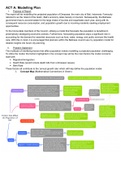
To refine the model, the factors highlighted in the concept map will be the main factors the model concerns
itself with:
➢ Migration/Immigration
➢ Death Rate (would include death tolls from unforeseen issues)
➢ Birth Rate
These factors all contribute to the ‘annual growth rate’ which will help define the population model.
i. Concept Map (Mathematical Connections in Green)
I. Purpose of Report
The report will be modelling the projected population of Denpasar, the main city of Bali, Indonesia. Famously
referred to as the ‘island of the Gods’, Bali’s economy relies heavily on tourism. Subsequently, the Balinese
government has to accommodate for the large intake of tourists and expatriates each year, along with its
consequent resource consumption, and population growth due to incoming residents seeking employment
opportunities.
To the honourable members of the Council, utilising a model that forecasts the population is beneficial in
preemptively strategizing economic policies. Furthermore, forecasting population plays a significant role in
accounting for the demand for essential resources such as food, water, energy, and public services like health
care. With this in mind, it is encouraged that planners within the Balinese council use my population model for
reliable insights into future city planning.
II. Problem Statement
The multitude of interfering factors that affect population makes modelling a projected population challenging.
To refine the model, the factors highlighted in the concept map will be the main factors the model concerns
itself with:
➢ Migration/Immigration
➢ Death Rate (would include death tolls from unforeseen issues)
➢ Birth Rate
These factors all contribute to the ‘annual growth rate’ which will help define the population model.
i. Concept Map (Mathematical Connections in Green)


