
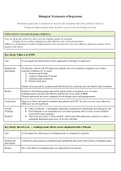
Biological Treatments of Depression
Biomedical approaches to treatment are based on the assumption that if the problem is based on
biological malfunctioning, drugs should be used to restore the biological system.
SSRIs (Selective Serotonin Reuptake Inhibitors)
They are drugs that selectively affect only the reuptake pumps for serotonin
- A change from an earlier antidepressant that affected a mix of neurotransmitters.
SSRIs are a development of earlier antidepressants as they are less toxic, have less addictive properties and have fewer
negative side effects.
Key Study: Elkin et al (1999)
Aim To investigate the effectiveness of three approaches to therapy for depression
Method and 28 clinicians worked with 250 depression patients who were randomly assigned to one of three
participants treatment conditions for 16 weeks.
1) Interpersonal therapy
2) Cognitive Behavioural Therapy
3) Antidepressant medication
4) Placebo medication
Patients were assessed by symptoms and life function by a clinician who was blind to their treatment.
Results Patients in all treatment groups showed an improvement in symptoms over 16 weeks.
Antidepressants were the most effective and best for severe cases of MDD
Placebos performed the worse compared to both therapy styles and antidepressants
Conclusions Drugs are a faster and superior treatment than placebo and CBT, but only in severe cases otherwise,
differences are not significant.
Critical ● Ethics of placebo → participants expecting a treatment but intentionally not being given one
Thinking ● Psychotherapy is not standardised so not cannot guarantee that everyone in that condition
received the same treatment
MAGEC ● There may have been a “third-variable” which caused the depression symptoms to reduce →
sometimes depression goes away on its own with time
Key Study: Kirsch et al. → Antidepressant effects can be duplicated with a Placebo
Aim To investigate the effectiveness of antidepressants in comparison to placebo
Method and Conducted a meta-analysis of published and unpublished data on the effectiveness of antidepressants
participants
Results 82% of the effect on antidepressants was duplicated by the placebo
, Critical ● In many clinically blind trials the clinicians and patients sometimes work out which condition
Thinking they have been assigned to causing experimenter bias and demand characteristics
● Antidepressants interfere with the brain’s natural self-regulation processes making an
MAGEC individual more vulnerable to depression in the future.
● Study shows that antidepressants should not be prescribed as much as they are
Study: Cusin - Pramipexole, a Dopamine Agonist
Related concept(s): Pramipexole is an exogenous antagonist that binds to dopamine receptors and mimics their action to
increase activity of dopamine systems
Aim Investigate the effectiveness of pramipexole as a dopamine agonist to treat depression symptoms linked
to low dopamine levels
Method and A randomised controlled trial with “treatment-resistant” participants (ie. SSRI’s didn’t improve their
participants symptoms). Participants took a pramipexole or placebo for 8 weeks.
Depression symptoms measured with MADRS scale before treatment and after 8 weeks.
Results There was a significant reduction in MDD symptoms in pramipexole conditions
Conclusions Increasing dopamine activity with agonist pramipexole may alleviate symptoms of depression by
returning pleasurable experiences
Critical ● What happens to depressed patients when they stop taking the agonist? They may be subject to
Thinking relapses and withdrawal symptoms
● Provides evidence for the role of dopamine in causing depression
MAGEC ● Practical application of agonists to treat issues caused by the low level of neurotransmitter: eg.
Parkinson's and depression


