

Written by students who passed Immediately available after payment Read online or as PDF Wrong document? Swap it for free 4.6 TrustPilot
logo-home
Document preview thumbnail
Preview 3 out of 16 pages
Exam (elaborations)

NURS 6512C-24 Week 11 Final Exam (100 out of 100 Points; Summer QTR)

Document preview thumbnail
Preview 3 out of 16 pages

1. Question: A cervical polyp usually appears as a: 2. Question: During chest assessment, you note the patient’s voice quality while auscultating the lung fields. The voice sound is intensified, there is a nasal quality to the voice, and the e’s sound like a’s. This sound is indicative of: 3. Question: A common finding in markedly obese and pregnant women is: 4. Question: Tarry black stool should make you suspect: 5. Question: If your patient has nipple discharge, you will most likely need a: 6. Question: Inspection of the scrotum should reveal: 7. Question: Throughout the history and physical examination, the clinician should: 8. Question: The family history for a patient with joint pain should include information about siblings with: 9. Question: The adnexa of the uterus are composed of the: 10. Question: Darian is a 14-year-old adolescent who states his right testicle has a soft swollen mass. The testicle is not painful upon palpation. The right in guinal canal is without masses. The mass does transilluminate with a penlight. This collection of symptoms is consistent with: 11. Question: Kawasaki disease is suspected when assessments of a child reveal: 12. Question: When palpating breast tissue, the examiner should use the at each site. 13. Question: Functional assessment is most important during the examination of a(n): 14. Question: Adrian Thompson is a 19-year-old girl who presents to the clinic with complaints of severe, acute chest pain. Her mother reports that Andrian, apart from occasional sinus infections, Andrian is not prone to respiratory problems. What potential risk factor is most important to assess with regards to Adrian's current problem? 15. Question: An examiner has rotated a brush several times into the cervical os. The brush was withdrawn and stroked lightly on a glass slide. The slide was sprayed with fixative. Which type of specimen requires this technique for collection? 16. Question: You are initially evaluating the equilibrium of Ms. Q. You ask her to stand with her feet together and arms at her sides. She loses her balance. Ms. Q. has a positive: 17. Question: Which one of the following is a proper technique for use of a speculum during a vaginal examination? 18. Question: Your older clinic patient is being seen today as a follow-up for a 2-day history of pneumonia. The patient continues to have a productive cough, shortness of breath, and lethargy and has been spending most of the day lying in bed. You should begin the chest examination by: 19. Question: Recent unilateral inversion of a previously everted nipple suggests: 20. Question: The finger-to-nose test allows assessment of: 21. Question: Your 15-year-old patient is athletic and thin. Radio graphy of an ankle injury reveals a stress fracture. You should question this patient about her: 22. Question: Which condition is considered progressive rather than reversible? 23. Question: The rectal past medical history of all patients should include inquiry about: 24. Question: Your patient's chief complaint is repeated pencil-like stools. Further examination should include: 25. Question: Examination of the patient in the lithotomy, or knee-chest, position includes: 26. Question: The physical assessment technique most frequently used to assess joint symmetry is: 27. Question: In the most effective percussion technique of the posterior lung fields, the patient cooperates by: 28. Question: While examining a 30-year-old woman, you note that one breast is slightly larger than the other. In response to this finding, you should: 29. Question: The reliability of health-related findings and observations is the responsibility of the: 30. Question: Loss of immediate and recent memory with retention of remote memory suggests: 31. Question: To assess a cremasteric reflex, the examiner strokes the: 32. Question: When assessing superficial pain, touch, vibration, and position perceptions, you are testing: 33. Question: Which one of the following techniques is used to detect a torn meniscus? 34. Question: To spread the breast tissue evenly over the chest wall, you should ask the woman to lie supine with: 35. Question: An ophthalmoscopic eye examination involves: 36. Question: If a patient cannot shrug the shoulders against resistance, which cranial nerve (CN) requires further evaluation? 37. Question: You are conducting a clinical breast examination for your 30-year-old patient. Her breasts are symmetrical with bilateral, multiple tender masses that are freely moveable with well-defined borders. You recognize that these symptoms and assessment findings are consistent with: 38. Question: The Mini-Mental State Examination: 39. Question: Diabetic peripheral neuropathy will likely produce: 40. Question: Inquiry about nocturnal muscles pasms would be most significant when taking the musculoskeletal history of: 41. Question: When is the mental status portion of the neurologic system examination performed? 42. Question: The goals of pre participation sports evaluation include: 43. Question: You are examining Mr. S., a79-year-old diabetic man complaining of claudication. Which of the following physical findings is consistent with the diagnosis of arterial occlusion? 44. Question: The Denver II is a tool used to determine: 45. Question: When palpating joints, crepitus may occur when: 46. Question: The musculoskeletal examination should begin when: 47. Question: For purposes of examination and communication of physical findings, the breast is divided into: 48. Question: You are conducting an examination of Mr. Curtis's heart and blood vessels and auscultate a grade III murmur. The intensity of this murmur is: 49. Question: The spread of the impulse through the ventricles (ventricular depolarization) is depicted on the ECG as the: 50. Question: A patient you are seeing in the emergency department for chest pain is suspected of having amyocardial infarction. During the health history interview of his family history, here latest hat his father had died of "heart trouble."The most important follow-up question you should pose is which of the following? 51. Question: When assessing a 17-year-old for nuchalrigidity, you gently raise his head off the examination table. He involuntarily flexes his hips and knees. To confirm our suspicions associated with this positive test, you would also perform a test for the 52. Question: The examiner percusses for diaphragmatic excursion along the: 53. Question: The examiner percusses for diaphragmatic excursion along the: 54. Question: Ulnar deviation and boutonniere deformities are characteristic of: 55. Question: A pulsation that is diminished to the point of being barely palpable would be graded as: 56. Question: A finding that is indicative of osteoarthritis is: 57. Question: A patient in the deepest coma would be scored a on the Glasgow Coma Scale. 58. Question: Facial muscle or tongue weakness may result in: 59. Question: The best way to ease the apprehension of a 3-year-old child before a physical examination is to: 60. Question: The presence of cervical motion tenderness may indicate: 61. Question: During a routine prenatal visit, Ms. T. was noted a shaving dependent edema, varicosities of the legs, and hemorrhoids. She expressed concern about these symptoms. You explain to Ms. T. that her enlarged uterus is compressing her pelvic veins and her inferior venacava. You would further explain that these findings: 62. Question: The difference in blood pressure readings between the right and the left arms is considered normal upto 63. Question: Breath odorsmay clue the examiner to certain under lying meta bolic conditions. The odor of ammonia on the breath may signify: 64. Question: Post ural hypo tension is defined as a when the patient stands, compared with sitting or supine readings. 65. Question: Palpation of a normal prostate in an older adult is likely to feel: 66. Question: An apical PMI palpated beyond the left fifth intercostal space may indicate: 67. Question: It is especially important to test for ankle clonus if: 68. Question: Whileinterviewinga70-year-oldfemaleclinicpatient, she tells you that she takes gink gobilob a and St. John's wort. You make a short note to check for results of the: 69. Question: A grade IV mitral regurgitation murmur would: 70. Question: Normal changes of the aging brain include: 71. Question: Cranial nerve XII may be assessed in an infant by: 72. Question: A red, hot swollen joint in a 40-year-old man should lead you to suspect: 73. Question: Assessing orientation to person, place, and time helps determine: 74. Question: Adrian Thomas is a 19-year-old girl who presents to the clinic with complaints of severe, acute chest pain. Her father reports that Adrian, apart from occasional sinus infections, Adrian is not prone to respiratory problems. What potential risk factor is most important to assess with regards to Adrian's current problem? 75. Question: Breath sounds normally heard over the trachea are called: 76. Question: Montgomery tubercles are most prominent in the breasts of: 77. Question: If pitting edema is unilateral, you would suspect occlusion of a: 78. Question: You are examining a patient in the emergency department who has recently sustained head trauma. In order to initially assess this patient's neurologic status, you would: 79. Question: To assess spinal levels L2, L3, and L4, which deep tendon reflex should be tested? 80. Question: Which of the following statements is true regarding the examination of peripheral arteries? 81. Question: To hear diastolic heart sounds, you should ask patients to: 82. Question: You are conducting a pre participation physical examination for a 10-year-old girl with Down syndrome who will be playing basketball. She has slight torticollis and mild ankle clonus. What additional diagnostic testing would be required for her? 83. Question: The fore skin is tight and cannot be easily retracted. You should: 84. Question: In the adult, the apical impulse should be most visible when the patient is in what position? 85. Question: When you attempt to move a 10-month-old child from his mother's lap to the examination table, he screams loudly. Your best action is to: 86. Question: The strength of the trapezius muscle is evaluated by having the patient: 87. Question: Bimanual examination of the uterus includes: 88. Question: Anterior cruciate ligament integrity is assessed via the 89. Question: The for a men ovale should close: 90. Question: The checkout station for pre participation physical evaluation (PPE) is critical because at this point: 91. Question: You are interviewing a 20-year-old patient with a new-onset psychotic disorder. The patient is a pathetic and has disturbed thoughts and language patterns. The nurse recognizes this behavior pattern as consistent with a diagnosis of: 92. Question: Part of the screening orthopedic component of the examination includes evaluating the person while he or she is: 93. Question: A positive straight leg raise test usually indicates: 94. Question: The Mini-Mental State Examination should be administered for the patient who: 95. Question: When the Good enough-Harris Drawing Test is administered to a child, the evaluator principally observes the: 96. Question: Palpation of epitrochlear nodes is part of the: 97. Question: You are performing a two-point discrimination test as part of a well physical examination. Theare a with the ability to discern two points in the shortest distance is the: 98. Question: An idiopathic spasm of arterioles in the digits is termed: 99. Question: You are assessing Mr. Z.'s fluid volume status as a result of heart failure. If your finger depresses a patient's edematousankleto a depth of 6mm, you should record this pitting as: 100. Question: Electrical activity recorded by the electro cardiogram (ECG) tracing that deno test he spread of the stimulus through the atria is the: 101. Question: When completing this exam, did you comply with Walden University's Code of Conduct including the expectations for academic integrity?

Content preview

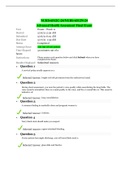
NURS-6512C-24/NURS-6512N-24
Advanced Health Assessment Final Exam
Test Exam - Week 11
Started 5/16/21 5:29 AM
Submitted 5/16/21 6:19 AM
Due Date 5/17/21 1:59 AM
Status Completed
Attempt Score 100 out of 100 points
Time Elapsed 50 minutes out of 2
hours
Instructions Please answer each question below and click Submit when you have
completed the Exam.
Results Displayed Submitted Answers
 Question 1
A cervical polyp usually appears as a:


Selected Answer: bright-red soft protrusion from the endocervical canal.
 Question 2
During chest assessment, you note the patient’s voice quality while auscultating the lung fields. The
voice sound is intensified, there is a nasal quality to the voice, and the e’s sound like a’s. This sound is
indicative of:

Selected Answer: lung consolidation.
 Question 3
A common finding in markedly obese and pregnant women is:


Selected Answer: lordosis.
 Question 4
Tarry black stool should make you suspect:


Selected Answer: upper intestinal bleeding.
 Question 5
If your patient has nipple discharge, you will most likely need a:


Selected Answer: glass slide and fixative.

,  Question 6
Inspection of the scrotum should reveal:


Selected Answer: left scrotal sac lower than the right.
 Question 7
Throughout the history and physical examination, the clinician should:


 Question 8
Selected Answer: evaluate the whole patient.
The family history for a patient with joint pain should include information about siblings with:


 Question 9
Selected Answer: genetic disorders.
The adnexa of the uterus are composed of the:


 Question 10
Selected Answer: fallopian tubes and ovaries.
Darian is a 14-year-old adolescent who states his right testicle has a soft swollen mass. The testicle is
not painful upon palpation. The right inguinal canal is without masses. The mass does
transilluminate with a penlight. This collection of symptoms is consistent with:


Selected Answer: hydrocele
 Question 11
Kawasaki disease is suspected when assessments of a child reveal:


Selected Answer: conjunctival injection, strawberry tongue, and edema of the hands and feet.
 Question 12
When palpating breast tissue, the examiner should use the at each site.


Selected Answer: finger pads, gliding
 Question 13
Functional assessment is most important during the examination of a(n):


Selected Answer: Adolescent

,  Question 14
Adrian Thompson is a 19-year-old girl who presents to the clinic with complaints of severe, acute chest
pain. Her mother reports that Andrian, apart from occasional sinus infections, Andrian is not prone to
respiratory problems. What potential risk factor is most important to assess with regards to
Adrian's current problem?


Selected Answer: Cocaine use
 Question 15
An examiner has rotated a brush several times into the cervical os. The brush was withdrawn and
stroked lightly on a glass slide. The slide was sprayed with fixative. Which type of specimen requires
this technique for collection?


Selected Answer: Cytology smear
 Question 16
You are initially evaluating the equilibrium of Ms. Q. You ask her to stand with her feet together
and arms at her sides. She loses her balance. Ms. Q. has a positive:


Selected Answer: Romberg sign.
 Question 17
Which one of the following is a proper technique for use of a speculum during a vaginal examination?


Selected Answer: Press introitus downward; insert closed speculum obliquely.
 Question 18
Your older clinic patient is being seen today as a follow-up for a 2-day history of pneumonia. The
patient continues to have a productive cough, shortness of breath, and lethargy and has been
spending most of the day lying in bed. You should begin the chest examination by:


Selected Answer: auscultating the lung bases.
 Question 19
Recent unilateral inversion of a previously everted nipple suggests:


Selected Answer: cancer.
 Question 20
The finger-to-nose test allows assessment of:


Selected Answer: coordination and fine motor function.

Document information

Study
Unknown
Uploaded on
May 2, 2022
Number of pages
16
Written in
2021/2022
Type
Exam (elaborations)
Contains
Questions & answers
CA$57.09

Wrong document? Swap it for free Within 14 days of purchase and before downloading, you can choose a different document. You can simply spend the amount again.
Written by students who passed
Immediately available after payment
Read online or as PDF

Seller avatar
Reputation scores are based on the amount of documents a seller has sold for a fee and the reviews they have received for those documents. There are three levels: Bronze, Silver and Gold. The better the reputation, the more your can rely on the quality of the sellers work.
studyguider55
3.9
(122)
Sold
455
Followers
313
Items
1565
Last sold
2 months ago


Why students choose Stuvia

Created by fellow students, verified by reviews

Quality you can trust: written by students who passed their tests and reviewed by others who've used these notes.

Didn't get what you expected? Choose another document

No worries! You can instantly pick a different document that better fits what you're looking for.

Pay as you like, start learning right away

No subscription, no commitments. Pay the way you're used to via credit card and download your PDF document instantly.

Student with book image

“Bought, downloaded, and aced it. It really can be that simple.”

Alisha Student

Working on your references?

Create accurate citations in APA, MLA and Harvard with our free citation generator.

Working on your references?

Frequently asked questions

