

Written by students who passed Immediately available after payment Read online or as PDF Wrong document? Swap it for free 4.6 TrustPilot
logo-home
Document preview thumbnail
Preview 2 out of 10 pages
Exam (elaborations)

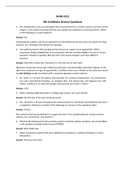
NURS 6512 Week 6 Midterm Review Questions (Fall QTR)

Document preview thumbnail
Preview 2 out of 10 pages

1. Question: Raymonds is a 24-year-old patient who has presented for a routine concern over her current weight. In your patient teaching with her, you explain the importance of macro nutrients. Which of the following is a macronutrient? 2. Question: Your patient presents with symptoms that lead you to suspect acute appendicitis. Which assessment finding is least likely to be associated with this condition early in its course? 3. Question: Jones is a 45-year-old patient who presents for a physical examination. On examination, you note costochondral beading, an enlarged skull, and bowed legs and diagnose him with rickets. A deficiency of which fat-soluble micronutrient can result in rickets? 4. Question: When assessing abdominal pain in a college-age woman, one must include: 5. Question: Hartzell is a 34-year-old patient who has presented for nutritional counseling because she is a vegetarian. Deficiency of which of the following is a concern in the vegetarian diet? 6. Question: Which of the following formats would be used for visits that address problems not yet identified in the problem-oriented medical record (POMR)? 7. Question: When examining a patient with tense abdominal musculature, a helpful technique is to have the patient... 8. Question: Peritonitis produces bowel sounds that are: 9. Question: Penicillin is considered a: 10. Question: When conducting an adult otos copic examination, you should 11. Question: White, rounded, or oval ulcerations surrounded by a red halo and found on the oral mucosa are? 12. Question: Walters, a 32-year-old patient, tells you that his ears are "stopped up." An objective assessment of this complaint is achieved by using the: 13. Question: To perform the Rinne test, place the tuning fork on the: 14. Question: L. presents to the clinic with severe groin pain and a history of kidney stones. Mr. L.'s son tells you that, for religious reasons, his father wishes to keep any stone that is passed into the urine filter that he has been using. What is your most appropriate response? 15. Question: The most common form of birth trauma of the scalp is: 16. Question: George Michaels, a 22-year-old patient, tells the nurse that he is here today to "check his allergies." He has been having "green nasal discharge" for the last 72 hours. How would the nurse document his reason for seeking care? 17. Question: The position on a clock, topographic notations, and anatomicl and marks: 18. Question: Britton is a 34-year-old patient who presents to the office with complaints of skin rashes. You have noted a 4' 3-cm, rough, elevated area of psoriasis. This is an example of a: 19. Question: The secretory activity of the sebaceous glands is stimulated by: 20. Question: Sweat glands, hair, and nails are all formed from: 21. Question: Spasmodic muscular contractions of the head, face, or neck are called: 22. Question: A bruit, or blowing sound, over the skull or temporal region of an adult indicates 23. Question: Before performing an abdominal examination, the examiner should: 24. Question: Fluorescing lesions are best distinguished using a(n): 25. Question: In counseling a client regarding nutrition education, you explain that linoleic acid, a major fatty acid, is thought to be essential for: 26. Question: The recommended minimum daily protein requirement for the normal adult is: 27. Question: Otten is a 45-year-old patient who presents with a complaint of weight gain. Which medication is frequently associated with weight gain? 28. Question: When examining the skull of a 4-month-old baby, you should normally find: 29. Question: During physical examination of a 30-year-old Chinese man, you notice slight asymmetry of his face. The cranial nerve examination is normal. Your best action is to: 30. Question: In issues surrounding ethical decision making, beneficence refers to the: 31. Question: Webb is a 38-year-old patient who has been changing her lifestyle to eat in a healthy way and lose weight. During your health promotion education regarding her nutritional status, you explain the function of dietary protein as: 32. Question: Which cranial nerves innervate the face? 33. Question: You are collecting a history from an 11-year-old girl. Her mother is sitting next to her in the examination room. When collecting history from older children or adolescents, they should be: 34. Question: Davis is a 27-year-old patient with a BMI of 33. Based on her BMI, your diagnosis would be: 35. Question: The adult recommended dietary fat intake should be g/day. (trick question; is your question asking for % or Grams?) (For a 2000cal diet fat intake = 44-78 g; 1500cal diet fat intake = 33-58g; 1800cal diet fat intake = 40-70g; 2000cal diet fat intake = 44-78g; 2500cal diet fat intake =56-97g). 36. Question: Which is the best way to position a patient's neck for palpation of the thyroid? 37. Question: Nuchal rigidity is most commonly associated with: 38. Question: A flat, non palpable lesion is described as a macule if the diameteris: 39. Question: Which statement is true regarding the relationship of physical characteristics and culture? 40. Question: You are examining a pregnant patient and have noted a vascular lesion. When you blanche over the vascular lesion, the site blanches and refills evenly from the center outward. The nurse documents this lesion as a: 41. Question: Britton brings her 16-year-old son in with a complaint that he is not developing correctly into adolescence. Which structures disproportionately enlarge in the male during adolescence? 42. Question: Cherry angiomas are a common finding in: 43. Question: The recommended minimum daily protein requirement for the normal adult is: 44. Question: The examiner’s evaluation of a patient’s mental status belongs inthe: 45. Question: Recommended carbohydrate content of total dietary intake (% total calories)is %. 46. Question: A college student comes to the student health center complaining of difficulty in concentrating during class and while studying. The diet that would contribute to this problem is one that consumes mostly: 47. Question: During an interview, tears appear in the patient's eyes and his voice becomes shaky. Initially, you should: 48. Question: Franklin is speaking with you, the health care provider, about his respiratory problem. Mr. Franklin says,"I've had this cough for 3 days, and it's getting worse."You reply, "Tell me more about your cough." Mr. Franklin states, "I wish I could tell you more. That's why I'm here. You tell me what's wrong!" Which care giver response would be most appropriate for enhancing communication? 49. Question: You have just completed a skin assessment on Mr. Baker. During your assessment, you have transilluminated a skin lesion. During the physical examination, you know that skin lesions are transilluminated to distinguish: 50. Question: Subjective and symptomatic data are: 51. Question: and Mrs. Johnson have presented to the office with their infant son with complaints of ear drainage. When examining an infant's middle ear, the nurse should use one hand to stabilize the otoscope against the head while using the other hand to: 52. Question: Kinder is a 39-year-old patient who presents to the office with complaints of an earache. In explaining to the patient about the function of her ears, which ear structure would you tell her is responsible for equalizing atmospheric pressure when swallowing, sneezing, or yawning? 53. Question: The term denoting the caregiver's need to do no harm to the patient is: 54. Question: A guideline for history taking is for caregivers to: 55. Question: Tympanic thermometers measure body temperature when a probe is placed: 56. Question: You are using an ophthalmoscope to examine a patient's inner eye. You rotate the lens selector clockwise, then counterclockwise to compensate for: 57. Question: A rubber or plastic ring should be around the bell endpiece of a stethoscope to: 58. Question: Graceisa 58-year-old patient who has a diagnosis of pernicious anemia.Which B vitamin is deficient in patients with perniciousanemia? 59. Question: During percussion, a dull tone is expected to be heard over: 60. Question: Pigmented, raised,warty lesions over the face and trunk should be assessed by an experienced practitioner who can distinguish: 61. Question: Unusual white areas on the skin may be due to: 62. Question: A blood pressure cuff bladder should be long enough to: 63. Question: Nasal symptoms that imply an allergic response include: 64. Question: Your patient is complaining of acute, intense sharp epigastric pain that radiates to the back and left scapula with nausea and vomiting. Based on this history, your prioritized physical examination should be to: 65. Question: Which technique is most likely to result in the patient’s understanding of questions? 66. Question: Your patient presents with symptoms that lead you to suspect acute appendicitis. Which assessment finding is least likely to be associated with this condition? 67. Question: Your patient is a 48-year-old woman with complaints of severe cramping pain in the abdomen and right flank. Her past medical history includes a history of bladder calculi. You diagnose her with renal calculi at this time. Which of the following symptoms would you expect with her diagnosis? (Select all that apply.) 68. Question: Which cranial nerves innervate the face? 69. Question: A fixed image of any group that rejects its potential for originality or individuality is known as a(n): 70. Question: Which of the following occurs when firm pressure is used to apply the stethoscope's bell end-piece to the skin? 71. 72. Question: Which question would be considered a leading question? 73. Question: The attitudes of the health care professional: 74. Question: Underestimation of blood pressure will occur if the blood pressure cuff's width covers: 75. Question: In a syndrome in which regional pain extends beyond this specific peripheral nerve injury, you would notice which of the following: (Select all that apply.) 76. Question: Which of the following occurs with malignant hypertension? (Select all that). 77. Question: Berger is a 39-year-old woman who presents with a complaint of epigastric abdominal pain. You have completed the inspection of the abdomen. What is your next step in the assessment process? 78. Question: Inspection of the abdomen should begin with the patient supine and the examiner: 79. Question: Abdul is a 40-year-old Middle Eastern man who presents to the office for a first visit with the complaint of new abdominal pain. You are concerned about violating a cultural prohibition when you prepare to do his rectal examination. The best tactic would be to: 80. Question: To approximate vocal frequencies, which tuning fork should be used to assess hearing? 81. Question: When taking a history, yous hould: 82. Question: G. is being seen for her routine physical examination. She is a college graduate and president of a research firm. Although her exact salary is unknown, she has adequate health insurance. Most of the above information is part of Ms. G.'s history. 83. Question: Williams, age 25, has recovered recently from an upper and lower respiratory infection. He describes along-standing nasal dripping. He is seeking treatment for a mild hearing loss that has not gone away. Information concerning his chronic postnasal drip should be documented within which section of his history? 84. Question: Brittle nails are typical findings in: 85. Question: A brief statement of the reason the patient is seeking health care is called the: 86. Question: Which of the following is an expected change in the assessment of the thyroid during pregnancy? 87. Question: Macronutrients are so named because they: 88. Question: Tuning forks with a frequency of 500 to 1000 Hz are most commonly used to measure: 89. Question: A 17-year-old girl presents to the clinic for a sports physical. Physical examination findings reveal bradycardia, multiple erosions of tooth enamel, and scars on her knuckles. She appears healthy otherwise. You should ask her if she: 90. Question: Which technique is most likely to result in the patient's understanding of questions? 91. Question: A tool used to screen adolescents for alcoholism is the: 92. Question: Your patient returns for a blood pressure check 2 weeks after a visit during which you performed a complete history and physical. This visit would be documented by creating a(n): 93. Question: Which of the following is "ABCD" characteristic of malignant melanoma? 94. Question: When are open-ended questions generally most useful? 95. Question: A 5-year-old child presents with nasal congestion and a headache. To assess for sinus tenderness, you should palpate over the: 96. Question: You are completing a general physical examination on Mr. Rock, a 39-year-old man with complaints of constipation. When examining a patient with tense abdominal musculature, a helpful technique is to have the patient: 97. Question: Differential diagnoses belong in the: 98. Question: Tracheal tug suggests the presence of a (n): 99. Question: D. complains of a headache. During the history, he mentions his use of alcohol and illicit drugs. This information would most likely belong in the: 100. Question: Periods of silence during the interview can serve important purposes, such as: 101. Question: Percussing at the right midclavicular line, below the umbilicus, and continuing upward is the correct technique for locating the:

Content preview

NURS 6512
Wk 6 Midterm Review Questions
1. Mrs. Raymonds is a 24-year-old patient who has presented for a routine concern over her current
weight. In your patient teaching with her, you explain the importance of macronutrients. Which
of the following is a macronutrient?

Answer: Fat

Carbohydrates, protein, and fat are referred to as macronutrients because they are required in large
amounts. Iron, thiamine, and calcium are minerals.

2. Your patient presents with symptoms that lead you to suspect acute appendicitis. Which
assessment finding is least likely to be associated with this condition early in its course? (tricky
question). (Similar to question #63, but with a few words changed, each have different
answers)

Answer: Obturator muscle test. (because it’s a late sign not an early sign).

Obturator muscle test. Psoas sign, McBurney point pain, and periumbilical pain that migrates to the
right lower quadrant are signs of appendicitis. Conditions that cause irritation of the obturator muscle
are late findings usually associated with a ruptured appendix or pelvic abscess.

3. Mr. Jones is a 45-year-old patient who presents for a physical examination. On examination,
you note costochondral beading, an enlarged skull, and bowed legs and diagnose him with
rickets. A deficiency of which fat-soluble micronutrient can result in rickets?

Answer: Vit D

4. When assessing abdominal pain in a college-age woman, one must include:

Answer: the first day of the last menstrual period.

5. Mrs. Hartzell is a 34-year-old patient who has presented for nutritional counseling because she is
a vegetarian. Deficiency of which of the following is a concern in the vegetarian diet?

Answer: Vit B12

The nutrients that may be deficient in a vegetarian diet, if not carefully planned, include proteins,
calcium, iron, vitamin B12, and vitamin D.
6. Which of the following formats would be used for visits that address problems not yet identified
in the problem-oriented medical record (POMR)?
Answer: Brief SOAP note.
7. When examining a patient with tense abdominal musculature, a helpful technique is to have
the patient...
Answer: flex his or her knees

, 8. Peritonitis produces bowel sounds that are:
Answer: hypoactive
9. Penicillin is considered a:
Answer: Hot medicine
10. White, rounded, or oval ulcerations surrounded by a red halo and found on the oral mucosa are?
Answer: aphthous ulcers (canker sore)
11. When conducting an adult otoscopic examination, you should
Answer: select the largest speculum that will fit in the auditory canal.
12. Which part of the information contained in the patient's record may be used in court?
Answer: All information
13. Mr. Walters, a 32-year-old patient, tells you that his ears are "stopped up." An objective
assessment of this complaint is achieved by using the:
Answer: tympanometer.
14. To perform the Rinne test, place the tuning fork on the:
Answer: mastoid process
15. Mr. L. presents to the clinic with severe groin pain and a history of kidney stones. Mr. L.'s son
tells you that, for religious reasons, his father wishes to keep any stone that is passed into the
urine filter that he has been using. What is your most appropriate response?
Answer: "With your father's permission, we will examine the stone and request that it be returned to
him.
16. The most common form of birth trauma of the scalp is:
Answer: caput succedaneum. Which is seen over the presenting part of the head during delivery as the
skull passes through the pelvis
17. George Michaels, a 22-year-old patient, tells the nurse that he is here today to "check his
allergies." He has been having "green nasal discharge" for the last 72 hours. How would the nurse
document his reason for seeking care?
Answer: GM is a 22-year-old male here for having "green nasal discharge" for the past 72 hours
18. The position on a clock, topographic notations, and anatomic landmarks:
Answer: are methods for recording locations of findings.
19. Mrs. Britton is a 34-year-old patient who presents to the office with complaints of skin rashes.
You have noted a 4' 3-cm, rough, elevated area of psoriasis. This is an example of a:
Answer: A plaque; by definition, is an elevated, firm, rough lesion with a flat top surface larger than 1
cm in diameter, as seen in someone with, for example, psoriasis .


Document information

Study
Unknown
Uploaded on
April 29, 2022
Number of pages
10
Written in
2021/2022
Type
Exam (elaborations)
Contains
Questions & answers
CA$55.66

Wrong document? Swap it for free Within 14 days of purchase and before downloading, you can choose a different document. You can simply spend the amount again.
Written by students who passed
Immediately available after payment
Read online or as PDF

Seller avatar
Reputation scores are based on the amount of documents a seller has sold for a fee and the reviews they have received for those documents. There are three levels: Bronze, Silver and Gold. The better the reputation, the more your can rely on the quality of the sellers work.
studyguider55
3.9
(122)
Sold
455
Followers
313
Items
1565
Last sold
2 months ago


Why students choose Stuvia

Created by fellow students, verified by reviews

Quality you can trust: written by students who passed their tests and reviewed by others who've used these notes.

Didn't get what you expected? Choose another document

No worries! You can instantly pick a different document that better fits what you're looking for.

Pay as you like, start learning right away

No subscription, no commitments. Pay the way you're used to via credit card and download your PDF document instantly.

Student with book image

“Bought, downloaded, and aced it. It really can be that simple.”

Alisha Student

Working on your references?

Create accurate citations in APA, MLA and Harvard with our free citation generator.

Working on your references?

Frequently asked questions
