

Written by students who passed Immediately available after payment Read online or as PDF Wrong document? Swap it for free 4.6 TrustPilot
logo-home
Document preview thumbnail
Preview 2 out of 12 pages
Exam (elaborations)

NURS 6512 Week 6 Midterm Compilation (Spring Qtr)

Document preview thumbnail
Preview 2 out of 12 pages

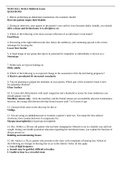
1. Question: Before performing an abdominal examination, the examiner should: 2. Question: During an interview, tears appear in the patient’s eyes and his voice becomes Initially, you should: 3. Question: Which of the following is the most accurate reflection of an individual’s food intake? 4. Question: Percussing at the right midclavicular line, below the umbilicus, and continuing upward is the correct technique for locating the: 5. Question: A fixed image of any group that rejects its potential for originality or individuality is known as a: 6. Question: Brittle nails are typical findings in: 7. Question: Which of the following is an expected change in the assessment of the thyroid during pregnancy? 8. Question: You are planning to palpate the abdomen of your patient. Which part of the examiner's hand is best for palpating vibration? 9. Question: A5-year-old child presents with nasal congestion and a headache to assess for sinus tenderness you should palpate over the: 10. Question: Unusual white areas on the skin may be due to 11. Question: You are using an ophthal moscope to examine a patient’s inner eye. You rotate the lens selector clockwise, then counterclockwise to compensate for: 12. Question: Webb is a 38-year old patient who has been changing her lifestyle to eat in a healthy way and lose weight: during your health promotion education regarding her nutritional status, you explain the function of dietary protein as: 13. Question: Akins is a 78-y/o patient who presents to the clinic with complaints of hearing loss. Which of the following are changes in hearing that occur in the elderly? Select all that apply. 14. Question: The most superior part of the stomach is the 15. Question: Grace is a 58-year-old patient who has a diagnosis of pernicious anemia. Which B vitamin is deficient in patients with pernicious anemia? 16. Question: A51-y/o woman calls with complaints of weight loss and constipation. She reports enlarged hemorrhoids and rectal bleeding. You advise her to: 17. Question: Placing the base of a vibrating tuning fork on the midline vertex of the patient’s head is a test for: 18. Question: Which technique is most likely to result in the patients understanding of questions? 19. Question: Williams, age 25, has recovered recently from an upper and lower respiratory infection. He describes a long-standing nasal dripping. He is seeking treatment for a mild hearing loss that has not gone away. Information concerning his chronic postnasal drip should be documented within which section of the history? 20. Question: Nasal symptoms that imply an allergic response include: 21. Question: Franklin is speaking with you the health care provider, about his respiratory problem. Mr. Franklin says, “I’ve had this cough for 3 days and it’s getting worse.” You reply, “Tell me more about your cough.” Mr. Franklin states, “I wish I could tell you more, that’s why I am here! You tell me what’s wrong.” Which caregiver response would be the most appropriate for enhancing communication? 22. Question: When taking a history, you should: 23. Question: Which of the following formats would be used for visits that address problems not yet identified in the problem-oriented medical record (POMR)? 24. Question: and Mrs. Johnson have presented to the office with their infant son with complaints of ear drainage. When examining an infant’s middle ear, the nurse should use one hand to stabilize the otoscope against the head while using the other hand to: 25. Question: Which question would be considered a leading question? 26. Question: Black is a 44y/o patient who presents to the clinic with complaints of neck pain that he thinks is from his job involving computer data entry. As the examiner, you are checking the range of motion in his neck and note the greatest degree of cervical mobility is at? 27. Question: The term denoting the caregiver’s need to do no harm to the patient is: 28. Question: A tool used to screen adolescents for alcoholism is the: 29. Question: Under normal circumstances, how much water is lost daily by the body? 30. Question: You have just completed a skin assessment on Baker. During your assessment, you have transilluminated a skin lesion. During the physical examination, you know that skin lesions aretransilluminated to distinguish: 31. Question: Mills is a 55-year-old patient who presents to the office for an initial visit for health promotion.A survey of mobility and activities of activities of daily living is part ofa(n): 32. Question: Sweat glands, hair, and nails are all formed from? 33. Question: A brief statement of the reason the patient is seeking health care is called the? 34. Question: Which part of the information contained in the patient’s record may be used in court? 35. Question: Which cranial nerves innervate the face? 36. Question: In counseling a client regarding nutrition education, you explain that linoleic acid, a major fatty acid,is thought to be essential for? 37. Question: When are open-ended questions generally most useful? 38. Question: Knowledge of the culture or cultures represented by the patient should be used to? 39. Question: Berger is a 39-year-old woman who presents with a complaint of epigastric abdominal pain.You have completed the inspection of the abdomen. What is your next step in the assessment process? 40. Question: A guideline for history taking is for caregivers to? 41. Question: Which type of speculum should be used to examine a patient’s tympanic membrane? 42. Question: You are palpating a patient’s thyroid and find that its broadest dimension measures 4cm. the right lobe is 25% larger than the left. These data would indicate: 43. Question: L. presents to the clinic with severe groin pain and a history of kidney stones. Mr. L.’s son tells you that, for religious reasons, his father wishes to keep any stone that is passed into the urine filter that he has been using. What is your most appropriate response? 44. Question: You are examining a pregnant patient and have noted a vascular lesion. When you Blanche over the vascular lesion, the site blanches and refills evenly from the center outward. The nurse documents this lesion as a? 45. Question: As you explain your patient’s condition to her husband, you notice that he is leaning toward you and pointedly blinking his eyes. Knowing that he is from England, your most appropriate response to this behavior is to? 46. Question: Expected normal percussion tones include? 47. Question: Abdul is a 40-year-old Middle Eastern man who presents to the office for a first visit with the complaint of new abdominal pain. You are concerned about violating a cultural prohibition when you prepare to do his rectal examination. The best tactic would be to? 48. Question: Fluorescing lesions are best distinguished using a(n)? 49. Question: Hartzell is a 34-year-old patient who has presented for nutritional counseling because she is a vegetarian. Deficiency of which of the following is a concern in the vegetariandiet? 50. Question: Underestimation of blood pressure will occur if the blood pressure cuff’s bladder: width covers? 51. Question: Britton is a 34-year-old patient who presents to the office with complaints of skin rashes.You have noted a 4’3cm, rough, elevated area of psoriasis. This is an example of a? 52. Question: Penicillin was considered a “Miracle drug” for all of the following reasons EXCEPT: 53. Question: Small, minute bruises are called? 54. Question: After thorough inspection of the abdomen, the next assessment step is? 55. Question: When you are questioning a patient regarding alcohol intake, she tells you that she is only a social drinker. Which initial response is appropriate? 56. Question: Regardless of the origin, discharge is described by noting? 57. Question: Recommended carbohydrate content of total dietary intake (% total calories)is? 58. Question: Tuning forks with a frequency of 500 to 1000 Hz are most commonly used to measure? 59. Question: Auscultation should be carried out last, except when examining the? 60. Question: Kevin Marks is a new health care provider. What is the best method to develop cultural competence? 61. Which of the following is an “ABCD” characteristic of malignantmelanoma? 62. Tracheal tug suggests the presence ofa(n)? 63. Which assessment finding is least likely to be associated with this condition early in its course? 64. Question: The review of systems is a component of the: 65. Question: Cherry angiomas are a common finding in: 66. Question: Donalds is a 45-year-old roofer. Your inspection to determine color variations of the skin is best conducted: 67. Question: To correctly document absent bowel sounds, one must listen continuously for: 68. Question: The adult recommended dietary fat intake should be g/day. 69. Question: Jones is a 45-year-old patient who presents for a physical examination. On examination, you note costochondral beading, enlarged skull, and bowed legs and diagnose him with rickets. A deficiency of which fat-soluble micronutrient can result in rickets? 70. Question: A flat, non-palpable lesion is described as a macule if the diameteris: 71. Question: Raymonds is a 24-year-old patient who has presented for a routine concern over her current weight. In your patient teaching with her, you explain the importance of macronutrients. Which of the following is a macronutrient? 72. Question: Which of the following organs is part of the alimentary tract? 73. Question: Sanchez is a 45-year-old gentleman who has presented to the office for a physical examination to establish a new primary care healthcare provider. Which of the following describes aphysical, not acultural, differentiator? 74. Question: To approximate vocal frequencies, which tuning fork should be used to assess hearing? 75. Question: During percussion, a dull tone is expected to be heard over: 76. Question: The attitudes of the health care professional: 77. Question: When recording physical findings, which data are recorded first for all systems? 78. Question: Spasmodic muscular contractions of the head, face, or neck are called: 79. Question: Which of the following occurs when firm pressure is used to apply the stethoscope’s bell end-piece to the skin? 80. Question: Differential diagnoses belong in the: 81. Question: Pigmented, raised, warty lesions over the face and trunk should be assessed by an experienced practitioner who can distinguish: 82. Question: Walter’s, a 32-year-old patient, tells you that his ears are “stopped up.” An objective assessment of this complaint is achieved by using the: 83. Question: Leonard brings her newborn infant into the pediatrician’s office for a first well-baby visit. As the health care provider, you teach her that newborns are more vulnerable to hypothermia due to: 84. Question: Tympanic thermometers measure body temperature when a probe is placed: 85. Question: A serous membrane that lines the abdominal cavity and forms a protective cover for many abdominal structures is the: 86. Question: White, rounded, or oval ulcerations surrounded by a red halo and found on the oral mucosa are: 87. Question: When assessing abdominal pain in a college-age woman, one must include: 88. Question: Your patient is complaining of acute, intense sharp epigastric pain that radiates to the back and left scapula with nausea and vomiting. Based on this history, your prioritized physical examination should be to: 89. Question: The infant should be placed in which position to have his or her height or length measured? 90. Question: Marks is a 66-year-old patient who presents for a physical examination to the clinic. Which question has the most potential for exploring a patient’s cultural beliefs related to a health problem? 91. Question: Which of the following is the most vital nutrient? 92. Question: What finding is unique to the documentation of a physical examination of an infant? 93. Question: G. reports an increase in her alcohol intake over the past 5 years. To screen her for problem drinking, you would use the: 94. Question: D. complains of a headache. During the history he mentions his use of alcohol and illicit drugs. This information would most likely belong in the: 95. Question: You are completing a general physical examination on Rock, a 39-year-old man with complaints of constipation. When examining a patient with tense abdominal musculature, a helpful technique is to have the patient: 96. Question: When communicating with older children and teenagers, you should be sensitive to their: 97. Question: Periods of silence during the interview can serve important purposes, such as: 98. Question: The recommended minimum daily protein requirement for the normal adult is: 99. Question: To perform the Rinne test, place the tuning fork on the: 100. Question: Johnson presents with a freely movable cystic mass in the midline of the high neck region at the base of the tongue. This is most likely a: 101. Question: A 22-year-old female nurse is interviewing an 86-year-old male patient. The patient avoids eye contact and answers questions only by saying, "Yeah," "No," or "I guess so." Which of the following is appropriate for the interviewer to say or ask?

Content preview

NURS 6512, Week 6 Midterm Exam
QUESTIONS

1. Before performing an abdominal examination, the examiner should:
Have the patient empty their bladder

2. During an interview, tears appear in the patient’s eyes and his voice becomes shaky. Initially, you should:
offer a tissue and let him know it is all right to cry

3. Which of the following is the most accurate reflection of an individual’s food intake?
Food Diary

4. Percussing at the right midclavicular line, below the umbilicus, and continuing upward is the correct
technique for locating the:
Lower liver border

5. A fixed image of any group that rejects its potential for originality or individuality is known as a:
Stereotype


7. Brittle nails are typical findings in:
Older adults

8. Which of the following is an expected change in the assessment of the thyroid during pregnancy?
A Bruit is auscultated d/t increased vascularity

9. You are planning to palpate the abdomen of your patient. Which part of the examiner's hand is best
for palpating vibration?
Ulnar Surface

10. A 5-year-old child presents with nasal congestion and a headache to assess for sinus tenderness you
should palpate over the:
Maxillary sinuses only - Only the maxillary and the frontal sinuses are accessiblefor physical examination;
however, the young child doesnot develop frontal sinuses until 7 to 8 years of age

12. Unusual white areas on the skin may be due to
Vitiligo

13. You are using an ophthalmoscope to examine a patient’s inner eye. You rotate the lens selector
clockwise, then counterclockwise to compensate for:
Myopia (nearsighted) (or hyperopia (farsighted)

14. Mrs. Webb is a 38-year old patient who has been changing her lifestyle to eat in a healthy way and lose
weight: during your health promotion education regarding her nutritional status, you explain the function of
dietary protein as:
Building and maintaining tissues

15. Mr. Akins is a 78-y/o patient who presents to the clinic with complaints of hearing loss. Which of
the following are changes in hearing that occur in the elderly? Select all that apply.
c. Loss of high frequency
e. Sounds may be garbled, difficult to localize
f. Unable to hear in a crowded room

, 16. The most superior part of the stomach is the
Fundus

17. Mrs. Grace is a 58-year-old patient who has a diagnosis of pernicious anemia. Which B vitamin is
deficient in patients with pernicious anemia?
B12

18. A 51-y/o woman calls with complaints of weight loss and constipation. She reports enlarged
hemorrhoids and rectal bleeding. You advise her to:
Come to the laboratory for a stool guaiac test.

19. Placing the base of a vibrating tuning fork on the midline vertex of the patient’s head is a test for:
Lateralization of Sound

20. Which technique is most likely to result in the patients understanding of questions?
Use the patient’s own terms if possible.

21. Mr. Williams, age 25, has recovered recently from an upper and lower respiratory infection. He describes
a long-standing nasal dripping. He is seeking treatment for a mild hearing loss that has not gone away.
Information concerning his chronic postnasal drip should be documented within which section of the history?
Past medical data

22. Nasal symptoms that imply an allergic response include:
Bluish gray turbinates.
("Turbinates that appear bluish gray or pale pink with a swollen, boggy consistency may indicate allergies")

23. Mr. Franklin is speaking with you the health care provider, about his respiratory problem. Mr. Franklin says,
“I’ve had this cough for 3 days and it’s getting worse.” You reply, “Tell me more about your cough.” Mr.
Franklin states, “I wish I could tell you more, that’s why I am here! You tell me what’s wrong.” Which
caregiver response would be the most appropriate for enhancing communication?
After 3 days, you're tired of coughing. Have you had a fever?"

24. When taking a history, you should:
Use a chronologic and sequential framework.

25. Which of the following formats would be used for visits that address problems not yet identified in the
problem-oriented medical record (POMR)?
Brief SOAP note

26. Mr. and Mrs. Johnson have presented to the office with their infant son with complaints of ear drainage.
When examining an infant’s middle ear, the nurse should use one hand to stabilize the otoscope against the head
while using the other hand to:
Pull the auricle down and back - in an effort to straighten the upward curvature of the canal

27. Which question would be considered a leading question?
You don't get headaches often, do you?"

28. Mr. Black is a 44y/o patient who presents to the clinic with complaints of neck pain that he thinks is from
his job involving computer data entry. As the examiner, you are checking the range of motion in his neck and
note the greatest degree of cervical mobility is at?
C 4 to C 5: C4 and C5 or C5 and C 6 provide the greatest horizontal mobility in adults


Document information

Study
Unknown
Uploaded on
April 29, 2022
Number of pages
12
Written in
2021/2022
Type
Exam (elaborations)
Contains
Questions & answers
CA$65.65

Wrong document? Swap it for free Within 14 days of purchase and before downloading, you can choose a different document. You can simply spend the amount again.
Written by students who passed
Immediately available after payment
Read online or as PDF

Seller avatar
Reputation scores are based on the amount of documents a seller has sold for a fee and the reviews they have received for those documents. There are three levels: Bronze, Silver and Gold. The better the reputation, the more your can rely on the quality of the sellers work.
studyguider55
3.9
(122)
Sold
455
Followers
313
Items
1565
Last sold
2 months ago


Why students choose Stuvia

Created by fellow students, verified by reviews

Quality you can trust: written by students who passed their tests and reviewed by others who've used these notes.

Didn't get what you expected? Choose another document

No worries! You can instantly pick a different document that better fits what you're looking for.

Pay as you like, start learning right away

No subscription, no commitments. Pay the way you're used to via credit card and download your PDF document instantly.

Student with book image

“Bought, downloaded, and aced it. It really can be that simple.”

Alisha Student

Working on your references?

Create accurate citations in APA, MLA and Harvard with our free citation generator.

Working on your references?

Frequently asked questions
