

Written by students who passed Immediately available after payment Read online or as PDF Wrong document? Swap it for free 4.6 TrustPilot
logo-home
Document preview thumbnail
Preview 2 out of 11 pages
Exam (elaborations)

NURS 6630 Week 11 Final Exam

Document preview thumbnail
Preview 2 out of 11 pages

1. Question: Benzodiazepines can be withdrawn abruptly despite duration of therapy/abuse. 2. Question: Which medication below would you use in addition to benzodiazepine treatment if the patient is experiencing psychosis during alcohol withdrawal delirium? 3. Question: Select the correct treatment regarding drugs involved in addiction management and their corresponding mechanism of action. 4. Question: What baseline levels should you perform before initiating an anti-ADHD medication? 5. Question: Which of the following drugs in the treatment of Alzheimer’s Disease requires administration with food? 6. Question: Which medication below should be routine for all suspected cases of alcohol intoxication and dependence? 7. Question: Patient is a 75-year-old female with a confirmed diagnosis of Alzheimer’s Disease. She is currently on Donepezil 10 mg daily. She is accompanied to your clinic today by her daughter, who informs you that her mother has recently had an increase in depressive symptoms. She has no history of mood disorders. She has a history of hypertension and tonic-clonic seizures, but both are controlled. Assuming this patient will be thoroughly evaluated for the diagnosis of depression, what would you recommend as initial therapy? 8. Question: Y. R. is a 35-year-old woman who presents to your clinic today complaining of ankle pain. She said she was running the trail when she saw a snake. During a quick turn to run away from the snake, she twisted her ankle. Which of the following medications may be a good choice in helping Y. R. with her pain? 9. Question: If a patient suffers from a multitude of small strokes and later begins experiencing mood disturbances in an acute fashion that sometimes resolve, from what type of dementia would you think that patient may suffer? 10. Question: The experience of pain is ALWAYS subjective 11. Question: Which of the following alcohol screening tools lack sensitivity to detect hazardous/problem drinking? 12. Question: There are many different types of dementia. Which dementia is NOT a direct result of disrupted neurotransmitters, but a result of degeneration of different regions in the brain? Onset of the disease is typically before the age of 60, and very rare after the age of 75. 13. Question: T. C. is an 88-year-old male who is diagnosed at your clinic with Dementia with Lewy Bodies. He currently has some debilitating gait issues, which makes his quality of life very poor. His memory is still intact with minor deficits. Which medication would likely benefit T. C. as his initial therapy? 14. Question: Choose the correct statement regarding medications used for alcoholism 15. Question: T. B. is a 55-year-old male who has diagnosed with type 2 diabetes 10+ years ago. He has since had complications from the disease and is sufering from severe neuropathy. On top of that, T. B. is struggling with his mental health and was recently told he could be depressed but he had refused treatment at that time. Besides getting his blood sugar under control, what medication(s) can we use that may be useful in helping T. B.? 16. Question: This medication cannot be used for more than 5 days, it is a non-steroidal, anti- inflammatory drug, and it is often substituted for morphine due to its rapid onset and high potency. What is this medication? 17. Question: What is the difference between Ritalin and Focalin? 18. Question: Which club drug is structurally similar to GABA? 19. Question: A new patient presents to your clinic today. The patient is a 13-year-old boy who complains that he has no interest in anything. The patient states, “I just want to sleep more than I normally do, and I don’t care much for playing my video games anymore.” His mother states he cannot focus on anything for more than a few minutes at a time, and that he often gets in trouble at school because he cannot sit still. What would you recommend at this time? 20. Question: What should our treatment goal be with our patients when it comes to managing chronic pain? 21. Question: Of the following neurotransmitters, which ones play a critical role in modulating attention in ADHD? 22. Question: Select the correct description of a somatoform disorder. 23. Question: When can bupren orphine be initiated in a patient who is suffering from an opioid overdose? 24. Question: Drug addiction includes many prescription medications and illegal substances. Of the drugs listed, which ones can be withdrawn abruptly WITHOUT medical intervention to prevent withdraw seizures? 25. Question: Ifapatientisbeingmanagedforchronicpainandisnotgettingbetteraftermonthsof therapy with multiple agents (i.e., NSAIDs with opioids, muscle relaxants with NSAIDs, etc.), what should be your next step in helping the patient? 26. Question: Which neurotransmitters are likely involved in the patho physiology of withdrawal seizures? 27. Question: Which of the following drugs in the treatment of Alzheimer’s Disease helps normalize glutamate by antagonizing the NMDA receptor? 28. Question: Choose the correct statement regarding an anti-ADHD medication and its respectful mechanism of action 29. Question: Which enzyme does disulfiram inhibit leading to a build-up of the ethanol metabolite acetaldehyde? 30. Question: Of the axons involved in the transmission of pain, which one is thinly myelinated and conducts that first feeling of pain that is often felt as coming on as a sharp, rapid feeling? 31. Question: Of the following medications, which one is contraindicated with stimulants such as Ritalin or Adderall? 32. Question: T. K. is a 72-year-old female who has sufered many strokes in the past, likely due to uncontrolled hypertension and hyperlipidemia. She has now been diagnosed with vascular dementia due to memory loss and motor system slowing. What is the recommended treatment for T. K.? 33. Question: Daytrana is the MPH transdermal system of methylphenidate approved for the treatment of ADHD in children aged 6 years and older. What is the difference in terms of the metabolism compared to the other formulations in this class? 34. Question: Which features are consistent with delirium? 35. Question: Disorientation, tremor, hyperactivity, fever, hallucinations, marked wakefulness, and increased autonomic tone are all features that are consistent with which part of alcohol withdrawal? 36. Question: E. B., a 55-year-old female, is a patient at your clinic today who has a past medical history significant for breast cancer, hypertension, hepatic cirrhosis, type 2 diabetes, and a recent diagnosis of alcohol use disorder. She has no known drug allergies. She states she is ready to quit drinking but fears the cravings that it may bring. Which medication would you recommend for E. B. to begin? 37. Question: Which medication is a selective alpha-adrenergic agonist that works by mimicking nore pine phrine binding in the pre-frontal cortex, which makes it particularly useful in the treatment of ADHD? 38. Question: In the patho physiology of Alzheimer’s Disease, there are certain proteins that lead to the plaquesandtanglesthatresultinthisprogressive,irreversiblebraindisorder.Choosethe appropriate protein with its corresponding pathology. 39. Question: The patient is a 16-year-old girl with a past history of substance use disorder. She has been known to abuse prescription opioids and smokes one pack of cigarettes every day. She has been in and out of recovery for the past year. During her last admission into a recovery center, she was diagnosed with ADHD, which may have contributed to her addictive personality. She presents to your clinic today to initiate pharmacotherapy for her new diagnosis. What would you recommend in this patient? Her current weight is 55 kg. 40. Question: Which of the following drugs is often used in the management of opioid addiction due to its ceiling efect? 41. Question: Disulfiram has been proven effective in the treatment of alcoholism, but recently it has been trialed in the management of cocaine addiction. What is the mechanism of action that likely helps produce these aversive effects? 42. Question: Select all the criteria for what is considered “At-Risk Drinking.” 43. Question: Which of the following psychiatric conditions is present in both domains (i.e., core psychopathology & pain-related psychological symptoms) of chronic pain that will likely lead to an outcome of disability, pain, and poor quality of life? 44. Question: Which medication(s) requires a test dose to determine accurate use of the drug (i.e., how addicted the patient truly is on a certain drug) before beginning a titration schedule to withdrawal the patient? 45. Question: Which of the following is the only Black Box Warning associated with the medication atomoxetine? 46. Question: FILL INTHEBLANK: is the main neurotransmitter behind reward systems inthe brain, which usually leads to addiction when altered in anyway. 47. Question: Patient is a 10-year-old female with diagnosed ADHD who was started on Ritalin 5 mg twice a day over 2 months ago. She is still experiencing the triad of symptoms associated with ADHD (impaired attention, impulsivity, and excessive motor activity). Her mother reports that she is now having difficulty in falling asleep since starting the medication. She has been on no other anti-ADHD medications and the mother reports full compliance with medication regimen. What is the appropriate recommendation to make based on this scenario? 48. Question: SSRIs can be used in alcohol use disorder and ofer modest drinking reduction through an anti-craving efect. 49. Question: A 59-year-old male has been admitted to the E. D. due to a methamphetamine overdose. The patient’s friend reported he ingested up to 2 grams because “he thought cops were coming to get him.” The patient’s vitals are all within normal limits, except his blood pressure is 180/110. What is the best recommendation to make at this time? 50. Question: Of the following neurotransmitters, which one(s) are known to be severely disrupted in the disease Dementia with Lewy Bodies? 51. Question: When completing this exam, did you comply with Walden University’s Code of Conduct including the expectations for academic integrity?

Content preview

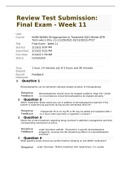
Review Test Submission:
Final Exam - Week 11
User
Course NURS-6630N-30-Approaches to Treatment-2021-Winter-QTR-
Term-wks-1-thru-11-(11/29/2021-02/13/2022)-PT27
Test Final Exam - Week 11
Started 2/13/22 8:07 PM
Submitted 2/13/22 9:22 PM
Due Date 2/14/22 1:59 AM
Status Completed
Attempt 96 out of 100 points
Score
Time 1 hour, 14 minutes out of 2 hours and 30 minutes
Elapsed
Results Feedback
Displayed
 Question 1
Benzodiazepines can be withdrawn abruptly despite duration of therapy/abuse.


Response Benzodiazepines should never be stopped suddenly; Page 194 “Under
Feedback: no circumstances should benzodiazepines be stopped abruptly.”
 Question 2
Which medication below would you use in addition to benzodiazepine treatment if the
patient is experiencing psychosis during alcohol withdrawal delirium?

Response “Haloperidol 50 to 10 mg PO or IM may be added and repeated after 1
Feedback: to 2 hours when psychosis or agitation is present.”
 Question 3
Select the correct treatment regarding drugs involved in addiction management and their
corresponding mechanism of action.


Response under Overdose subtitle: “Flumazenil, a specific benzodiazepine
Feedback: antagonist, reverses the life-threatening effects of a benzodiazepine
overdose.”
 Question 4
What baseline levels should you perform before initiating an anti-ADHD medication?


Response under Overview: “Before treatment with medications, it is usually

, Feedback: important to measure baseline levels of height, weight, blood
pressure, and pulse and to monitor them over the course of the
 Question 5
treatment.”
Which of the following drugs in the treatment of Alzheimer’s Disease requires
administration with food?


Response “Rivastigmine should be administered with meals to reduce
Feedback: gastrointestinal side effects.”
 Question 6
Which medication below should be routine for all suspected cases of alcohol intoxication
and dependence?


Response under Treatment of Wernicke’s encephalopathy: “Administration of the B
Feedback: vitamin thiamine (IM or IV) should be routine for all suspected cases of
alcohol intoxication and dependence.”
 Question 7
Patient is a 75-year-old female with a confirmed diagnosis of Alzheimer’s Disease. She is
currently on Donepezil 10 mg daily. She is accompanied to your clinic today by her
daughter, who informs you that her mother has recently had an increase in depressive
symptoms. She has no history of mood disorders. She has a history of hypertension and
tonic-clonic seizures, but both are controlled. Assuming this patient will be thoroughly
evaluated for the diagnosis of depression, what would you recommend as initial therapy?


Response SSRIs are effective in treating depressive symptoms. Answer choices A & B
Feedback: are both TCAs and are advised against due to side effect profile and the
fact this person is treatment naive (learned from previous exam) and
answer choice D is contraindicated in a patient with seizures.
 Question 8
Y. R. is a 35-year-old woman who presents to your clinic today complaining of ankle pain.
She said she was running the trail when she saw a snake. During a quick turn to run away
from the snake, she twisted her ankle. Which of the following medications may be a good
choice in helping Y. R. with her pain?

Response No specific page number, but ibuprofen would be the best choice since
Feedback: oxycodone isn’t recommended first-line (Box 17-1 on page 208) since no
other medications have been trialed; TCAs and SNRIs wouldn’t be a good
choice because the patient doesn’t show any signs of depression.
 Question 9
If a patient sufers from a multitude of small strokes and later begins experiencing mood
disturbances in an acute fashion that sometimes resolve, from what type of dementia
would you think that patient may sufer?

Response under the clinical features and
Feedback: diagnosis subtitle
 Question 10
The experience of pain is ALWAYS subjective

Document information

Study
Unknown
Uploaded on
April 23, 2022
Number of pages
11
Written in
2021/2022
Type
Exam (elaborations)
Contains
Questions & answers
CA$57.24

Wrong document? Swap it for free Within 14 days of purchase and before downloading, you can choose a different document. You can simply spend the amount again.
Written by students who passed
Immediately available after payment
Read online or as PDF

Seller avatar
Reputation scores are based on the amount of documents a seller has sold for a fee and the reviews they have received for those documents. There are three levels: Bronze, Silver and Gold. The better the reputation, the more your can rely on the quality of the sellers work.
studyguider55
3.9
(122)
Sold
455
Followers
313
Items
1565
Last sold
2 months ago


Why students choose Stuvia

Created by fellow students, verified by reviews

Quality you can trust: written by students who passed their tests and reviewed by others who've used these notes.

Didn't get what you expected? Choose another document

No worries! You can instantly pick a different document that better fits what you're looking for.

Pay as you like, start learning right away

No subscription, no commitments. Pay the way you're used to via credit card and download your PDF document instantly.

Student with book image

“Bought, downloaded, and aced it. It really can be that simple.”

Alisha Student

Working on your references?

Create accurate citations in APA, MLA and Harvard with our free citation generator.

Working on your references?

Frequently asked questions
