

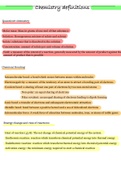
Chemistry definitions
Quantitive chemistry
Molar mass: Mass in grams of one mol of that substance
Solution: Homogeneous mixture of solute and solvent
Solute: substance that is dissolved in the solution
Concentration: amount of solute per unit volume of solution
Yield: a measure of the extent of a reaction, generally measured by the amount of product against the
amount of product that is possible
Chemical Bonding
Intramolecular bond: a bond which occurs between atoms within molecules
Electronegativity: a measure of the tendency of an atom to attract a bonding pair of electrons
Covalent bond: a sharing of least one pair of electrons by two non-metal atoms
Non-polar: an equal sharing of electrons
Polar covalent: an unequal sharing of electrons leading to dipole forming
Ionic bond: a transfer of electrons and subsequent electrostatic attraction
Metallic bond: bond between a positive kernel and a sea of delocalized electrons
Intermolecular force: A weak force of attraction between molecules, ions, or atoms of noble gases
Energy change and rate of reactions
Heat of reaction ( H): The net change of chemical potential energy of the system
Exothermic reaction: reaction which transform chemical potential energy into thermal energy
Endothermic reaction: reaction which transform thermal energy into chemical potential energy
Activation energy: the minimum energy required to start a chemical reaction
Quantitive chemistry
Molar mass: Mass in grams of one mol of that substance
Solution: Homogeneous mixture of solute and solvent
Solute: substance that is dissolved in the solution
Concentration: amount of solute per unit volume of solution
Yield: a measure of the extent of a reaction, generally measured by the amount of product against the
amount of product that is possible
Chemical Bonding
Intramolecular bond: a bond which occurs between atoms within molecules
Electronegativity: a measure of the tendency of an atom to attract a bonding pair of electrons
Covalent bond: a sharing of least one pair of electrons by two non-metal atoms
Non-polar: an equal sharing of electrons
Polar covalent: an unequal sharing of electrons leading to dipole forming
Ionic bond: a transfer of electrons and subsequent electrostatic attraction
Metallic bond: bond between a positive kernel and a sea of delocalized electrons
Intermolecular force: A weak force of attraction between molecules, ions, or atoms of noble gases
Energy change and rate of reactions
Heat of reaction ( H): The net change of chemical potential energy of the system
Exothermic reaction: reaction which transform chemical potential energy into thermal energy
Endothermic reaction: reaction which transform thermal energy into chemical potential energy
Activation energy: the minimum energy required to start a chemical reaction


