

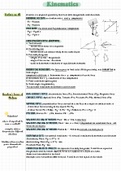
Kinematics
Vectors in 2D A vector is a physical quantity that has both magnitude and direction.
Diagonal vectors are broken into x- and y- components
- Fx = Fcos(𝜽)
- Fy = Fsin(𝜽)
On a slope: Parallel and Perpendicular components
- Fg||= Fgsin 𝜽
- Fg⟂= Fgcos 𝜽
Constructing force diagrams:
1. Tail to head
- vectors that occur in a sequence
2. Parallelogram
- vectors that act concurrently on the same object
3. Free body diagram
- length of arrow = magnitude
- angle of the arrow = direction
- used to determine resultant or equilibrium (tension)
FinDing the Resultant: Use Pythagoras to find sides (90 degrees only), use SOHCAHTOA to
find angles.
component addition: 1. Determine the x- y- components of earth force
2. Determine the x- y- resultants of the components
3. Find resultant-pythagorus
4. Find angle-trigonometry
The parallel resultant determines acceleration
Newton's Laws of non-contact force: electrostatic force (FE), Gravitational Force (Fg), Magnetic force
Motion Contact force: Applied force (FA), Tension (FT), Friction (Fs/Fk), Normal force (FN)
Normal Force: perpendicular force exerted on a surface on a object in contact with it
- if not other forces acting on the object: Fn=Fg
- if other forces: Fn + F(Ay) - Fg = 0, Fn = Fg + F(Asin 𝜽), Ft + (-Fg) = 0
Friction: Static: Fs = ℳFn, Kinetic: Fk = ℳFn
Definitions!
Newton’s 1st Law of Motion: Fnet = 0N, a= 0 m/s (inertia)
why is it important to
wear a seatbelt? Newton’s 2nd law of motion: Fnet = ma, a ≠ 0 m/s (dependent on resultant force - all
forces on an object)
examples of force Newton’s 3rd Law of Motion: F(A on B) = - F(B on A) (action-reaction pairs)
diagrams for different
situations
suspended (lift): horizontal resultant = 0, vertical resultant determines acceleration
Stationary: Fnet/ Fg + (-FT) = 0
Identify action-reaction Accelerating: Fnet/Fg + (-FT) = ma
pairs (demonstrate Freefall: Fnet/Fg = ma
properties)
connected objects (pulley): do separate free body diagrams, V and A are equal in
magnitude and direction. Applied forces are applied to 1 object @ a time.
Same axis: horizontal or vertical
multiple axes: horizontal AND vertical, V and A are not equal in direction
Vectors in 2D A vector is a physical quantity that has both magnitude and direction.
Diagonal vectors are broken into x- and y- components
- Fx = Fcos(𝜽)
- Fy = Fsin(𝜽)
On a slope: Parallel and Perpendicular components
- Fg||= Fgsin 𝜽
- Fg⟂= Fgcos 𝜽
Constructing force diagrams:
1. Tail to head
- vectors that occur in a sequence
2. Parallelogram
- vectors that act concurrently on the same object
3. Free body diagram
- length of arrow = magnitude
- angle of the arrow = direction
- used to determine resultant or equilibrium (tension)
FinDing the Resultant: Use Pythagoras to find sides (90 degrees only), use SOHCAHTOA to
find angles.
component addition: 1. Determine the x- y- components of earth force
2. Determine the x- y- resultants of the components
3. Find resultant-pythagorus
4. Find angle-trigonometry
The parallel resultant determines acceleration
Newton's Laws of non-contact force: electrostatic force (FE), Gravitational Force (Fg), Magnetic force
Motion Contact force: Applied force (FA), Tension (FT), Friction (Fs/Fk), Normal force (FN)
Normal Force: perpendicular force exerted on a surface on a object in contact with it
- if not other forces acting on the object: Fn=Fg
- if other forces: Fn + F(Ay) - Fg = 0, Fn = Fg + F(Asin 𝜽), Ft + (-Fg) = 0
Friction: Static: Fs = ℳFn, Kinetic: Fk = ℳFn
Definitions!
Newton’s 1st Law of Motion: Fnet = 0N, a= 0 m/s (inertia)
why is it important to
wear a seatbelt? Newton’s 2nd law of motion: Fnet = ma, a ≠ 0 m/s (dependent on resultant force - all
forces on an object)
examples of force Newton’s 3rd Law of Motion: F(A on B) = - F(B on A) (action-reaction pairs)
diagrams for different
situations
suspended (lift): horizontal resultant = 0, vertical resultant determines acceleration
Stationary: Fnet/ Fg + (-FT) = 0
Identify action-reaction Accelerating: Fnet/Fg + (-FT) = ma
pairs (demonstrate Freefall: Fnet/Fg = ma
properties)
connected objects (pulley): do separate free body diagrams, V and A are equal in
magnitude and direction. Applied forces are applied to 1 object @ a time.
Same axis: horizontal or vertical
multiple axes: horizontal AND vertical, V and A are not equal in direction


