

Mome
Momen tum and
ntum Impulse
and Impul se
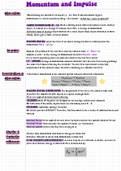
Momentum
"Quantifying the motion of an object": p = mv. Unit of measurement: kg.m/s
momentum is a vector quantity (mag. + direction) = choose up + right as positive!
Change in momentum (Pf - pi): When a moving object comes into contact with another
object, it results in a change of velocity, therefore, a change in momentum.
Different types of change: object bounces on a wall, object stops, object continues to move
slowly, object gets a boost, vertical bounce
Newtons 2nd law: when the force of an object changes so does it velocity hence the
momentum. Fnet = ΔP/Δt
Impulse Impulse (J): product of the net force and the contact time, J = Fnet x Δt
impulse is also = to the change in momentum therefore FnetΔt = mΔv
It is a vector quantity and is in same direction as the net force vector.
e.g - Airbags: change in momentum remains constant, but the use of an airbag prolongs
the time (t) of impact during the accident. The net force experienced is inversely
proportional to the contact time, therefore resulting in a smaller net force.
Conservation of Total linear momentum of an isolated system remains conserved (constant)
Momentum
Newtons 3rd law & momentum: the magnitude of the force, the contact time and
therefore the impulse on both objects are equal in magnitude.
Force are applied between objects during:
Collisions: move off together (or dropped on vertically), collide and rebounds
NB: take note of direction, objects that are stationery have Vi = 0
Explosions: explosions, springs, firearms
NB: do not join but SEPERATE! Therefore, P(before) must have a value of combined mass and
velocity
Internal forces: forces applied on each other by objects within the system (contact forces)
External forces: forces outside the system (friction, air resistance)
Isolated system: no net external force acting on it
Elastic & Elastic: both momentum and kinetic energy are conserved
Inelastic Inelastic: collision in which only momentum is conserved
Is the collision elastic/inelastic?: in order to prove if a collision is elastic, we have to
collisions
prove that kinetic energy is conserved Ek is calculated by:
Momen tum and
ntum Impulse
and Impul se
Momentum
"Quantifying the motion of an object": p = mv. Unit of measurement: kg.m/s
momentum is a vector quantity (mag. + direction) = choose up + right as positive!
Change in momentum (Pf - pi): When a moving object comes into contact with another
object, it results in a change of velocity, therefore, a change in momentum.
Different types of change: object bounces on a wall, object stops, object continues to move
slowly, object gets a boost, vertical bounce
Newtons 2nd law: when the force of an object changes so does it velocity hence the
momentum. Fnet = ΔP/Δt
Impulse Impulse (J): product of the net force and the contact time, J = Fnet x Δt
impulse is also = to the change in momentum therefore FnetΔt = mΔv
It is a vector quantity and is in same direction as the net force vector.
e.g - Airbags: change in momentum remains constant, but the use of an airbag prolongs
the time (t) of impact during the accident. The net force experienced is inversely
proportional to the contact time, therefore resulting in a smaller net force.
Conservation of Total linear momentum of an isolated system remains conserved (constant)
Momentum
Newtons 3rd law & momentum: the magnitude of the force, the contact time and
therefore the impulse on both objects are equal in magnitude.
Force are applied between objects during:
Collisions: move off together (or dropped on vertically), collide and rebounds
NB: take note of direction, objects that are stationery have Vi = 0
Explosions: explosions, springs, firearms
NB: do not join but SEPERATE! Therefore, P(before) must have a value of combined mass and
velocity
Internal forces: forces applied on each other by objects within the system (contact forces)
External forces: forces outside the system (friction, air resistance)
Isolated system: no net external force acting on it
Elastic & Elastic: both momentum and kinetic energy are conserved
Inelastic Inelastic: collision in which only momentum is conserved
Is the collision elastic/inelastic?: in order to prove if a collision is elastic, we have to
collisions
prove that kinetic energy is conserved Ek is calculated by:


