

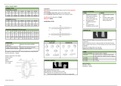
ORAL ANATOMY
PRIMARY TEETH Innervation
ERUPTION (in months) ■ All dental and periodontal innervation arises from the trigeminal
8-12 9-13 13-19 16-22 25-33 nerve (CN V). HEIGHT OF CONTOUR
A B C D E ■ The maxillary nerve (V-2) supplies the maxillary teeth. FACIAL LINGUAL
A B C D E ■ The mandibular nerve (V-3) supplies the mandibular teeth. • Located in the cervical • Anterior teeth: cervical
6-10 10-16 14-18 17-23 23-31 third except mandibular third
The DB root of the Max M1 is àPSAN molars (junction of • Posterior teeth: middle
MB root à MSAN. cervical and middle 3rd) third except mandibular
SHEDDING (in years)
6-7 7-8 10-12 9-11 10-12 • Most prominent – PM2 (occlusal 3rd)
NUMBERING SYSTEM mandibular posterior
A B C D E
teeth
A B C D E
• Least prominent –
6-8 7-8 9-12 9-11 10-12
mandibular anterior teeth
ERUPTION: PERMANENT TEETH (in years)
PROXIMAL CEJ
6 7-8 8-9 10- 10- 11- 12 17-
11 12 12 21
1 2 3 4 5 6 7 8
1 2 3 4 5 6 7 8
6 6-7 7-8 9-10 10- 11- 12 17-
12 12 21
■ The maximum height of the proximal CEJ contour increases
PROXIMAL CONTACTS anteriorly.
EMBRASURE MAXILLARY MANDIBULAR ■ The mesial CEJ contour is always greater than the distal contour.
Largest occlusal between max canine and PM1. ■ The greatest CEJ contour is on the maxillary central incisor (mesial
embrasure surface).
Largest incisal embrasure between max lateral and canine ■ Facial and lingual CEJs curve apically.
Smallest incisal embrasure between mand centrals. ■ Mesial and distal CEJs curve coronally.
■ In general, lingual embrasures > buccal embrasures, except Max M1 LOBES
(buccal embrasures > lingual) Incisors and canine 4 lobes (3 labial, 1 lingual)
Premolar 4 lobes (3 buccal, 1 lingual) except mand
Anterior teeth have 6 line angles. PM2, which has 5 lobes (3 buccal, 2 lingual)
Posterior teeth 1st molar 5 lobes
have 8 line 2nd molar 4 lobes
angles. PROXIMAL SURFACES 3rd molar 4-5 lobes
All teeth have 4
point angles. ARCH LENGTHS
Maxillary: 128mm
Mandibular: 126mm
■ Triangular: All anterior teeth.
■ Trapezoidal: All maxillary posterior teeth.
■ Rhomboidal: All mandibular posterior teeth.
§ The facial and lingual surfaces of all teeth are trapezoidal.
Christine Monastrial
, LATERAL INCISOR CANINE
MAXILLARY PERMANENT TEETH Unique characteristics Unique characteristics
CENTRAL INCISOR ■Third most common congenitally missing tooth (next to third ■ Longest tooth.
Unique characteristics molars). ■ Longest cusp.
■ Most prominent tooth. ■ Third most variable tooth form (next to third molars). ■ Third longest crown (next to mand canine and max central).
■ Greatest mesial CEJ contour of all teeth. ■ Peg lateral (microdont) ■ Widest (B-L) anterior tooth.
■ Second longest crown (next to mandibular canine). ■ Dens-in-dente ■ Maxillary tooth least likely to be extracted.
■ Widest (M-D) of all anterior teeth. ■ Most common tooth to have a palato-radicular groove (2–5% Crown morphology
Crown morphology prevalence), ■ Has prominent facial ridge.
■ Occlusal shape is triangular; proximal shape is triangular. which can make scaling difficult. ■ Cusp tip centered over root (from facial).
■ Has three mamelons and four developmental grooves. Crown morphology ■ Mesial cusp ridge < distal.
■ MMR > DMR. ■ Occlusal shape is oval; proximal shape is triangular. ■ Mesial surface is straighter (less convex) than the distal.
■ M-I corner sharper than D-I. ■ MMR (straight) > DMR. Occlusal morphology
■ Narrowest incisal embrasures of all maxillary teeth. ■ M-I corner sharper than D-I. ■ F-L dimension > M-D (from occlusal).
Occlusal morphology Occlusal morphology ■ Has a prominent lingual ridge, which splits the lingual fossa into
■ M-D dimension > F-L (from occlusal). ■ M-D dimension > F-L (from occlusal). mesial and distal fossae.
■ Cingulum: slightly distal. ■ Most developed lingual anatomy of all anterior teeth. ■ Cusp tip located slightly M-F (from occlusal. And more labial
Root morphology ■ Lingual surface is the most concave of all incisors. ■ Cingulum: central and prominent.
■ Least likely to have a divided root canal. ■ Cingulum: central. Often prominent (talon cusp), creating a Root morphology
■ Roundest root form; can be rotated during extraction. lingual ■ Longest root.
■ Blunted apex. pit. ■ Root is oval-shaped and flattened M-D (deeper on distal).
■ Has greatest axial inclination toward the facial. Root morphology
■ Sits almost vertically (M-D) in alveolar bone. ■ Root just as long as maxillary central.
■ Typically curves to the distal.
SECOND PREMOLAR
Unique characteristics
FIRST PREMOLAR
■ Shorter and smaller than maxillary first premolar
Unique characteristics
■ Largest of all premolars
Crown morphology
■ Distal cusp ridge > mesial cusp ridge.
Crown morphology
■ Has a buccal ridge, but not as prominent as first premolar.
■ has a prominent buccal ridge
■ Only permanent tooth with mesial cusp ridge > distal cusp ridge.
Occlusal morphology
■ Has a prominent mesial marginal ridge groove, which can make
■ Occlusal shape is hexagonal; proximal shape is trapezoidal.
scaling difficult.
■ Occlusal table is more ovoid and symmetrical than maxillary first
premolar.
Occlusal morphology
■ Occlusal table has a short central groove with more supplemental
■ Occlusal shape is hexagonal; proximal shape is trapezoidal.
grooves. Has “wrinkled” appearance.
■ Occlusal table has long central groove with fewer supplemental
■ 2 cusps: buccal, palatal (slightly mesial).
grooves. No central pit, but has mesial/distal pits.
■ Buccal cusp height = palatal.
■ 2 cusps: buccal (slightly distal), palatal (slightly mesial).
■ Buccal cusp height > palatal.
Root morphology
Root morphology
■ Only premolar without a mesial root depression.
■ Only premolar with two roots (B > P).
■ Has a prominent mesial root concavity.
■ Sits most vertically (B-L) in alveolar bone.
Christine Monastrial
, FIRST MOLAR SECOND MOLAR THIRD MOLAR
Unique characteristics Unique characteristics Unique characteristics
■ Largest permanent tooth. ■ Similar to maxillary first molar but smaller and more angular. ■ Most variable shape of any other tooth (with mandibular third
■ Only tooth that is broader lingually than buccally. ■ Second most common tooth to have cervical enamel projections molar).
■ Widest tooth (B-L). (next ■ Second most congenitally missing tooth (next to mandibular third
■ First permanent maxillary tooth to erupt to mandibular second molar). molar).
■ Closest tooth to the opening of Stenson’s (parotid) duct. ■ Shortest permanent tooth.
Crown morphology ■ Most common tooth to have enamel pearls (with mandibular
■ Only tooth with a pronounced distal concavity at the CEJ, which Crown morphology third molars).
can ■ Crown morphology (parotid) duct.
make scaling difficult. Crown morphology
■ Has a long buccal groove with a central pit. Occlusal morphology ■ Shortest maxillary crown.
■ Has a distolingual groove with a pit (on all maxillary molars). ■ Occlusal table is usually rhomboidal, but can be heart-shaped if Occlusal morphology
the DL cusp is absent; proximal shape is trapezoidal. ■ Occlusal table is usually heart-shaped since DL cusp has little or
Occlusal morphology ■ 4 cusps: MB, ML (largest), DB, DL (smallest). no development; proximal shape is trapezoidal.
■ Occlusal shape is rhomboidal; proximal shape is trapezoidal. ■ Has smaller oblique ridge with a transverse groove. ■ Crown tapers lingually.
■ 4 cusps: MB, ML (largest), DB, DL (smallest). Root morphology ■ 3 cusps: MB, DB, lingual.
■ Sometimes has fifth cusp of Carabelli lingual to ML cusp. ■ Roots are typically longer, closer together, and more distally ■ Oblique ridge is poorly developed and often absent.
■ Primary cusp triangle: formed by ML, MB, and DB cusps (same for inclined than the maxillary first molar. Occasionally fused.
all maxillary molars). ■ Longer root trunk than maxillary first molar. Root morphology
■ Secondary cusp triangle: formed by DL cusp.
■ Roots are often fused and distally inclined.
■ Cusp heights: ML > MB > DB (primary cusp triangle) > DL
(Secondary cusp triangle) > Carabelli.
■ Only tooth with two triangular ridges on one cusp (ML cusp): form
the transverse and oblique ridges.
■ Has most prominent oblique ridge of all maxillary molars.
■ The transverse groove of the oblique ridge connects the central
and distal fossae (same for all maxillary molars).
Root morphology
■ 3 roots: MB, DB (shortest), palatal (longest).
■ Distance from furcation entrance to CEJ: Mesial (3.6 mm) < buccal
(4.2 mm) < distal (4.8 mm).
■ Apices are closest to maxillary sinus.
■ MB and DB roots are often shaped like “plier handles.”
■ MB root has more common (94%) and deeper (0.3 mm)
concavities than other roots.
Christine Monastrial
, MANDIBULAR PERMANENT TEETH CANINE
CENTRAL INCISOR LATERAL INCISOR Unique characteristics
Unique characteristics Unique characteristics ■ Longest crown.
■ Smallest tooth. ■ Slightly larger in all dimensions than the mandibular central. ■ Second longest tooth (next to max canine).
■ Narrowest (M-D) tooth. ■ Second smallest tooth (next to mandibular central). ■ Longest tooth in mandible.
■ Most symmetrical tooth. ■ Not as symmetrical as the mandibular central. ■ Second longest root (next to max canine).
■ Greatest mesial CEJ contour of mandibular teeth. Crown morphology ■ Mandibular tooth least likely to be extracted.
■ First succedaneous tooth to erupt. ■ Crown is tilted distally on the root (from facial). Crown morphology
Crown morphology ■ MMR > DMR. ■ Has a facial ridge, but less prominent than max canine.
■ MMR = DMR. ■ Incisal edge lingual to long axis (from proximal). ■ Mesial cusp ridge < distal.
■ D-I corner is equally as sharp as M-I. Occlusal morphology ■ Mesial surface is nearly parallel with the long axis.
■ Incisal edge lingual to long axis (from proximal). ■ F-L dimension > M-D (from occlusal). ■ Cusp tip slightly lingual to long axis (from proximal).
Occlusal morphology ■ Incisal edge is twisted disto-lingually (from occlusal).
■ F-L dimension > M-D (from occlusal). ■ Cingulum: slightly distal and indistinct. Occlusal morphology
■ Incisal edge perpendicular to B-L bisector (from occlusal). Root morphology ■ F-L dimension > M-D (from occlusal).
■ Cingulum: central and indistinct. ■ Longest root of all incisors. ■ Has a lingual ridge, but less prominent than max canine.
Root morphology ■ Root has mesial (deeper) and distal concavities (hourglass ■ Cusp tip located slightly distal (from occlusal).
■ Root has mesial and distal (deeper) concavities (hourglass shaped). ■ Cingulum: slightly distal and less prominent than max canine.
shaped).
■ Longer than maxillary central. Root morphology
■ Root is oval-shaped and flattened M-D (deeper on mesial).
SECOND PREMOLAR ■ Anterior tooth most likely to have a bifurcated root.
Unique characteristics ■ Only root that may be mesially inclined.
■ Most congenitally missing premolar.
FIRST PREMOLAR ■ The gingival papilla between the first and second premolar is the
Unique characteristics shortest.
■ Smallest of all premolars. Crown morphology
■ Lingual surface is wider (M-D) than that of the mandibular first
Crown morphology premolar.
■ Has a prominent mesio-lingual groove. ■ Shorter and wider than the mandibular first premolar (from
■ MMR < DMR. buccal).
■ Mesial marginal ridge has slight concavity.
Occlusal morphology ■ Only premolar with five lobes: three buccal and two lingual.
■ Occlusal shape is diamond-shaped; proximal shape is rhomboidal Occlusal morphology
(tilted lingually). ■ Occlusal shape is square; proximal shape is rhomboidal (tilted
■ Only posterior tooth with an occlusal plane tilted lingually. lingually).
■ Has most prominent transverse ridge of all premolars, which ■ Occlusal surface can have three configurations:
splits mesial and distal fossae. No central groove. ■ Y (most common configuration): 3 cusps—buccal > ML > DL,
■ 2 cusps: buccal (functional), lingual (nonfunctional). with a single central pit.
■ Buccal cusp is larger (2/3 of occlusal surface) than the lingual. ■ H: 2 cusps—buccal and lingual with short central groove.
■ U: 2 cusps—buccal and lingual with crescent-shaped central
Root morphology groove.
■ Root is broader (B-L), and may have proximal concavities. ■ Buccal cusp is shorter and blunter than lingual cusps.
■ ML cusp is larger than the DL cusp.
■ Mesial marginal ridge has slight concavity.
Root morphology
■ Root is longer than the mandibular first premolar.
■ Apex closest to mental foramen.
Christine Monastrial
PRIMARY TEETH Innervation
ERUPTION (in months) ■ All dental and periodontal innervation arises from the trigeminal
8-12 9-13 13-19 16-22 25-33 nerve (CN V). HEIGHT OF CONTOUR
A B C D E ■ The maxillary nerve (V-2) supplies the maxillary teeth. FACIAL LINGUAL
A B C D E ■ The mandibular nerve (V-3) supplies the mandibular teeth. • Located in the cervical • Anterior teeth: cervical
6-10 10-16 14-18 17-23 23-31 third except mandibular third
The DB root of the Max M1 is àPSAN molars (junction of • Posterior teeth: middle
MB root à MSAN. cervical and middle 3rd) third except mandibular
SHEDDING (in years)
6-7 7-8 10-12 9-11 10-12 • Most prominent – PM2 (occlusal 3rd)
NUMBERING SYSTEM mandibular posterior
A B C D E
teeth
A B C D E
• Least prominent –
6-8 7-8 9-12 9-11 10-12
mandibular anterior teeth
ERUPTION: PERMANENT TEETH (in years)
PROXIMAL CEJ
6 7-8 8-9 10- 10- 11- 12 17-
11 12 12 21
1 2 3 4 5 6 7 8
1 2 3 4 5 6 7 8
6 6-7 7-8 9-10 10- 11- 12 17-
12 12 21
■ The maximum height of the proximal CEJ contour increases
PROXIMAL CONTACTS anteriorly.
EMBRASURE MAXILLARY MANDIBULAR ■ The mesial CEJ contour is always greater than the distal contour.
Largest occlusal between max canine and PM1. ■ The greatest CEJ contour is on the maxillary central incisor (mesial
embrasure surface).
Largest incisal embrasure between max lateral and canine ■ Facial and lingual CEJs curve apically.
Smallest incisal embrasure between mand centrals. ■ Mesial and distal CEJs curve coronally.
■ In general, lingual embrasures > buccal embrasures, except Max M1 LOBES
(buccal embrasures > lingual) Incisors and canine 4 lobes (3 labial, 1 lingual)
Premolar 4 lobes (3 buccal, 1 lingual) except mand
Anterior teeth have 6 line angles. PM2, which has 5 lobes (3 buccal, 2 lingual)
Posterior teeth 1st molar 5 lobes
have 8 line 2nd molar 4 lobes
angles. PROXIMAL SURFACES 3rd molar 4-5 lobes
All teeth have 4
point angles. ARCH LENGTHS
Maxillary: 128mm
Mandibular: 126mm
■ Triangular: All anterior teeth.
■ Trapezoidal: All maxillary posterior teeth.
■ Rhomboidal: All mandibular posterior teeth.
§ The facial and lingual surfaces of all teeth are trapezoidal.
Christine Monastrial
, LATERAL INCISOR CANINE
MAXILLARY PERMANENT TEETH Unique characteristics Unique characteristics
CENTRAL INCISOR ■Third most common congenitally missing tooth (next to third ■ Longest tooth.
Unique characteristics molars). ■ Longest cusp.
■ Most prominent tooth. ■ Third most variable tooth form (next to third molars). ■ Third longest crown (next to mand canine and max central).
■ Greatest mesial CEJ contour of all teeth. ■ Peg lateral (microdont) ■ Widest (B-L) anterior tooth.
■ Second longest crown (next to mandibular canine). ■ Dens-in-dente ■ Maxillary tooth least likely to be extracted.
■ Widest (M-D) of all anterior teeth. ■ Most common tooth to have a palato-radicular groove (2–5% Crown morphology
Crown morphology prevalence), ■ Has prominent facial ridge.
■ Occlusal shape is triangular; proximal shape is triangular. which can make scaling difficult. ■ Cusp tip centered over root (from facial).
■ Has three mamelons and four developmental grooves. Crown morphology ■ Mesial cusp ridge < distal.
■ MMR > DMR. ■ Occlusal shape is oval; proximal shape is triangular. ■ Mesial surface is straighter (less convex) than the distal.
■ M-I corner sharper than D-I. ■ MMR (straight) > DMR. Occlusal morphology
■ Narrowest incisal embrasures of all maxillary teeth. ■ M-I corner sharper than D-I. ■ F-L dimension > M-D (from occlusal).
Occlusal morphology Occlusal morphology ■ Has a prominent lingual ridge, which splits the lingual fossa into
■ M-D dimension > F-L (from occlusal). ■ M-D dimension > F-L (from occlusal). mesial and distal fossae.
■ Cingulum: slightly distal. ■ Most developed lingual anatomy of all anterior teeth. ■ Cusp tip located slightly M-F (from occlusal. And more labial
Root morphology ■ Lingual surface is the most concave of all incisors. ■ Cingulum: central and prominent.
■ Least likely to have a divided root canal. ■ Cingulum: central. Often prominent (talon cusp), creating a Root morphology
■ Roundest root form; can be rotated during extraction. lingual ■ Longest root.
■ Blunted apex. pit. ■ Root is oval-shaped and flattened M-D (deeper on distal).
■ Has greatest axial inclination toward the facial. Root morphology
■ Sits almost vertically (M-D) in alveolar bone. ■ Root just as long as maxillary central.
■ Typically curves to the distal.
SECOND PREMOLAR
Unique characteristics
FIRST PREMOLAR
■ Shorter and smaller than maxillary first premolar
Unique characteristics
■ Largest of all premolars
Crown morphology
■ Distal cusp ridge > mesial cusp ridge.
Crown morphology
■ Has a buccal ridge, but not as prominent as first premolar.
■ has a prominent buccal ridge
■ Only permanent tooth with mesial cusp ridge > distal cusp ridge.
Occlusal morphology
■ Has a prominent mesial marginal ridge groove, which can make
■ Occlusal shape is hexagonal; proximal shape is trapezoidal.
scaling difficult.
■ Occlusal table is more ovoid and symmetrical than maxillary first
premolar.
Occlusal morphology
■ Occlusal table has a short central groove with more supplemental
■ Occlusal shape is hexagonal; proximal shape is trapezoidal.
grooves. Has “wrinkled” appearance.
■ Occlusal table has long central groove with fewer supplemental
■ 2 cusps: buccal, palatal (slightly mesial).
grooves. No central pit, but has mesial/distal pits.
■ Buccal cusp height = palatal.
■ 2 cusps: buccal (slightly distal), palatal (slightly mesial).
■ Buccal cusp height > palatal.
Root morphology
Root morphology
■ Only premolar without a mesial root depression.
■ Only premolar with two roots (B > P).
■ Has a prominent mesial root concavity.
■ Sits most vertically (B-L) in alveolar bone.
Christine Monastrial
, FIRST MOLAR SECOND MOLAR THIRD MOLAR
Unique characteristics Unique characteristics Unique characteristics
■ Largest permanent tooth. ■ Similar to maxillary first molar but smaller and more angular. ■ Most variable shape of any other tooth (with mandibular third
■ Only tooth that is broader lingually than buccally. ■ Second most common tooth to have cervical enamel projections molar).
■ Widest tooth (B-L). (next ■ Second most congenitally missing tooth (next to mandibular third
■ First permanent maxillary tooth to erupt to mandibular second molar). molar).
■ Closest tooth to the opening of Stenson’s (parotid) duct. ■ Shortest permanent tooth.
Crown morphology ■ Most common tooth to have enamel pearls (with mandibular
■ Only tooth with a pronounced distal concavity at the CEJ, which Crown morphology third molars).
can ■ Crown morphology (parotid) duct.
make scaling difficult. Crown morphology
■ Has a long buccal groove with a central pit. Occlusal morphology ■ Shortest maxillary crown.
■ Has a distolingual groove with a pit (on all maxillary molars). ■ Occlusal table is usually rhomboidal, but can be heart-shaped if Occlusal morphology
the DL cusp is absent; proximal shape is trapezoidal. ■ Occlusal table is usually heart-shaped since DL cusp has little or
Occlusal morphology ■ 4 cusps: MB, ML (largest), DB, DL (smallest). no development; proximal shape is trapezoidal.
■ Occlusal shape is rhomboidal; proximal shape is trapezoidal. ■ Has smaller oblique ridge with a transverse groove. ■ Crown tapers lingually.
■ 4 cusps: MB, ML (largest), DB, DL (smallest). Root morphology ■ 3 cusps: MB, DB, lingual.
■ Sometimes has fifth cusp of Carabelli lingual to ML cusp. ■ Roots are typically longer, closer together, and more distally ■ Oblique ridge is poorly developed and often absent.
■ Primary cusp triangle: formed by ML, MB, and DB cusps (same for inclined than the maxillary first molar. Occasionally fused.
all maxillary molars). ■ Longer root trunk than maxillary first molar. Root morphology
■ Secondary cusp triangle: formed by DL cusp.
■ Roots are often fused and distally inclined.
■ Cusp heights: ML > MB > DB (primary cusp triangle) > DL
(Secondary cusp triangle) > Carabelli.
■ Only tooth with two triangular ridges on one cusp (ML cusp): form
the transverse and oblique ridges.
■ Has most prominent oblique ridge of all maxillary molars.
■ The transverse groove of the oblique ridge connects the central
and distal fossae (same for all maxillary molars).
Root morphology
■ 3 roots: MB, DB (shortest), palatal (longest).
■ Distance from furcation entrance to CEJ: Mesial (3.6 mm) < buccal
(4.2 mm) < distal (4.8 mm).
■ Apices are closest to maxillary sinus.
■ MB and DB roots are often shaped like “plier handles.”
■ MB root has more common (94%) and deeper (0.3 mm)
concavities than other roots.
Christine Monastrial
, MANDIBULAR PERMANENT TEETH CANINE
CENTRAL INCISOR LATERAL INCISOR Unique characteristics
Unique characteristics Unique characteristics ■ Longest crown.
■ Smallest tooth. ■ Slightly larger in all dimensions than the mandibular central. ■ Second longest tooth (next to max canine).
■ Narrowest (M-D) tooth. ■ Second smallest tooth (next to mandibular central). ■ Longest tooth in mandible.
■ Most symmetrical tooth. ■ Not as symmetrical as the mandibular central. ■ Second longest root (next to max canine).
■ Greatest mesial CEJ contour of mandibular teeth. Crown morphology ■ Mandibular tooth least likely to be extracted.
■ First succedaneous tooth to erupt. ■ Crown is tilted distally on the root (from facial). Crown morphology
Crown morphology ■ MMR > DMR. ■ Has a facial ridge, but less prominent than max canine.
■ MMR = DMR. ■ Incisal edge lingual to long axis (from proximal). ■ Mesial cusp ridge < distal.
■ D-I corner is equally as sharp as M-I. Occlusal morphology ■ Mesial surface is nearly parallel with the long axis.
■ Incisal edge lingual to long axis (from proximal). ■ F-L dimension > M-D (from occlusal). ■ Cusp tip slightly lingual to long axis (from proximal).
Occlusal morphology ■ Incisal edge is twisted disto-lingually (from occlusal).
■ F-L dimension > M-D (from occlusal). ■ Cingulum: slightly distal and indistinct. Occlusal morphology
■ Incisal edge perpendicular to B-L bisector (from occlusal). Root morphology ■ F-L dimension > M-D (from occlusal).
■ Cingulum: central and indistinct. ■ Longest root of all incisors. ■ Has a lingual ridge, but less prominent than max canine.
Root morphology ■ Root has mesial (deeper) and distal concavities (hourglass ■ Cusp tip located slightly distal (from occlusal).
■ Root has mesial and distal (deeper) concavities (hourglass shaped). ■ Cingulum: slightly distal and less prominent than max canine.
shaped).
■ Longer than maxillary central. Root morphology
■ Root is oval-shaped and flattened M-D (deeper on mesial).
SECOND PREMOLAR ■ Anterior tooth most likely to have a bifurcated root.
Unique characteristics ■ Only root that may be mesially inclined.
■ Most congenitally missing premolar.
FIRST PREMOLAR ■ The gingival papilla between the first and second premolar is the
Unique characteristics shortest.
■ Smallest of all premolars. Crown morphology
■ Lingual surface is wider (M-D) than that of the mandibular first
Crown morphology premolar.
■ Has a prominent mesio-lingual groove. ■ Shorter and wider than the mandibular first premolar (from
■ MMR < DMR. buccal).
■ Mesial marginal ridge has slight concavity.
Occlusal morphology ■ Only premolar with five lobes: three buccal and two lingual.
■ Occlusal shape is diamond-shaped; proximal shape is rhomboidal Occlusal morphology
(tilted lingually). ■ Occlusal shape is square; proximal shape is rhomboidal (tilted
■ Only posterior tooth with an occlusal plane tilted lingually. lingually).
■ Has most prominent transverse ridge of all premolars, which ■ Occlusal surface can have three configurations:
splits mesial and distal fossae. No central groove. ■ Y (most common configuration): 3 cusps—buccal > ML > DL,
■ 2 cusps: buccal (functional), lingual (nonfunctional). with a single central pit.
■ Buccal cusp is larger (2/3 of occlusal surface) than the lingual. ■ H: 2 cusps—buccal and lingual with short central groove.
■ U: 2 cusps—buccal and lingual with crescent-shaped central
Root morphology groove.
■ Root is broader (B-L), and may have proximal concavities. ■ Buccal cusp is shorter and blunter than lingual cusps.
■ ML cusp is larger than the DL cusp.
■ Mesial marginal ridge has slight concavity.
Root morphology
■ Root is longer than the mandibular first premolar.
■ Apex closest to mental foramen.
Christine Monastrial


