
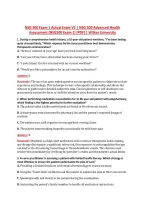
NSG 500 Exam 1 Actual Exam V2 | NSG 500 Advanced Health
Assessment (NSG500 Exam 1) [PDF] | Wilkes University
1. During a comprehensive health history, a 55-year-old patient mentions, “I’ve been feeling
quite stressed lately.” Which response by the nurse practitioner best demonstrates
therapeutic communication?
A. “Stress is common at your age; have you tried exercising more?”
B. “Can you tell me more about what has been causing your stress?”
C. “I understand, I’m also stressed with my current workload.”
D. “Would you like a prescription for an anti-anxiety medication?”
Answer: B
Rationale: The use of an open-ended question encourages the patient to elaborate on their
experience and feelings. This technique fosters a therapeutic relationship and allows the
clinician to gather more detailed subjective data. Closed questions or self-disclosure can
prematurely narrow the focus or shift the attention away from the patient’s needs.
2. When performing medication reconciliation for an 80-year-old patient with polypharmacy,
which finding is the highest priority for further evaluation?
A. The patient takes a daily multivitamin not listed in the electronic record.
B. A discrepancy exists between the pharmacy list and the patient’s reported dosage of
warfarin.
C. The patient uses a pill organizer to manage their evening doses.
D. The patient reports taking ibuprofen occasionally for mild knee pain.
Answer: B
Rationale: Warfarin is a high-alert medication with a narrow therapeutic index, making
any dosage discrepancy a significant safety risk. Discrepancies in anticoagulation therapy
can lead to life-threatening hemorrhage or thromboembolic events. The clinician must
resolve this immediately by verifying the provider’s orders and the patient’s actual intake.
3. A nurse practitioner is assessing a patient with limited health literacy. Which strategy is
most effective to ensure the patient understands the plan of care?
A. Providing a detailed brochure with medical terminology to ensure accuracy.
B. Using the ‘Teach-Back’ method to ask the patient to explain the plan in their own words.
C. Speaking loudly and slowly to the patient during the examination.
D. Instructing the patient’s family member to handle all medication instructions.
,Answer: B
Rationale: The teach-back method is a validated tool for assessing a patient’s
understanding of medical instructions. It allows the clinician to identify gaps in
comprehension and correct misconceptions in real-time. This approach promotes patient
autonomy and improves adherence to the treatment plan.
4. Which component of the social history is most critical to document for a patient living in an
urban area with a new diagnosis of asthma?
A. Current housing conditions and exposure to environmental triggers.
B. The patient’s highest level of completed education.
C. The patient’s preferred method of recreational activity.
D. Frequency of dental check-ups and oral hygiene habits.
Answer: A
Rationale: Environmental triggers such as mold, dust mites, or pests in housing can
significantly exacerbate asthma symptoms. Identifying these social determinants of health
is essential for creating an effective management plan. Failure to address environmental
factors can lead to poor disease control despite pharmacological intervention.
5. While assessing a 4-year-old child, the nurse practitioner notes a heart rate of 110 beats
per minute at rest. How should this finding be interpreted?
A. This is a normal resting heart rate for a child in this age group.
B. The child is showing signs of moderate tachycardia requiring an EKG.
C. The heart rate is dangerously low and requires immediate intervention.
D. The finding is only normal if the child has a documented fever.
Answer: A
Rationale: The normal resting heart rate for a preschool-aged child (3-5 years) typically
ranges from 80 to 120 beats per minute. Clinical interpretation of vital signs must be age-
specific to avoid unnecessary testing or missed diagnoses. The practitioner should consider
the child’s activity level and emotional state during the measurement.
6. In the ‘Review of Systems’ (ROS) section of a health history, where should a clinician
document a patient’s report of occasional chest pain?
A. Under the Cardiovascular section of the ROS.
B. Under the Past Medical History section.
C. Under the Physical Examination findings.
D. Under the Chief Complaint only.
, Answer: A
Rationale: The Review of Systems is a systematic collection of subjective data regarding
the patient’s body systems. Occasional chest pain is a subjective symptom that belongs in
the Cardiovascular subsection of the ROS. Objective findings from the physical exam, such
as heart sounds, are documented separately.
7. A clinician is constructing a three-generation genogram. Which information is most
important to include for each family member?
A. Current occupation and employer name.
B. History of minor seasonal allergies.
C. Preferred religious or spiritual beliefs.
D. Age of death and cause of death for deceased relatives.
Answer: D
Rationale: Genograms are used to identify hereditary patterns and familial risks for
chronic diseases. Documenting the age and cause of death provides crucial data for
calculating a patient’s risk for conditions like premature coronary artery disease or cancer.
This information guides the clinician in recommending appropriate screenings.
8. A patient from a culture that values indirect eye contact looks down throughout the
interview. What is the most appropriate action for the clinician?
A. Maintain a respectful distance and observe the patient’s non-verbal comfort.
B. Document the patient as being ‘withdrawn and depressed.’
C. Firmly ask the patient to look up to ensure they are listening.
D. Assume the patient is being untruthful about their history.
Answer: A
Rationale: Cultural humility requires recognizing that non-verbal cues like eye contact
vary across cultures. In many cultures, avoiding direct eye contact is a sign of respect
toward authority figures or clinicians. Incorrectly labeling this behavior as a psychiatric
symptom or lack of engagement can damage the therapeutic alliance.
9. Which finding during a physical exam of an adult patient requires immediate further
evaluation?
A. A respiratory rate of 18 breaths per minute while talking.
B. A blood pressure reading of 138/88 mmHg in a patient with no history of HTN.
C. A pulse oximetry reading of 88% on room air.
D. A body mass index (BMI) of 26.5 kg/m2.
Assessment (NSG500 Exam 1) [PDF] | Wilkes University
1. During a comprehensive health history, a 55-year-old patient mentions, “I’ve been feeling
quite stressed lately.” Which response by the nurse practitioner best demonstrates
therapeutic communication?
A. “Stress is common at your age; have you tried exercising more?”
B. “Can you tell me more about what has been causing your stress?”
C. “I understand, I’m also stressed with my current workload.”
D. “Would you like a prescription for an anti-anxiety medication?”
Answer: B
Rationale: The use of an open-ended question encourages the patient to elaborate on their
experience and feelings. This technique fosters a therapeutic relationship and allows the
clinician to gather more detailed subjective data. Closed questions or self-disclosure can
prematurely narrow the focus or shift the attention away from the patient’s needs.
2. When performing medication reconciliation for an 80-year-old patient with polypharmacy,
which finding is the highest priority for further evaluation?
A. The patient takes a daily multivitamin not listed in the electronic record.
B. A discrepancy exists between the pharmacy list and the patient’s reported dosage of
warfarin.
C. The patient uses a pill organizer to manage their evening doses.
D. The patient reports taking ibuprofen occasionally for mild knee pain.
Answer: B
Rationale: Warfarin is a high-alert medication with a narrow therapeutic index, making
any dosage discrepancy a significant safety risk. Discrepancies in anticoagulation therapy
can lead to life-threatening hemorrhage or thromboembolic events. The clinician must
resolve this immediately by verifying the provider’s orders and the patient’s actual intake.
3. A nurse practitioner is assessing a patient with limited health literacy. Which strategy is
most effective to ensure the patient understands the plan of care?
A. Providing a detailed brochure with medical terminology to ensure accuracy.
B. Using the ‘Teach-Back’ method to ask the patient to explain the plan in their own words.
C. Speaking loudly and slowly to the patient during the examination.
D. Instructing the patient’s family member to handle all medication instructions.
,Answer: B
Rationale: The teach-back method is a validated tool for assessing a patient’s
understanding of medical instructions. It allows the clinician to identify gaps in
comprehension and correct misconceptions in real-time. This approach promotes patient
autonomy and improves adherence to the treatment plan.
4. Which component of the social history is most critical to document for a patient living in an
urban area with a new diagnosis of asthma?
A. Current housing conditions and exposure to environmental triggers.
B. The patient’s highest level of completed education.
C. The patient’s preferred method of recreational activity.
D. Frequency of dental check-ups and oral hygiene habits.
Answer: A
Rationale: Environmental triggers such as mold, dust mites, or pests in housing can
significantly exacerbate asthma symptoms. Identifying these social determinants of health
is essential for creating an effective management plan. Failure to address environmental
factors can lead to poor disease control despite pharmacological intervention.
5. While assessing a 4-year-old child, the nurse practitioner notes a heart rate of 110 beats
per minute at rest. How should this finding be interpreted?
A. This is a normal resting heart rate for a child in this age group.
B. The child is showing signs of moderate tachycardia requiring an EKG.
C. The heart rate is dangerously low and requires immediate intervention.
D. The finding is only normal if the child has a documented fever.
Answer: A
Rationale: The normal resting heart rate for a preschool-aged child (3-5 years) typically
ranges from 80 to 120 beats per minute. Clinical interpretation of vital signs must be age-
specific to avoid unnecessary testing or missed diagnoses. The practitioner should consider
the child’s activity level and emotional state during the measurement.
6. In the ‘Review of Systems’ (ROS) section of a health history, where should a clinician
document a patient’s report of occasional chest pain?
A. Under the Cardiovascular section of the ROS.
B. Under the Past Medical History section.
C. Under the Physical Examination findings.
D. Under the Chief Complaint only.
, Answer: A
Rationale: The Review of Systems is a systematic collection of subjective data regarding
the patient’s body systems. Occasional chest pain is a subjective symptom that belongs in
the Cardiovascular subsection of the ROS. Objective findings from the physical exam, such
as heart sounds, are documented separately.
7. A clinician is constructing a three-generation genogram. Which information is most
important to include for each family member?
A. Current occupation and employer name.
B. History of minor seasonal allergies.
C. Preferred religious or spiritual beliefs.
D. Age of death and cause of death for deceased relatives.
Answer: D
Rationale: Genograms are used to identify hereditary patterns and familial risks for
chronic diseases. Documenting the age and cause of death provides crucial data for
calculating a patient’s risk for conditions like premature coronary artery disease or cancer.
This information guides the clinician in recommending appropriate screenings.
8. A patient from a culture that values indirect eye contact looks down throughout the
interview. What is the most appropriate action for the clinician?
A. Maintain a respectful distance and observe the patient’s non-verbal comfort.
B. Document the patient as being ‘withdrawn and depressed.’
C. Firmly ask the patient to look up to ensure they are listening.
D. Assume the patient is being untruthful about their history.
Answer: A
Rationale: Cultural humility requires recognizing that non-verbal cues like eye contact
vary across cultures. In many cultures, avoiding direct eye contact is a sign of respect
toward authority figures or clinicians. Incorrectly labeling this behavior as a psychiatric
symptom or lack of engagement can damage the therapeutic alliance.
9. Which finding during a physical exam of an adult patient requires immediate further
evaluation?
A. A respiratory rate of 18 breaths per minute while talking.
B. A blood pressure reading of 138/88 mmHg in a patient with no history of HTN.
C. A pulse oximetry reading of 88% on room air.
D. A body mass index (BMI) of 26.5 kg/m2.


