
RELIAS-STYLE DYSRHYTHMIA BASIC A | PRACTICE EXAM BANK
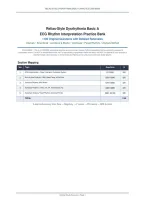
Relias-Style Dysrhythmia Basic A
ECG Rhythm Interpretation Practice Bank
1100 Original Questions with Detailed Rationales
Intervals • Sinus/Atrial • Junctional & Blocks • Ventricular • Paced Rhythms • Analysis Method
DISCLAIMER – This is an ORIGINAL educational practice resource on basic cardiac rhythm interpretation themes commonly assessed in
competency exams. It is NOT an official Relias exam, NOT a reproduction of proprietary Relias test items, and NOT a substitute for your employer’s
required module, ACLS training, or clinical protocols. Passing scores and exact content are facility-specific.
Section Mapping
Sec Topic Questions N
1 ECG Fundamentals – Paper, Intervals & Conduction System Q1-Q220 220
2 Sinus & Atrial Rhythms – NSR, Brady/Tachy, A-Fib/Flutte Q221-Q440 220
3 Junctional Rhythms & AV Blocks Q441-Q660 220
4 Ventricular Rhythms – PVCs, VT, VF, Idioventricular, As Q661-Q880 220
5 Systematic Analysis, Paced Rhythms & Clinical Prioritie Q881-Q1100 220
TOTAL 1100
5-step method every time: Rate → Regularity → P waves → PR interval → QRS duration
Original Study Resource | Page 1
, RELIAS-STYLE DYSRHYTHMIA BASIC A | PRACTICE EXAM BANK
Section 1: ECG Fundamentals – Paper, Intervals & Conduction System
Q1: The normal pacemaker of the heart is the:
A. AV node
B. SA node [CORRECT]
C. Purkinje fibers
D. Bundle branches only
Correct Answer: B
Rationale: SA node normally initiates the impulse at 60–100/min.
Q2: One small box on standard ECG paper equals:
A. 0.20 sec
B. 0.04 sec [CORRECT]
C. 1.0 sec
D. 0.12 sec
Correct Answer: B
Rationale: Small box = 0.04 sec; large box = 0.20 sec.
Q3: One large box on standard ECG paper equals:
A. 0.04 sec
B. 0.20 sec [CORRECT]
C. 0.12 sec
D. 2.0 sec
Correct Answer: B
Rationale: 5 small boxes = 0.20 sec.
Original Study Resource | Page 2
, RELIAS-STYLE DYSRHYTHMIA BASIC A | PRACTICE EXAM BANK
Q4: A normal PR interval is:
A. 0.04–0.08 sec
B. 0.12–0.20 sec [CORRECT]
C. 0.24–0.40 sec
D. >0.40 sec
Correct Answer: B
Rationale: PR 0.12–0.20 sec is normal AV conduction time.
Q5: A normal QRS duration is generally:
A. >0.20 sec
B. <0.12 sec [CORRECT]
C. 0.20–0.24 sec
D. Exactly 0.40 sec
Correct Answer: B
Rationale: Narrow QRS is typically <0.12 sec.
Q6: If the SA node fails, the AV junction may pace at about:
A. 60–100/min
B. 40–60/min [CORRECT]
C. 150–250/min
D. 300–400/min
Correct Answer: B
Rationale: Junctional escape rate ~40–60.
Q7: Ventricular escape rhythms typically fire at about:
A. 60–100/min
B. 20–40/min [CORRECT]
C. 150–250/min
D. 300/min
Correct Answer: B
Rationale: Purkinje/ventricular escape is slow.
Original Study Resource | Page 3
, RELIAS-STYLE DYSRHYTHMIA BASIC A | PRACTICE EXAM BANK
Q8: To estimate rate for a regular rhythm, divide 300 by:
A. Number of small boxes in a 6-second strip only
B. Number of large boxes between consecutive R waves [CORRECT]
C. Number of P waves only
D. PR interval in mm
Correct Answer: B
Rationale: 300 method for regular rhythms.
Q9: A 6-second strip method multiplies QRS count by:
A. 5
B. 10 [CORRECT]
C. 20
D. 60
Correct Answer: B
Rationale: 6 sec × 10 = rate/min.
Q10: The P wave represents:
A. Ventricular depolarization
B. Atrial depolarization [CORRECT]
C. Ventricular repolarization
D. AV node delay only
Correct Answer: B
Rationale: P = atrial depolarization.
Original Study Resource | Page 4
Relias-Style Dysrhythmia Basic A
ECG Rhythm Interpretation Practice Bank
1100 Original Questions with Detailed Rationales
Intervals • Sinus/Atrial • Junctional & Blocks • Ventricular • Paced Rhythms • Analysis Method
DISCLAIMER – This is an ORIGINAL educational practice resource on basic cardiac rhythm interpretation themes commonly assessed in
competency exams. It is NOT an official Relias exam, NOT a reproduction of proprietary Relias test items, and NOT a substitute for your employer’s
required module, ACLS training, or clinical protocols. Passing scores and exact content are facility-specific.
Section Mapping
Sec Topic Questions N
1 ECG Fundamentals – Paper, Intervals & Conduction System Q1-Q220 220
2 Sinus & Atrial Rhythms – NSR, Brady/Tachy, A-Fib/Flutte Q221-Q440 220
3 Junctional Rhythms & AV Blocks Q441-Q660 220
4 Ventricular Rhythms – PVCs, VT, VF, Idioventricular, As Q661-Q880 220
5 Systematic Analysis, Paced Rhythms & Clinical Prioritie Q881-Q1100 220
TOTAL 1100
5-step method every time: Rate → Regularity → P waves → PR interval → QRS duration
Original Study Resource | Page 1
, RELIAS-STYLE DYSRHYTHMIA BASIC A | PRACTICE EXAM BANK
Section 1: ECG Fundamentals – Paper, Intervals & Conduction System
Q1: The normal pacemaker of the heart is the:
A. AV node
B. SA node [CORRECT]
C. Purkinje fibers
D. Bundle branches only
Correct Answer: B
Rationale: SA node normally initiates the impulse at 60–100/min.
Q2: One small box on standard ECG paper equals:
A. 0.20 sec
B. 0.04 sec [CORRECT]
C. 1.0 sec
D. 0.12 sec
Correct Answer: B
Rationale: Small box = 0.04 sec; large box = 0.20 sec.
Q3: One large box on standard ECG paper equals:
A. 0.04 sec
B. 0.20 sec [CORRECT]
C. 0.12 sec
D. 2.0 sec
Correct Answer: B
Rationale: 5 small boxes = 0.20 sec.
Original Study Resource | Page 2
, RELIAS-STYLE DYSRHYTHMIA BASIC A | PRACTICE EXAM BANK
Q4: A normal PR interval is:
A. 0.04–0.08 sec
B. 0.12–0.20 sec [CORRECT]
C. 0.24–0.40 sec
D. >0.40 sec
Correct Answer: B
Rationale: PR 0.12–0.20 sec is normal AV conduction time.
Q5: A normal QRS duration is generally:
A. >0.20 sec
B. <0.12 sec [CORRECT]
C. 0.20–0.24 sec
D. Exactly 0.40 sec
Correct Answer: B
Rationale: Narrow QRS is typically <0.12 sec.
Q6: If the SA node fails, the AV junction may pace at about:
A. 60–100/min
B. 40–60/min [CORRECT]
C. 150–250/min
D. 300–400/min
Correct Answer: B
Rationale: Junctional escape rate ~40–60.
Q7: Ventricular escape rhythms typically fire at about:
A. 60–100/min
B. 20–40/min [CORRECT]
C. 150–250/min
D. 300/min
Correct Answer: B
Rationale: Purkinje/ventricular escape is slow.
Original Study Resource | Page 3
, RELIAS-STYLE DYSRHYTHMIA BASIC A | PRACTICE EXAM BANK
Q8: To estimate rate for a regular rhythm, divide 300 by:
A. Number of small boxes in a 6-second strip only
B. Number of large boxes between consecutive R waves [CORRECT]
C. Number of P waves only
D. PR interval in mm
Correct Answer: B
Rationale: 300 method for regular rhythms.
Q9: A 6-second strip method multiplies QRS count by:
A. 5
B. 10 [CORRECT]
C. 20
D. 60
Correct Answer: B
Rationale: 6 sec × 10 = rate/min.
Q10: The P wave represents:
A. Ventricular depolarization
B. Atrial depolarization [CORRECT]
C. Ventricular repolarization
D. AV node delay only
Correct Answer: B
Rationale: P = atrial depolarization.
Original Study Resource | Page 4


