
PSYCH 242 – RESEARCH METHODS IN PSYCHOLOGY | PRACTICE EXAM BANK
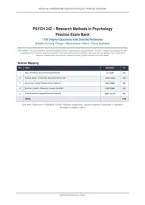
PSYCH 242 – Research Methods in Psychology
Practice Exam Bank
1100 Original Questions with Detailed Rationales
Scientific Thinking • Design • Measurement • Ethics • Critical Evaluation
DISCLAIMER – This is an ORIGINAL educational practice resource on psychological research methods. It is NOT an official university exam and NOT
a reproduction of any school’s proprietary test items. Psych 242 content varies by institution; align study with your syllabus. If your Psych 242 is
abnormal, developmental, physiological, or social psychology, request a bank for that focus instead.
Section Mapping
Sec Topic Questions N
1 Ways of Knowing & Goals of Psychological Science Q1-Q220 220
2 Research Design – Experiments, Quasi-Experiments & Vari Q221-Q440 220
3 Measurement, Validity, Reliability & Basic Statistics C Q441-Q660 220
4 Methods in Practice – Observation, Surveys, Bias & Ethi Q661-Q880 220
5 Critical Evaluation & Integrated Research Reasoning Q881-Q1100 220
TOTAL 1100
Core ideas: Empiricism • Falsifiability • IV/DV • Random assignment ≠ random sampling • Correlation ≠ causation •
Reliability vs validity • Ethics
Original Study Resource | Page 1
, PSYCH 242 – RESEARCH METHODS IN PSYCHOLOGY | PRACTICE EXAM BANK
Section 1: Ways of Knowing & Goals of Psychological Science
Q1: Empiricism emphasizes that knowledge should be based on:
A. Authority alone without evidence
B. Systematic observation and evidence [CORRECT]
C. Tenacity only
D. Intuition exclusively
Correct Answer: B
Rationale: Empirical approaches rely on observable evidence.
Q2: Tenacity as a way of knowing means:
A. Changing beliefs with every new fact immediately always
B. Holding beliefs stubbornly even against contradictory evidence [CORRECT]
C. Only laboratory experimentation
D. Peer-reviewed publication only
Correct Answer: B
Rationale: Tenacity resists change.
Q3: Authority as a way of knowing relies on:
A. Personal sensory data only
B. Accepting information because an influential source asserts it [CORRECT]
C. Random guessing
D. Only double-blind trials
Correct Answer: B
Rationale: Authority can be useful but is fallible.
Original Study Resource | Page 2
, PSYCH 242 – RESEARCH METHODS IN PSYCHOLOGY | PRACTICE EXAM BANK
Q4: A scientific theory should be:
A. Impossible to test
B. Falsifiable—capable of being shown wrong by evidence [CORRECT]
C. Accepted on faith only
D. Unrelated to data
Correct Answer: B
Rationale: Falsifiability is a hallmark of science.
Q5: Description in science involves:
A. Only intervening experimentally always
B. Systematically observing and recording phenomena [CORRECT]
C. Ignoring measurement
D. Only publishing opinions
Correct Answer: B
Rationale: Description is a core research goal.
Q6: Prediction in research means:
A. Guessing without theory
B. Stating expected outcomes based on theory or prior findings [CORRECT]
C. Only describing the past
D. Avoiding hypotheses
Correct Answer: B
Rationale: Predictions test understanding.
Q7: Quantitative research primarily:
A. Avoids numbers
B. Uses numerical measurement and statistical analysis to examine patterns [CORRECT]
C. Only collects lived-experience narratives exclusively
D. Rejects operational definitions
Correct Answer: B
Rationale: Quantity and statistics define the approach.
Original Study Resource | Page 3
, PSYCH 242 – RESEARCH METHODS IN PSYCHOLOGY | PRACTICE EXAM BANK
Q8: Qualitative research often focuses on:
A. Only p-values
B. Lived experiences, meanings, and rich contextual description [CORRECT]
C. Mandatory random assignment always
D. Only large national surveys
Correct Answer: B
Rationale: Depth and meaning are central.
Q9: Parsimony prefers:
A. The most complex explanation always
B. Simpler explanations when they account for the data equally well [CORRECT]
C. Ignoring data
D. Only intuitive stories
Correct Answer: B
Rationale: Occam’s razor in scientific reasoning.
Q10: The scientific method is best characterized as:
A. A fixed single recipe with no iteration
B. A cyclical process of questioning, testing, analyzing, and revising [CORRECT]
C. Only library reading
D. Rejecting all prior theory
Correct Answer: B
Rationale: Science is iterative and self-correcting.
Original Study Resource | Page 4
PSYCH 242 – Research Methods in Psychology
Practice Exam Bank
1100 Original Questions with Detailed Rationales
Scientific Thinking • Design • Measurement • Ethics • Critical Evaluation
DISCLAIMER – This is an ORIGINAL educational practice resource on psychological research methods. It is NOT an official university exam and NOT
a reproduction of any school’s proprietary test items. Psych 242 content varies by institution; align study with your syllabus. If your Psych 242 is
abnormal, developmental, physiological, or social psychology, request a bank for that focus instead.
Section Mapping
Sec Topic Questions N
1 Ways of Knowing & Goals of Psychological Science Q1-Q220 220
2 Research Design – Experiments, Quasi-Experiments & Vari Q221-Q440 220
3 Measurement, Validity, Reliability & Basic Statistics C Q441-Q660 220
4 Methods in Practice – Observation, Surveys, Bias & Ethi Q661-Q880 220
5 Critical Evaluation & Integrated Research Reasoning Q881-Q1100 220
TOTAL 1100
Core ideas: Empiricism • Falsifiability • IV/DV • Random assignment ≠ random sampling • Correlation ≠ causation •
Reliability vs validity • Ethics
Original Study Resource | Page 1
, PSYCH 242 – RESEARCH METHODS IN PSYCHOLOGY | PRACTICE EXAM BANK
Section 1: Ways of Knowing & Goals of Psychological Science
Q1: Empiricism emphasizes that knowledge should be based on:
A. Authority alone without evidence
B. Systematic observation and evidence [CORRECT]
C. Tenacity only
D. Intuition exclusively
Correct Answer: B
Rationale: Empirical approaches rely on observable evidence.
Q2: Tenacity as a way of knowing means:
A. Changing beliefs with every new fact immediately always
B. Holding beliefs stubbornly even against contradictory evidence [CORRECT]
C. Only laboratory experimentation
D. Peer-reviewed publication only
Correct Answer: B
Rationale: Tenacity resists change.
Q3: Authority as a way of knowing relies on:
A. Personal sensory data only
B. Accepting information because an influential source asserts it [CORRECT]
C. Random guessing
D. Only double-blind trials
Correct Answer: B
Rationale: Authority can be useful but is fallible.
Original Study Resource | Page 2
, PSYCH 242 – RESEARCH METHODS IN PSYCHOLOGY | PRACTICE EXAM BANK
Q4: A scientific theory should be:
A. Impossible to test
B. Falsifiable—capable of being shown wrong by evidence [CORRECT]
C. Accepted on faith only
D. Unrelated to data
Correct Answer: B
Rationale: Falsifiability is a hallmark of science.
Q5: Description in science involves:
A. Only intervening experimentally always
B. Systematically observing and recording phenomena [CORRECT]
C. Ignoring measurement
D. Only publishing opinions
Correct Answer: B
Rationale: Description is a core research goal.
Q6: Prediction in research means:
A. Guessing without theory
B. Stating expected outcomes based on theory or prior findings [CORRECT]
C. Only describing the past
D. Avoiding hypotheses
Correct Answer: B
Rationale: Predictions test understanding.
Q7: Quantitative research primarily:
A. Avoids numbers
B. Uses numerical measurement and statistical analysis to examine patterns [CORRECT]
C. Only collects lived-experience narratives exclusively
D. Rejects operational definitions
Correct Answer: B
Rationale: Quantity and statistics define the approach.
Original Study Resource | Page 3
, PSYCH 242 – RESEARCH METHODS IN PSYCHOLOGY | PRACTICE EXAM BANK
Q8: Qualitative research often focuses on:
A. Only p-values
B. Lived experiences, meanings, and rich contextual description [CORRECT]
C. Mandatory random assignment always
D. Only large national surveys
Correct Answer: B
Rationale: Depth and meaning are central.
Q9: Parsimony prefers:
A. The most complex explanation always
B. Simpler explanations when they account for the data equally well [CORRECT]
C. Ignoring data
D. Only intuitive stories
Correct Answer: B
Rationale: Occam’s razor in scientific reasoning.
Q10: The scientific method is best characterized as:
A. A fixed single recipe with no iteration
B. A cyclical process of questioning, testing, analyzing, and revising [CORRECT]
C. Only library reading
D. Rejecting all prior theory
Correct Answer: B
Rationale: Science is iterative and self-correcting.
Original Study Resource | Page 4


