
NR 293 – PHARMACOLOGY FOR NURSING PRACTICE | PRACTICE EXAM BANK
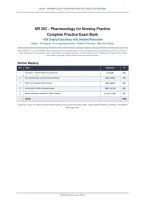
NR 293 – Pharmacology for Nursing Practice
Complete Practice Exam Bank
1400 Original Questions with Detailed Rationales
Safety • Prototypes • Nursing Implications • Patient Teaching • High-Alert Meds
DISCLAIMER – This is an ORIGINAL educational practice resource aligned with common undergraduate nursing pharmacology themes. It is NOT an
official Chamberlain University exam, NOT a reproduction of proprietary test items, and NOT clinical advice for real patients. Always follow your NR
293 syllabus, drug guide, facility policies, and current prescriber orders.
Section Mapping
Sec Topic Questions N
1 Foundations – PK/PD, Safety & Nursing Process Q1-Q280 280
2 Pain, Anticoagulation & Cardiovascular Prototypes Q281-Q560 280
3 Endocrine & Respiratory Pharmacology Q561-Q840 280
4 Anti-Infectives, CNS & Psychotropic Safety Q841-Q1120 280
5 Nursing Implications, Monitoring & Patient Teaching Q1121-Q1400 280
TOTAL 1400
Study tip: Focus on what to assess before giving a drug, what to monitor after, major adverse effects, antidotes, and patient
teaching points.
Original Study Resource | Page 1
, NR 293 – PHARMACOLOGY FOR NURSING PRACTICE | PRACTICE EXAM BANK
Section 1: Foundations – PK/PD, Safety & Nursing Process
Q1: Pharmacokinetics includes which processes?
A. Only therapeutic effect
B. Absorption, distribution, metabolism, and excretion [CORRECT]
C. Only receptor binding
D. Only nursing diagnosis
Correct Answer: B
Rationale: ADME describes what the body does to the drug.
Q2: The first-pass effect primarily affects:
A. IV medications exclusively by increasing levels
B. Oral drugs extensively metabolized before systemic circulation [CORRECT]
C. Topical creams only
D. Intramuscular onset always
Correct Answer: B
Rationale: First-pass can reduce oral bioavailability.
Q3: A drug’s half-life helps determine:
A. Tablet color
B. Dosing interval and time to steady state [CORRECT]
C. Only cost
D. Injection site
Correct Answer: B
Rationale: About 4–5 half-lives to near steady state.
Original Study Resource | Page 2
, NR 293 – PHARMACOLOGY FOR NURSING PRACTICE | PRACTICE EXAM BANK
Q4: Pharmacodynamics refers to:
A. Only excretion rate
B. What the drug does to the body (receptor effects, therapeutic and adverse responses)
[CORRECT]
C. Only pharmacy storage
D. Insurance coverage
Correct Answer: B
Rationale: PD = drug effects on the body.
Q5: The nursing process in pharmacology prioritizes:
A. Skipping assessment
B. Assessment, diagnosis/planning, implementation (safe admin), and evaluation of response
[CORRECT]
C. Only documentation of the brand name
D. Ignoring allergies
Correct Answer: B
Rationale: Safety starts with assessment and ends with evaluation.
Q6: High-alert medications require:
A. No extra precautions
B. Heightened safeguards because errors can cause severe harm (e.g., insulin, opioids,
anticoagulants) [CORRECT]
C. Only verbal orders without read-back
D. Storage mixed with look-alikes
Correct Answer: B
Rationale: ISMP high-alert lists guide practice.
Original Study Resource | Page 3
, NR 293 – PHARMACOLOGY FOR NURSING PRACTICE | PRACTICE EXAM BANK
Q7: The “rights” of medication administration include:
A. Only right patient
B. Right patient, drug, dose, route, time—and expanded rights such as documentation, reason,
response, and refusal [CORRECT]
C. Only right color
D. No verification needed
Correct Answer: B
Rationale: Multiple checks prevent errors.
Q8: Older adults often need dose adjustments because of:
A. Faster metabolism always
B. Changes in renal/hepatic function, body composition, and increased sensitivity [CORRECT]
C. No pharmacokinetic differences
D. Only improved clearance
Correct Answer: B
Rationale: Start low and go slow is a common principle.
Q9: Black box warnings indicate:
A. Mild cosmetic issues
B. Serious or life-threatening risks requiring prominent caution [CORRECT]
C. No clinical meaning
D. Only package design
Correct Answer: B
Rationale: Integrate into teaching and monitoring.
Original Study Resource | Page 4
NR 293 – Pharmacology for Nursing Practice
Complete Practice Exam Bank
1400 Original Questions with Detailed Rationales
Safety • Prototypes • Nursing Implications • Patient Teaching • High-Alert Meds
DISCLAIMER – This is an ORIGINAL educational practice resource aligned with common undergraduate nursing pharmacology themes. It is NOT an
official Chamberlain University exam, NOT a reproduction of proprietary test items, and NOT clinical advice for real patients. Always follow your NR
293 syllabus, drug guide, facility policies, and current prescriber orders.
Section Mapping
Sec Topic Questions N
1 Foundations – PK/PD, Safety & Nursing Process Q1-Q280 280
2 Pain, Anticoagulation & Cardiovascular Prototypes Q281-Q560 280
3 Endocrine & Respiratory Pharmacology Q561-Q840 280
4 Anti-Infectives, CNS & Psychotropic Safety Q841-Q1120 280
5 Nursing Implications, Monitoring & Patient Teaching Q1121-Q1400 280
TOTAL 1400
Study tip: Focus on what to assess before giving a drug, what to monitor after, major adverse effects, antidotes, and patient
teaching points.
Original Study Resource | Page 1
, NR 293 – PHARMACOLOGY FOR NURSING PRACTICE | PRACTICE EXAM BANK
Section 1: Foundations – PK/PD, Safety & Nursing Process
Q1: Pharmacokinetics includes which processes?
A. Only therapeutic effect
B. Absorption, distribution, metabolism, and excretion [CORRECT]
C. Only receptor binding
D. Only nursing diagnosis
Correct Answer: B
Rationale: ADME describes what the body does to the drug.
Q2: The first-pass effect primarily affects:
A. IV medications exclusively by increasing levels
B. Oral drugs extensively metabolized before systemic circulation [CORRECT]
C. Topical creams only
D. Intramuscular onset always
Correct Answer: B
Rationale: First-pass can reduce oral bioavailability.
Q3: A drug’s half-life helps determine:
A. Tablet color
B. Dosing interval and time to steady state [CORRECT]
C. Only cost
D. Injection site
Correct Answer: B
Rationale: About 4–5 half-lives to near steady state.
Original Study Resource | Page 2
, NR 293 – PHARMACOLOGY FOR NURSING PRACTICE | PRACTICE EXAM BANK
Q4: Pharmacodynamics refers to:
A. Only excretion rate
B. What the drug does to the body (receptor effects, therapeutic and adverse responses)
[CORRECT]
C. Only pharmacy storage
D. Insurance coverage
Correct Answer: B
Rationale: PD = drug effects on the body.
Q5: The nursing process in pharmacology prioritizes:
A. Skipping assessment
B. Assessment, diagnosis/planning, implementation (safe admin), and evaluation of response
[CORRECT]
C. Only documentation of the brand name
D. Ignoring allergies
Correct Answer: B
Rationale: Safety starts with assessment and ends with evaluation.
Q6: High-alert medications require:
A. No extra precautions
B. Heightened safeguards because errors can cause severe harm (e.g., insulin, opioids,
anticoagulants) [CORRECT]
C. Only verbal orders without read-back
D. Storage mixed with look-alikes
Correct Answer: B
Rationale: ISMP high-alert lists guide practice.
Original Study Resource | Page 3
, NR 293 – PHARMACOLOGY FOR NURSING PRACTICE | PRACTICE EXAM BANK
Q7: The “rights” of medication administration include:
A. Only right patient
B. Right patient, drug, dose, route, time—and expanded rights such as documentation, reason,
response, and refusal [CORRECT]
C. Only right color
D. No verification needed
Correct Answer: B
Rationale: Multiple checks prevent errors.
Q8: Older adults often need dose adjustments because of:
A. Faster metabolism always
B. Changes in renal/hepatic function, body composition, and increased sensitivity [CORRECT]
C. No pharmacokinetic differences
D. Only improved clearance
Correct Answer: B
Rationale: Start low and go slow is a common principle.
Q9: Black box warnings indicate:
A. Mild cosmetic issues
B. Serious or life-threatening risks requiring prominent caution [CORRECT]
C. No clinical meaning
D. Only package design
Correct Answer: B
Rationale: Integrate into teaching and monitoring.
Original Study Resource | Page 4


