
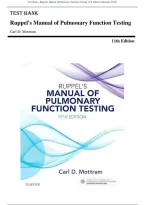
Test Bank - Ruppel's Manual of Pulmonary Function Testing 11th Edition (Mottram, 2018)
TEST BANK
Ruppel's Manual of Pulmonary Function Testing
Carl D. Mottram
11th Edition
, Test Bank - Ruppel's Manual of Pulmonary Function Testing 11th Edition (Mottram, 2018)
Table of Contents
Chapter 1: Indications for Pulmonary Function Testing
Chapter 2: Spirometry
Chapter 3: Diffusing Capacity Tests
Chapter 4: Lung Volumes, Airway Resistance, and Gas Distribution Tests
Chapter 5: Ventilation and Ventilatory Control Tests
Chapter 6: Blood Gases and Related Tests
Chapter 7: Cardiopulmonary Exercise Testing
Chapter 8: Pediatric Pulmonary Function Tests
Chapter 9: Bronchoprovocation Testing
Chapter 10: Specialized Test Regimens
Chapter 11: Pulmonary Function Test Equipment
Chapter 12: Quality Systems in the Pulmonary Function Laboratory
Chapter 13: Reference Values and Interpretation Strategies
, Test Bank - Ruppel's Manual of Pulmonary Function Testing 11th Edition (Mottram, 2018)
Chapter 1: Indications for Pulmonary Function Testing Test Bank
MULTIPLE CHOICE
1. Who first popularized spirometry for the evaluation of pulmonary function?
a. August and Marie Krogh
b. Alvan Barach
c. John Severinghaus
d. John Hutchinson
ANS: D
Hutchinson popularized the concept of using VC to assess lung function, and the names he
gave to several other lung compartments are still used today.
DIF: 1 REF: p. 2 OBJ: None M S C : NBRC: None
2. Which of the following are indications for performing spirometry?
1. Assess the risk of lung resection.
2. Determine the response to bronchodilator therapy.
3. Assess the severity of restrictive lung disease.
4. Quantify the extent of COPD.
a. 1 and 4
b. 2 and 3
c. 1 , 2, and 4
d. 2 , 3, and 4
ANS: C
Spirometry cannot assess severity of restriction; for that you need to measure lung volumes (
see Box 1-2, Chapter 1).
DIF: 1 REF: p. 7 OBJ: EL-2 MSC: NBRC: None
, Test Bank - Ruppel's Manual of Pulmonary Function Testing 11th Edition (Mottram, 2018)
3. The main indication for the measurement of lung volumes is to do which of the following?
a. Diagnose or assess the severity of restriction.
b. Evaluate the severity of pulmonary hypertension.
c. Determine the level of cardiopulmonary fitness.
d. Assess the risk of abdominal surgical procedures.
ANS: A
The most common reason for measuring lung volumes is to identify restrictive lung disease.
DIF: 1 REF: p. 35 OBJ: EL-2 MSC: NBRC: None
4. DLCO measurements may be indicated to evaluate pulmonary involvement in which of the
following systemic diseases?
a. Asthma
b. Sarcoidosis
c. Exertional hypoxemia
d. Guillain-Barré syndrome


