
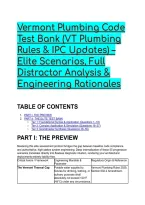
Vermont Plumbing Code
Test Bank (VT Plumbing
Rules & IPC Updates) –
Elite Scenarios, Full
Distractor Analysis &
Engineering Rationales
TABLE OF CONTENTS
1. PART I: THE PREVIEW
2. PART II: THE ELITE TEST BANK
○ Tier 1: Foundational Syntax & Application (Questions 1–18)
○ Tier 2: Complex Application & Simulation (Questions 19–37)
○ Tier 3: Grandmaster Synthesis (Questions 38–55)
PART I: THE PREVIEW
Mastering this elite assessment protocol bridges the gap between baseline code compliance
and authoritative, high-stakes system engineering. Deep internalization of these 55 progressive
scenarios translates directly into flawless diagnostic intuition, rendering your architectural
deployments entirely liability-free.
Critical Axiom / Framework Engineering Mandate & Regulatory Origin & Reference
Parameter
The Vermont Thermal Cap Potable water supplied to Vermont Plumbing Rules 2025;
fixtures for drinking, bathing, or Section 602.2 Amendment.
culinary purposes shall
absolutely not exceed 120°F
(49°C) under any circumstance.
,Critical Axiom / Framework Engineering Mandate & Regulatory Origin & Reference
Parameter
This must be enforced strictly
via an ASSE 1017 mixing valve
installed at the source.
The Trench Isolation Law The building sewer pipe and Vermont Plumbing Rules 2025;
the water service must maintain Section 603.2 & 703.1
a minimum of 10 feet (3048 Amendments.
mm) of horizontal separation,
with the water service buried no
less than 18 inches (458 mm)
deep to clear the frost line.
2024 IPC Paradigm Shifts Plastic DWV systems may now 2024 IPC Updates; Sections
be vacuum-tested as an 312.3, 305.8, 306.2.4.
alternative to pneumatic
pressure; expansive soils
strictly dictate suspended
under-floor piping; and buried
plastic sewers absolutely
mandate a 14 AWG insulated
tracer wire for locatability.
Trap-to-Vent Geometry Trap arm developed distances IPC Table 909.1 & Section
are rigidly capped by diameter 909.2.
(e.g., 1-1/2" trap = 6 ft
maximum, 2" = 8 ft, 3" = 12 ft).
Furthermore, a vent may never
connect closer than two pipe
diameters from the trap weir to
prevent flow turbulence.
The DFU Hierarchy A private bathroom group (1.6 IPC Table 709.1 & Table
gpf) functions as a unified 5 710.1(2).
DFU collective; however, any
horizontal branch or building
drain carrying a water closet
permanently defaults to a
3-inch minimum diameter
regardless of the mathematical
load.
PART II: THE ELITE TEST BANK
Tier 1: Foundational Syntax & Application
Q1: An architect specifies a new domestic water heater installation for a commercial office in
Montpelier, Vermont. Based on the principles of the Vermont Plumbing Rules (2025 Edition),
which action is MANDATORY prior to final fixture distribution? A) Installing a tempering valve
calibrated to 140°F (60°C) to prevent Legionella proliferation in the supply lines. B) Equipping
, the system with a non-adjustable thermostatic mixing valve that is engineered to fail to the hot
position. C) Installing a master thermostatic mixing valve meeting ASSE 1017 to limit the fixture
temperature to a maximum of 120°F (49°C). D) Bypassing the mixing valve requirement
completely if the tank's internal thermostat is permanently locked at 120°F (49°C).
● Answer: C (Installing a master thermostatic mixing valve meeting ASSE 1017 to limit the
fixture temperature to a maximum of 120°F (49°C))
● Distractor Analysis:
○ A is incorrect: Delivering 140°F water to the fixtures violates the strict Vermont
maximum of 120°F for drinking and bathing.
○ B is incorrect: ASSE 1017 valves must fail to the cold position to prevent scalding
during mechanical failure.
○ D is incorrect: Tank thermostats are inherently inaccurate due to thermal stacking
and are legally insufficient to satisfy the 120°F point-of-use maximum under
Vermont amendments.
The Mentor's Analysis: Vermont explicitly overrides standard IPC baseline temperatures,
enforcing a hard 120°F cap for bathing and culinary fixtures. When facing water heater
installations or retrofits, the immediate priority is mechanical temperature governance. By
utilizing an ASSE 1017 mixing valve, you bypass the common novice error of trusting the water
heater's internal, highly variable thermostat. Professional Intuition: If human hands touch the
water, the maximum temperature is 120°F; the ASSE 1017 valve is the sole legal guardian
of this mandate.
Q2: A contractor is excavating a shared utility trench for a new structure in Rutland, Vermont.
Based on the principles of Vermont's IPC amendments for water service, what is the MINIMUM
acceptable installation geometry for these parallel pipes? A) Water service buried 12 inches
deep, horizontally separated from the sewer by 5 feet. B) Water service buried 18 inches deep,
horizontally separated from the sewer by 5 feet. C) Water service buried 18 inches deep,
horizontally separated from the sewer by 10 feet. D) Water service buried 12 inches deep,
sleeved entirely in Schedule 40 PVC if within 10 feet of the sewer.
● Answer: C (Water service buried 18 inches deep, horizontally separated from the sewer
by 10 feet)
● Distractor Analysis:
○ A is incorrect: This represents the unamended IPC baseline, which Vermont
explicitly rejects due to frost depths and environmental priorities.
○ B is incorrect: Fails to meet the amended 10-foot horizontal separation rule,
satisfying only the depth requirement.
○ D is incorrect: Sleeving does not negate the hard geographical separation
requirements specified in the Vermont amendment of Sections 603.2 and 703.1.
The Mentor's Analysis: Vermont's harsh freeze cycles and strict environmental protections
demand deeper, wider trenches than the standard international code. When facing trench
design in Vermont, the immediate priority is verifying the 18-inch depth and 10-foot separation.
By utilizing state-specific spatial amendments, you bypass the common trap of relying on
national legacy codes that will fail inspection. Professional Intuition: In Vermont trenches,
double the IPC separation (to 10 feet) and add 6 inches to the depth (to 18 inches).
Q3: A hydronic heating boiler utilizing toxic glycol antifreeze is being installed in a Stowe,
Vermont residence. Based on the principles of backflow prevention, which device is the ONLY
appropriate choice to protect the potable water supply line feeding the boiler? A) An
atmospheric vacuum breaker (ASSE 1001) installed above the flood rim. B) A dual check valve
with an intermediate atmospheric vent (ASSE 1012). C) A reduced pressure principle backflow
Test Bank (VT Plumbing
Rules & IPC Updates) –
Elite Scenarios, Full
Distractor Analysis &
Engineering Rationales
TABLE OF CONTENTS
1. PART I: THE PREVIEW
2. PART II: THE ELITE TEST BANK
○ Tier 1: Foundational Syntax & Application (Questions 1–18)
○ Tier 2: Complex Application & Simulation (Questions 19–37)
○ Tier 3: Grandmaster Synthesis (Questions 38–55)
PART I: THE PREVIEW
Mastering this elite assessment protocol bridges the gap between baseline code compliance
and authoritative, high-stakes system engineering. Deep internalization of these 55 progressive
scenarios translates directly into flawless diagnostic intuition, rendering your architectural
deployments entirely liability-free.
Critical Axiom / Framework Engineering Mandate & Regulatory Origin & Reference
Parameter
The Vermont Thermal Cap Potable water supplied to Vermont Plumbing Rules 2025;
fixtures for drinking, bathing, or Section 602.2 Amendment.
culinary purposes shall
absolutely not exceed 120°F
(49°C) under any circumstance.
,Critical Axiom / Framework Engineering Mandate & Regulatory Origin & Reference
Parameter
This must be enforced strictly
via an ASSE 1017 mixing valve
installed at the source.
The Trench Isolation Law The building sewer pipe and Vermont Plumbing Rules 2025;
the water service must maintain Section 603.2 & 703.1
a minimum of 10 feet (3048 Amendments.
mm) of horizontal separation,
with the water service buried no
less than 18 inches (458 mm)
deep to clear the frost line.
2024 IPC Paradigm Shifts Plastic DWV systems may now 2024 IPC Updates; Sections
be vacuum-tested as an 312.3, 305.8, 306.2.4.
alternative to pneumatic
pressure; expansive soils
strictly dictate suspended
under-floor piping; and buried
plastic sewers absolutely
mandate a 14 AWG insulated
tracer wire for locatability.
Trap-to-Vent Geometry Trap arm developed distances IPC Table 909.1 & Section
are rigidly capped by diameter 909.2.
(e.g., 1-1/2" trap = 6 ft
maximum, 2" = 8 ft, 3" = 12 ft).
Furthermore, a vent may never
connect closer than two pipe
diameters from the trap weir to
prevent flow turbulence.
The DFU Hierarchy A private bathroom group (1.6 IPC Table 709.1 & Table
gpf) functions as a unified 5 710.1(2).
DFU collective; however, any
horizontal branch or building
drain carrying a water closet
permanently defaults to a
3-inch minimum diameter
regardless of the mathematical
load.
PART II: THE ELITE TEST BANK
Tier 1: Foundational Syntax & Application
Q1: An architect specifies a new domestic water heater installation for a commercial office in
Montpelier, Vermont. Based on the principles of the Vermont Plumbing Rules (2025 Edition),
which action is MANDATORY prior to final fixture distribution? A) Installing a tempering valve
calibrated to 140°F (60°C) to prevent Legionella proliferation in the supply lines. B) Equipping
, the system with a non-adjustable thermostatic mixing valve that is engineered to fail to the hot
position. C) Installing a master thermostatic mixing valve meeting ASSE 1017 to limit the fixture
temperature to a maximum of 120°F (49°C). D) Bypassing the mixing valve requirement
completely if the tank's internal thermostat is permanently locked at 120°F (49°C).
● Answer: C (Installing a master thermostatic mixing valve meeting ASSE 1017 to limit the
fixture temperature to a maximum of 120°F (49°C))
● Distractor Analysis:
○ A is incorrect: Delivering 140°F water to the fixtures violates the strict Vermont
maximum of 120°F for drinking and bathing.
○ B is incorrect: ASSE 1017 valves must fail to the cold position to prevent scalding
during mechanical failure.
○ D is incorrect: Tank thermostats are inherently inaccurate due to thermal stacking
and are legally insufficient to satisfy the 120°F point-of-use maximum under
Vermont amendments.
The Mentor's Analysis: Vermont explicitly overrides standard IPC baseline temperatures,
enforcing a hard 120°F cap for bathing and culinary fixtures. When facing water heater
installations or retrofits, the immediate priority is mechanical temperature governance. By
utilizing an ASSE 1017 mixing valve, you bypass the common novice error of trusting the water
heater's internal, highly variable thermostat. Professional Intuition: If human hands touch the
water, the maximum temperature is 120°F; the ASSE 1017 valve is the sole legal guardian
of this mandate.
Q2: A contractor is excavating a shared utility trench for a new structure in Rutland, Vermont.
Based on the principles of Vermont's IPC amendments for water service, what is the MINIMUM
acceptable installation geometry for these parallel pipes? A) Water service buried 12 inches
deep, horizontally separated from the sewer by 5 feet. B) Water service buried 18 inches deep,
horizontally separated from the sewer by 5 feet. C) Water service buried 18 inches deep,
horizontally separated from the sewer by 10 feet. D) Water service buried 12 inches deep,
sleeved entirely in Schedule 40 PVC if within 10 feet of the sewer.
● Answer: C (Water service buried 18 inches deep, horizontally separated from the sewer
by 10 feet)
● Distractor Analysis:
○ A is incorrect: This represents the unamended IPC baseline, which Vermont
explicitly rejects due to frost depths and environmental priorities.
○ B is incorrect: Fails to meet the amended 10-foot horizontal separation rule,
satisfying only the depth requirement.
○ D is incorrect: Sleeving does not negate the hard geographical separation
requirements specified in the Vermont amendment of Sections 603.2 and 703.1.
The Mentor's Analysis: Vermont's harsh freeze cycles and strict environmental protections
demand deeper, wider trenches than the standard international code. When facing trench
design in Vermont, the immediate priority is verifying the 18-inch depth and 10-foot separation.
By utilizing state-specific spatial amendments, you bypass the common trap of relying on
national legacy codes that will fail inspection. Professional Intuition: In Vermont trenches,
double the IPC separation (to 10 feet) and add 6 inches to the depth (to 18 inches).
Q3: A hydronic heating boiler utilizing toxic glycol antifreeze is being installed in a Stowe,
Vermont residence. Based on the principles of backflow prevention, which device is the ONLY
appropriate choice to protect the potable water supply line feeding the boiler? A) An
atmospheric vacuum breaker (ASSE 1001) installed above the flood rim. B) A dual check valve
with an intermediate atmospheric vent (ASSE 1012). C) A reduced pressure principle backflow


